Cemeteries

My sister wants to visit the cemetery. While we haven’t been there in years, I knew which one she meant, and was instantly flooded with memories. And the memory of boredom.

Our first dad died when we were young. After that, every Memorial Day, there was a trip to the cemetery. Mom would cut huge bouquets from snowball shrubs and rhododendrons taller than the house eaves. Us kids were required to go along, and the car would be filled with the sickening sweet scents of flowers, sap from cut branches and buds, and crushed leaves. Under it all would be the subtler scents of earth.
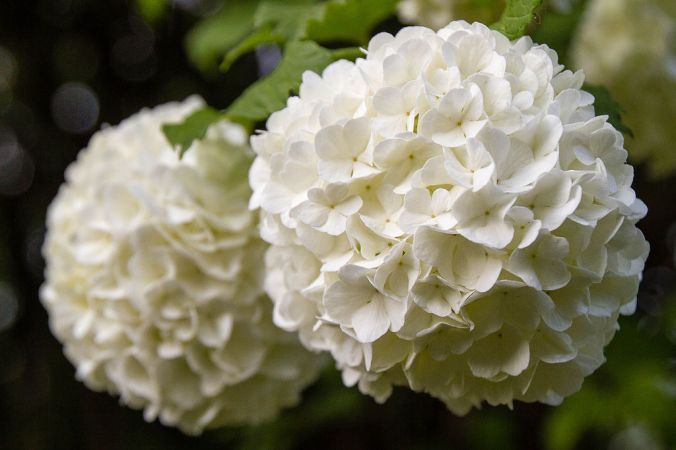
Snowball_flowers_(13985050634)

Wikimedia Commons Image, by Fulvio Spada

At the cemetery mom used a screwdriver to pull up the vase that invariably would have become overgrown with sod during the previous year. We got to run to the nearby fountain to fill the vase and then mom would arrange the flowers. And then stand there. We were required to also stand there solemnly.

Holly dad Aunty mom Lisa Steven neighbor

The sister held by our first dad, with paralysis taking over his right side. Aunty next to him. Me, blurry with movement sitting on the back step. Our brother’s little butt. Mom in the doorway in the dark coat.

I used to wonder what she thought about, while us kids fidgeted and waited for the heavy sigh and sniffled tears that said, finally, we could race back to the car and go home. Move on to more important kid things. As I got older I also wondered if there wasn’t a tiny part of her that was aware of the image she presented to all the other annual cemetery visitors – the woman alone with small children standing by a grave. Did people wander over after we left, to see the name of a man who died too young, with his Navy insignia on the headstone? Did they wonder what his story was? If he’d died in the Korean War, perhaps, since the dates were right? Did their imaginations conjure stories for the grieving widow, still so loyal? For the fatherless children? Of course they wouldn’t know that there was a second dad at home, most likely pottering out in the garage enjoying the rare quiet, with pipe in hand.

Dad 1990 flood

Second dad. Can you see the pipe stem (unlit at the time) in his left hand?

Later, more graves came along. Aunty, who was more like a grandmother. Her brother, Harry, who lived with her the last year of his life. The one us kids heard coming down the stairs with his signature slow, heavy tread, a week after he died. A great-uncle notorious for never knowing his slacks were unzipped (much to our entertainment) and who got his point across by poking people with his cane.

I find old cemeteries more interesting than new ones. Nine Mile Cemetery in Wallace, Idaho, is up a steep hillside among tamarack trees. I imagine the people there enjoying the view for centuries, since they are almost buried standing upright.

There was one cemetery in Dumfries, Scotland where the headstones were six-foot long slabs with the person’s life story carved there, still readable two hundred years later. The stories they wanted us to remember, beyond just their birth and death dates. The things they were proud of that no one, today, would know.

One of our grandfathers was buried in a small cemetery at the top of a hill in eastern Washington. You can stand there in the trees and hear the wind in their branches.

I have grandparents and great-grandparents and great-great grandparents buried in one called Cherry Creek. It’s also on top of a hill, but in northeastern Montana, where it’s all high mesas and wheat. Wild roses and sunflowers grow around the headstones and you can see for miles. The tiny church there used to double as a one-room schoolhouse that our grandmother taught at.
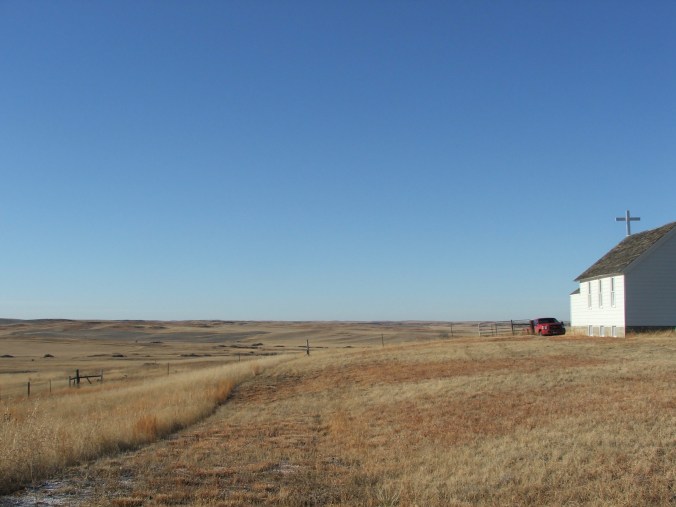
Montana 07 036

Photo doesn’t show the steep hillside below the truck.

Montana 07 031

I spent an overcast day years ago wandering Clare Abbey, near Ennis, Ireland. It’s the ruins of a monastery built in 1194, with the remains of a cemetery inside its walls. The Abbot’s grave is a small mausoleum and the ancient doors had big, rusty door knockers. I never had the courage to knock.

Those old cemeteries have stories.
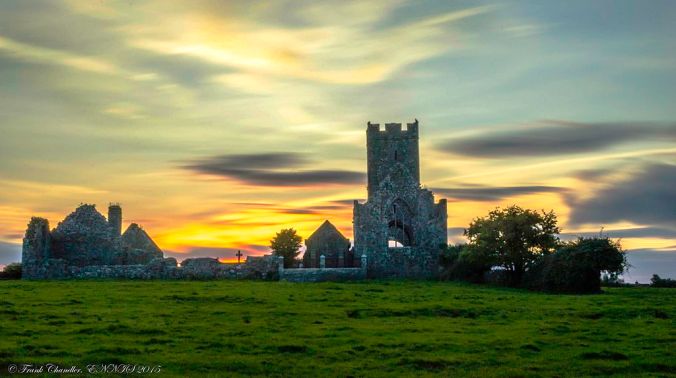
Clare_Abbey,_(Brian_Borus_Abbey),20150904-DSC_6842-2

Clare Abbey, Wikimedia Commons, by Frank Chandler

Newer ones seem lacking in stories. Strategically placed water fountains, surrounded by small flat headstones that can easily be mowed over. I imagine the landscape crew gets impatient on Memorial Day weekends when they have to mow around huge bouquets of snowballs and miniature flags.

As I age, I find myself leaning toward cremation or the concept of green burials, where I can be placed out in the woods to decompose naturally and fertilize the trees. Of course there’s no profit for funeral homes in that type of burial so I doubt it will ever be allowed. It reminds me of a poem I read years ago about the business of dying, about how we have to pay to get our loved ones back.

DSC_0048

Cherry Laurel tree


The kayak community here recently built a beautiful bench and hiked it in to a quiet place in the woods with a view of the river where our Sam used to kayak. That, to me, is a perfect, and heart-breaking memorial. That would be a place to visit, to remember. A place that symbolizes the person being remembered and brings that person back to mind, more than a generic square of bronze in a green lawn.

In the meantime, when my sister comes out here, I’ll drive her to the cemetery and we’ll wander together trying to find all the graves of family that we’re probably the only ones left who remember.

Maybe we’ll take flowers.

And I’ll try not to fidget.

Aunty and us Easter 2

Aunty with us (I’m in the middle)

Wedding Rings

I wore my husband’s wedding ring yesterday. It’s a simple gold band. Nothing to differentiate it from any other plain gold band.

He has a hard time hanging on to this ring so he asked me to keep it someplace safe. When I feel the need to have him close emotionally, as in when I’m facing something that makes me nervous, or stressed, or just wanting to be home with him, I wear his ring.

DSCN0058

He used to lose the ring.

A lot.

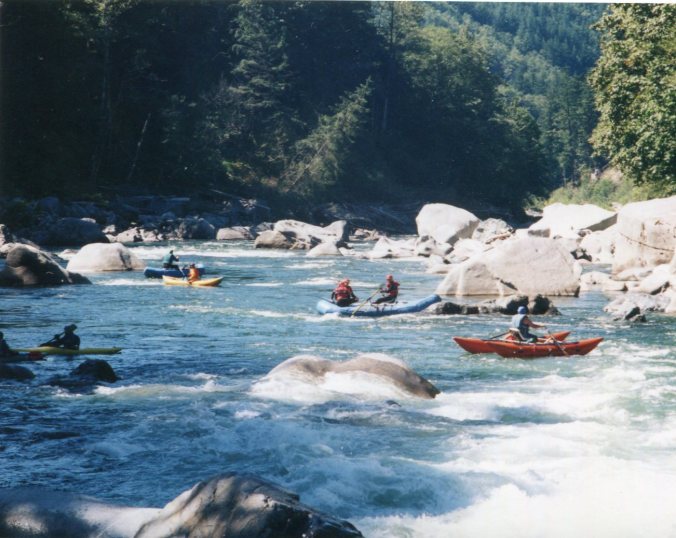
One day he came home devastated because he’d been on a swift water rescue training and the ring was gone. He knew it was gone forever, gold returned to earth, somewhere out there in whitewater. But instead, a lovely little toddler named Malia (now a lovely young woman) was crawling around on the floor in the fire department a couple weeks later. She found the ring under the couch.

Art on Cat boat

That’s Art on the orange cat boat

During one time when the ring was missing again (this time resurrected from his tool box) I told him we’d just buy another one. After all, it’s just a plain gold band. He got a bit upset with me. His exact words were: ‘But it won’t be the ring you put on my finger!’.

My thought, which I was smart enough not to say out loud, was ‘So it will be a new ring I put on your finger; what’s the big deal?’

wedding 1

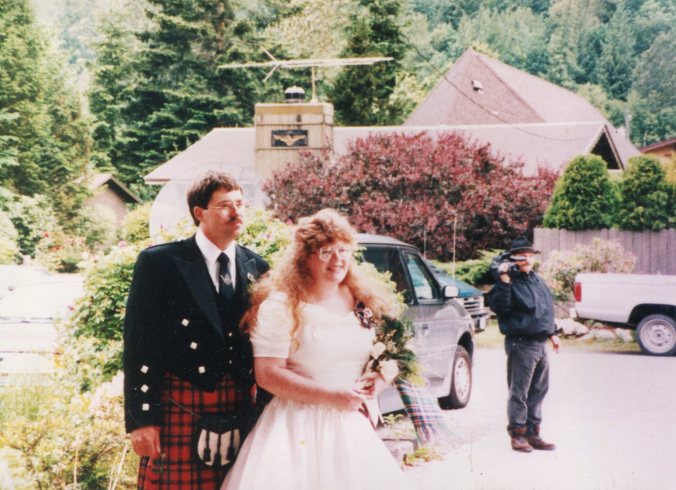
Wedding in fire department bay, not too long after a call. My hair had just come out of the helmet. Not that you can tell the difference.

The wedding ring he put on my finger originally was my grandmother’s. But one day a fold-down staircase in the ceiling of the cabin came loose from its bolts and landed on me. The ring had to be cut off. It now sits in an envelope waiting for me to do something with it.

DSCN0055

A very old ring


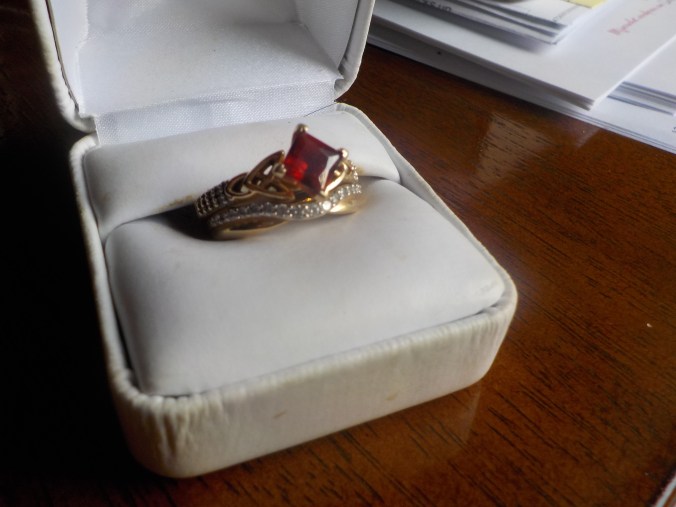
That following Christmas, he bought me a new wedding ring. A garnet, which is my favorite stone, in a Celtic-style setting. He confessed that while he hadn’t minded my grandmother’s ring, he’d always wanted to give me one that was from him. It took me a while to get used to the ring because it’s fancy. But now it’s another reason my grandmother’s ring is still in its envelope.

DSCN0057

So what’s in a wedding ring anyway? They’re symbolic, of course, but of what? Ownership? Commitment? Fidelity? Love? Taking one off is symbolic, too (unless of course you just keep losing it). Then it’s symbolic of the end of a relationship, by choice or by loss.

Or maybe symbolic of what will happen if you’re the waitress in the local diner who kept leaning too low to show him cleavage, while I sat right there. That ring on his finger is there for a reason, and sharing isn’t it. Which, I suppose, is that symbol of ownership rearing its ugly head.

I like the idea that I can be out in public, with that garnet ring on that specific finger, and know that anyone seeing it will get the message that someone wanted me enough to put the ring there. Which sounds kind of pathetic, I know. But it’s then symbolic of whom I’ve become. It’s almost, honestly, a symbol of pride. Which works both ways when he wears his ring. Kind of a ‘look who I’ve got!’

But for today, his ring is on my finger. Both of his rings.

Stories From The River Review

I just finished Ursula Hegi’s book for the second time. As I posted previously, the first time I read Stories From The River, I wasn’t sure I liked it. It made me uncomfortable. So when I came across it at the thrift store, I decided to reread it.

I’m still unsettled by the book.

Trudi Montag is a zwerg, a dwarf, living in Germany in the 1940s. She doesn’t fit in, she’s considered a freak, and even as a small child, she yearns to be tall. In some ways the novel is about Trudi coming to peace with who she is, and about her ability to be the story-keeper for her town. As I read the book, I understood, but didn’t always like, Trudi.

The book doesn’t end with everything neatly tied up. Some of the subplots are answered and some are not. For example, readers will never know what happened to one of the most important characters in Trudi’s life, who disappears. After all the suffering, I wanted a happy ending, and didn’t get it. That’s not to say there wasn’t peace for Trudi at the end. I just wanted more than that.

The first half of the book moves slowly, starting with Trudi at a very young age, dealing with a mentally ill mother. Sometimes the dialog and thoughts of Trudi seem far too old for her age. But that wasn’t enough to pull me out of the story.

There’s the temptation to skim past all this narrative that moves as slowly as the river in the story. But each little thing is skillfully woven into what is to come. If you skim, you’ll miss the meanings. Like I said though, it moves slow. You must be a patient reader.

One of the things that happens in this slow narrative is the reader is shown Germany during that time. How the people were brought up to be patient, to trust parents, adults, leaders, the government. To be orderly. The things that happen are tiny little trickles that slowly erode away the dam, allowing the flood that was to become Nazi Germany.

I think most people these days like to think that if they had lived during that time, they would have stood up, would have done something. But people now don’t understand the culture from that time period, the obedience instilled in everyone, even here in America, during the 1930s and 1940s. Especially in the women. In this book you see the ones who defied what was happening, and disappeared. You see the ones who embraced what was happening. The ones who secretly did what they could.

You see the racism, the ability of people to allow cruelty to others in order to keep their children safe. You see the slow, slow, slow encroaching of evil. So slow that most don’t even realize what was happening until it was too dangerous.

But at its heart, this isn’t a book about Hitler, or Nazi Germany. That time period is only about one third of the whole book. It’s a book about a child growing into a woman, absorbing stories, trying to find her life, struggling to come to terms with her difference. A woman who finds herself through all the stories that flowed into her from the people in her town. One who finds the power of stories.

I was uncomfortable reading about that time period and what everyone had to go through.

I was uncomfortable with parallels to the racism that still exists.

I was uncomfortable with the honest self-appraisal that I don’t know what I would have done in the same situation. I like to think I would have stood up for others, been brave, smuggled people out, fed the starving. Like the woman in the book who tosses a half-loaf of bread she’s just bartered for, to feed her family, into the train of starving Jews that passes through town. The woman is then arrested and never seen again. But the reality is I don’t know what I would have done, or would do, if my son’s life was in also in the balance.

In the end, I closed the book with this conclusion. Ursula Hegi is an amazing writer. She has created a story that got under my skin, that won’t leave me alone, that looked at life honestly, that looked at humanity honestly.

So no, there are no neatly tied up happy endings.

From near the ending, after the war is over:

‘They did not understand why Trudi Montag wanted to dig in the dirt, as they called it, didn’t understand that for her it had nothing to do with dirt but with the need to bring out the truth and never forget it. Not that she liked to remember any of it, but she understood that – whatever she knew about what had happened – would be with her from now on, and that no one could escape the responsibility of having lived in this time.’

Yes. No one can escape the responsibility of having lived in this time.