Velveteen Fifi

When I was three my dad gave me a stuffed dog. He was sick by then and paralyzed on his left side. I don’t know if he went to the effort to have someone drive him to a store or if my mom chose it.

img003

Me with a velveteen hat, and dad off to the side in his wheel chair that he would give me rides in

Either way, it was a kind of ugly, kind of weird stuffed animal. She was pink with a white patch on her chest and long floppy ears. Her body was soft and cuddly but her head, too large for the body, was made of something hard. That head was also so heavy that the soft neck wouldn’t support it. The head always flopped over like her neck was broken. But still, she was the last gift I received from my dad before he died.

Lisa & dad 6 wks

Me at six weeks when dad could still manage to stand

I’ve always been the one to buy the plant that’s dying on the sale rack, the pot with the lid that doesn’t fit right, the item others pass by or laugh at. I feel sorry for inanimate objects that no one wants. I think it’s the fault of that hard-headed stuffed dog. Who in their right mind would have bought her? Obviously one of my parents. Obviously the empathy with deformed objects is hereditary.

Mom's wedding

At some point I decided I should name that dog, although I had no interest in doing so. I felt I should love her more than anything because she was a gift from my dad. I pretended to love her more than anything. I named her after a kitten we had at the time. I made sure she rested on my bed between the pillows in a place of honor. I kept her for many years because I felt I should. I remember one time being a teen and upset about some drama. I held Fifi close as I cried because it seemed like something I should do, as if a stuffed dog would comfort me because the person who gave her to me was gone. But even in the middle of crying and clutching that hard head, I felt stupid, like I was putting on an act.

Holly & Big Doll

I never got attached to Big Doll either. This cute sibling inherited the hard plastic doll.

Eventually, well into my thirties, I finally got rid of Fifi. She was ratty by that time, with most of her body stuffing gone. The head was still intact though. I wonder two things now. One, why I never cut open her head to find out what was so hard in there. And two, if I had kept her, loved her more, would she have turned into a Velveteen Dog and come to life?

Our son had lots of stuffed animals, as most kids do. Oscar was the most loved. A little black and white dog that now sits on my bookshelf. Our son had to sleep with Oscar every night. And any parent will know what comes next. Oscar got lost. Oh, the drama! The heart-broken tears at night when he had to sleep alone!

Arthur & Jello

Our son out for a walk with his grandpa, and a real black and white dog, Jello

We searched the house. My parents, who had given him Oscar, got online (a momentous feat for them), found the company, and ordered another. The two dogs looked almost identical but this new one was named Fraser. That was acceptable to our son because at the time he was an avid fan of Due South and the main character’s name was Fraser.

DSCN0627

Oscar on top, Fraser on the bottom

Of course after Fraser arrived, Oscar was found. Our son had used him as a basketball for an indoor set, and Oscar hung suspended in the basket netting. Our son then slept with both.

He clearly loved them, which is why we still have them. He clearly loved them for real, unlike my pretend love for Fifi. I’m more attached to Oscar and Fraser than I ever was to Fifi. So maybe she wouldn’t have ever come to life after all.

In spite of my recent post about how we accumulate way too many things, I find myself wishing I’d kept Fifi. She could be up on that bookshelf with her ratty pink fur and broken neck and tipped-over head, right next to Oscar and Fraser.

Proof that maybe she was loved after all.

Lisa 3 wks

Dad and me at three weeks. 

Things

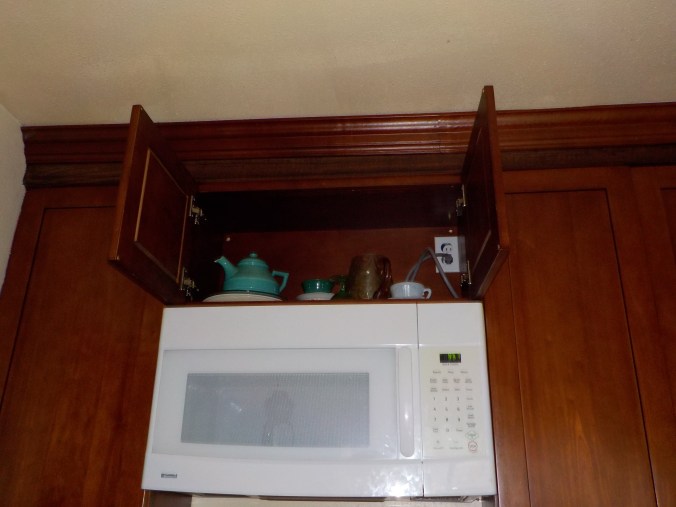
There’s this teapot. Pale turquoise and old. It used to sit on a little table behind my grandmother’s chair. Whenever we visited Aunty, as we called her, it was a backdrop to her rocking and telling stories. When she was headed toward her end days she gave things away. She asked me what I wanted and I told her the teapot. Not because it was worth money but because when I see it, I see her there, in that chair.

So where is the teapot now? Safely kept in a high cupboard. My husband has a habit of breaking things. I’ve learned over the years that things actually mean nothing. They’re just objects. Their value comes from the stories and memories, which can’t be broken or lost. So I don’t get too attached to things anymore. And if there is something I’m attached to, it gets placed in an out-of-the-way spot. Of course I recognize the teapot has no value in that cupboard. I rarely remember I have it. Someday my son will wonder why I kept that old thing I never used.

DSCN0629

The delicate, almost translucent, tea cup on the right is even older, belonging to my great-grandfather. The pitcher was also Aunty’s and she always used it for orange juice. And thats granulated honey in the microwave.

Occasionally I come across this popular writer’s prompt: ‘what do you carry?’. Of course there are so many interpretations of this question, from the emotional burdens we carry, to our secrets, to our things and how they reflect on our life. What do you carry?

I spent most of July traveling in Scotland and Denmark. The first time I went to Scotland, in 1979, I had a small backpack that carried all I needed for six weeks. This time I had a large rolling bag to check in and a smaller bag for under the airline seat.

DSCN0579

Very old things, ivory and bone and amber, in Rosenborg Slot (castle) in Denmark, built in the 1600s.

I packed way too many things. Partly because I googled Scotland weather and read it was raining, rather than contacting friends to find out they were having record-breaking heat. The woman I traveled with packed even more, and then bought luggage to hold all the things she bought. She traveled with six pairs of shoes and four different jackets, all the same style, but different colors. I don’t even own six pairs of shoes.

In airports and train stations and buses, I saw the things we feel we need to carry. So much paraphernalia. So much stuff. Especially on the planes. I feared we would never get off the ground. It was rare to find someone traveling light, and typically when I did, it was a young person with a backpack.

DSCN0612

Things the Vikings carried 1200 years ago, now in the Viking museum in Aarhus, Denmark.

Why do we need so many things? Is it a sign of our culture, a sign of affluence? Would any of those things we feel the need to travel with help us if the plane crashed on a deserted island? Would six pairs of shoes keep you alive? Then why do we need them?

It’s not just traveling overseas that I see this. Every Friday when I leave work I see the same thing on the highway. People headed east for the weekend, hauling huge trailers, driving giant bus-like motor-homes that in turn tow boats and smaller cars, or more trailers. All of it full of the things they can’t go a weekend without.

Things make life easier but they also weigh us down, physically and emotionally. I came home from this trip promising myself I’m going to get rid of stuff.

Except the teapot.

Curmudgeons and Sheep

While traveling recently in Scotland, we were invited to a sheep farm to watch how sheepdogs work. I’ve seen sheepdog trials many times and have also watched a friend’s dogs work. I’m always amazed at the intelligence of the dogs and the bond they have with their shepherd.

This visit sounded interesting though. Our guide told us to not get upset by the shepherd, a man named Neil. He has won many titles and awards, and his dogs have won even more. People come to him to have their dogs trained, or to purchase dogs from him. But we were told to not get upset if he came across as abrupt or curt. He showed people how dogs work sheep on a regular basis but it was clear that humoring the public was not part of his agreement. He didn’t like people much, we were told. He preferred dogs over humans.

Hmmm…sounds like someone I live with. My kind of non-people people. I liked him before we even got there.

When we arrived he was out in a pasture, holding a young dog, with several around him poised for action, knowing what was coming. The sheep were also poised in a flock, knowing what was coming. Our arrival was slowed slightly by my not paying attention (too busy watching the dogs and thinking of my favorite border collie, Jax) and tumbling to the ground in a grand entrance. But once we were gathered, Neil sent out the dogs.

DSCN0234

He explained each whistled command as the dogs worked, herding sheep out into the pasture, bringing them around, and singling one to return to Neil. The young dog he’d been holding was let loose to work. The pup was rough around the edges but very game.

I sidled closer to Neil.

I asked politely if I could ask him a question.

His eyebrows shot up.

I asked him how he knew a pup would be a good working dog.

It was like he was suddenly illuminated in the brightest of lights. He told me all about blood lines and parentage.

I then asked if there was a dog that had been the best to work with. And we were off on a long, wonderful story about a ‘soft’ dog. He sang the praises of this dog, who had lived to be quite elderly. Soft with lambs and puppies and children but spot-on dedicated and focused when working.

DSCN0235

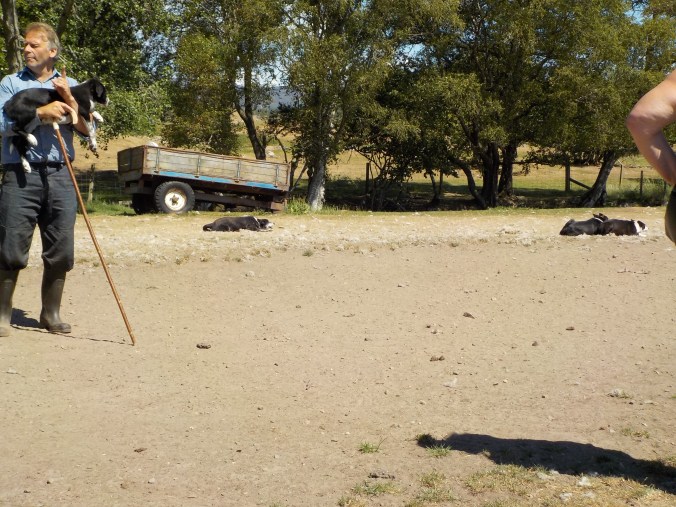
See the focus of the dog by the wagon? She’s poised with a low horizon to not scare sheep, waiting for the whistle.

Others sidled closer.

I then asked about the worst, or hardest dog. Again the stories poured forth of a young dog brought to him for training, whose confidence was destroyed before he arrived. The poor dog tried and failed repeatedly, with extreme lack of self-confidence. Neil said he refused to continue training because he couldn’t stand seeing the dog’s heart broken every time he came in from the pasture after failing yet again. The dog became a family pet instead.

DSCN0237

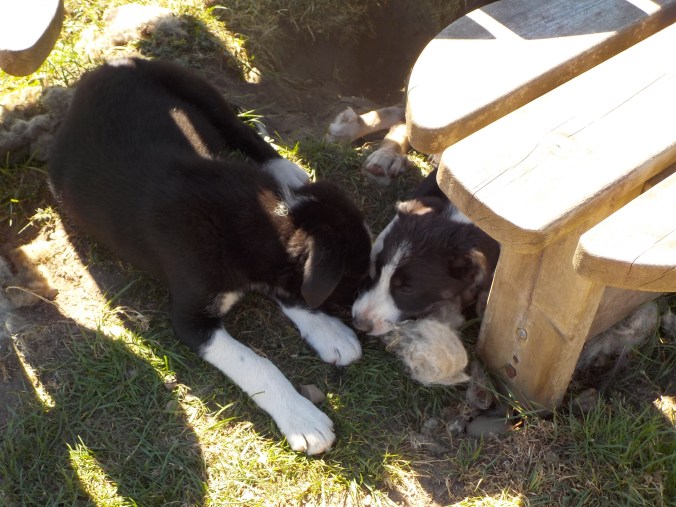
Two young ones more interested in playing with wool than playing with sheep.

After the stories, Neil abruptly left. Our guide said she was shocked at how talkative he’d been, and suggested we head back. But here he came around the corner of an outbuilding. And lined up in his arms was a row of tiny, ten-week-old puppies. Coming right up to me, he handed me squeaking and grunting fat puppies, talking about their blood lines and telling stories about their parents.

When we left, I thought about the contrast between what we had been warned to expect and what we’d found. And it was obvious what made the difference. Who wouldn’t light up when someone asked questions about the things they are passionate about, and love deeply? I didn’t do anything extraordinary. I think others would have asked similar questions if they hadn’t been intimidated by the guide’s warnings.

Me? I simply wanted to hear the stories.

And what wonderful stories they were.

DSCN0525