Lost Friends

Do you ever think about people who have crossed paths with you over the years and wonder where they are? Have you ever had a transitory moment with a stranger and left thinking they could have become friends?

That happened many times traveling. Someone met on a train, a brief conversation in a bed and breakfast, those moments when there was a click, a recognition of the other, a knowledge that if there was just more time…

I’m not sure that happens as much these days as it is so easy to give an email address. I wonder if this generation misses out on the mystery of those ‘what if’ questions.

Then there are those we have lost contact with. There is never an end to those stories. We don’t see how they grew up, who they became, how they maneuvered through life. We’re left with occasionally having something remind us of a person in our past. We spend a few moments wondering where they are and who they are, and then we immerse back into our busy lives. These days we might even take a moment to type their name into a search engine.

When I was young, there was a boy. I’m only going to use his first initial. K’s mother was a friend of my mother’s. Even though K was my age, mom seemed to think he needed watching after. Or maybe she thought I just needed to make up for past treatment of him. Supposedly, when we were toddlers I would get in K’s face and scream loudly just to make him cry.

I remember one day, about age seven or eight, and mom sent me to the local grocery store to buy a loaf of bread. This was in Seattle in the 1960s and the store was a couple blocks away. These days I’d be labeled a ‘free range’ child and hauled into foster care and my parents prosecuted. But I digress.

Mom made me take K along and made me hold his hand. I don’t know if she was afraid he’d wander into traffic, get lost, or what. On the way we had to walk by my ‘boyfriend’s’ house. If you can have a boyfriend at that age. N was furious, yelling at me that we were never going to get married because I was cheating on him. Seriously. At age eight.

K was terrified.

N grew up to marry young and divorce, then marry again and divorce again. I lost contact with his family years ago.

Back to K. There was also the time mom made us play Candyland on the back porch on a sunny day. We played 26 games. I won 23. K cried. I got in trouble for not letting him win.

The thing is, he was a nice kid. In our teens we got along fine. But we lost contact in later teen years. I mean, the only glue there, was the friendship between our parents. He grew up and moved away as did I.

I did hear that in his twenties he was living in California, had a job as a banker, and was in a very happy relationship with someone and that they hoped some day to be able to marry.

Which is why I’ve been thinking about him lately. Wondering if finally, way too many years later, now that we are moving into a period where gay marriage is finally being allowed legally, if K is married and happy.

Okay, I also wonder if he has nightmares about a kid screaming in his face, or giant Candyland board games haunting him.

So many people who have passed through our lives, touched them so briefly, left an impression, a sense of opportunity lost, or even, in the case of N, a sense of relief they are gone.

Life is so fleeting.

Being Anonymous

Why is the promise of anonymity so powerful?

From a writing standpoint I know all the reasons authors write under pseudonyms, not the least of which is the need for their families to not see what they are writing. But I’m wondering about this from a more generalized standpoint.

This past weekend my husband told me about a social media site called Whisper. People can post similar to Twitter or Facebook, but completely anonymous. I told him I found that rather creepy. He said some people need that in order to talk honestly about depression, identity, etc.

That makes me wonder about a society where we need a safety net of anonymous in order to be honest about who we are. In an ideal world that net would not be needed. But of course we are far from an ideal world.

With that said, I still find Whisper creepy. Maybe it’s the name. A whisper implies something secretive, sneaky, maybe even slightly cruel. After all, why whisper unless you don’t want someone else to hear? Remember those awful middle school and high school days when you’d be walking down the hall and see two kids whispering and giggling and know, just absolutely know, that it was about you? Remember that feeling in the pit of your stomach? That’s what the word ‘whisper’ implies to me.

Which brings me back to my initial question. Why is being anonymous so powerful? Why does it allow you to say or do things, or for that matter to post photos or behaviors, that you would not do if your name was attached? In a way it lowers inhibitions. So why are inhibitions lowered simply because your identity no longer exists?

I understand there are instances where personal safety could be seriously compromised if your name was visible, but I’m thinking here more about societal norms than politics, terrorism, racism, etc. Anonymous simply for the sense of power, not for safety or causes.

I don’t understand, and possibly because of that, I am going to strive to always sign my name, and if I’m doing something I don’t want my name attached to, then I better think twice about what I’m doing and why. Otherwise I may lose my identity by the simple act of not claiming my identity.

Old Books

Yesterday while weeding out books for the thrift store, I came across two old books.

The first was The Every Day Cook Book and Encyclopedia of Practical Recipes, written in 1892 by Miss E. Neil. It’s a quirky little book because the printer, Regan Printing House, in Chicago, put the cover on upside down. And inside the cover is a sticker for Wrigley’s Mineral Scouring Soap, sold by grocers everywhere at five cents a bar.

Why do I keep it? Some day when the mega-earthquake hits, I might need a recipe for cooking cow brains. Yes, there is one for that. Seriously though, Miss E. Neil fancied herself a scientist of ‘cookery’. I love the tone of her voice as she talks about the cooking water for potatoes being poisonous. She gives very thoughtful advice on how the mistress of the house should keep a passbook where she writes down her shopping list and the grocer writes in the prices so she can make sure the maid isn’t cheating her.

And then there’s this from her introduction where she is giving tips on maintaining the wood stove fire: ‘Food of every description is wholesome and digestible in proportion as it approaches nearer to the state of complete digestion, or, in other words, to that state termed chyme, whence the chile or milky juice that afterwards forms blood is absorbed, and conveyed to the heart. Now nothing is further from this state than raw meat and raw vegetables. Fire is therefore necessary to soften them, and thereby begin that elaboration which is consummated in the stomach.’

Think about all the women who used this cookbook, worrying about chyme.

The book is a snapshot through the window of time.

Miss E. Neil's tome.

Miss E. Neil’s tome.

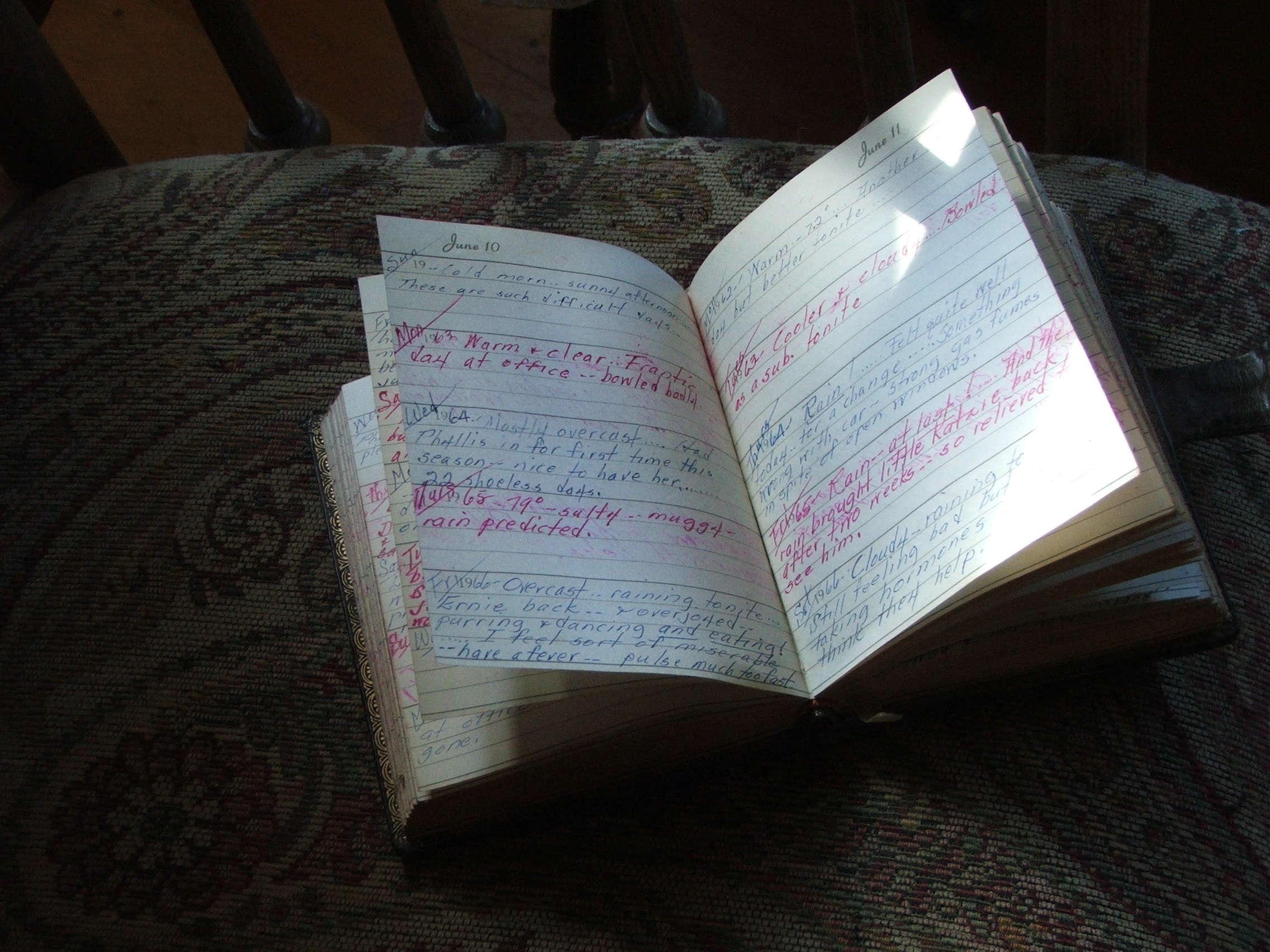
The second book is a diary of an old friend of my mother’s, Claire. I’ve posted before about her as she was a very unique woman who made a huge impression on me as a child. I planned to be just like her – a writer and hermit in the woods.

I admit to thinking diaries have to be these esoteric tomes where high lofty thoughts are left for those who follow. Probably why I struggle to write in one. But in reading Claire’s yesterday I realize that, like the cook book, diaries are also snapshots in time.

Claire's handwriting

Claire’s handwriting

Claire wrote about how many eggs she collected that day. What the weather was. What her weight was, her bowling score. How many days late or early her ‘shoes’ came. I used to wonder why she ordered so many shoes when I only saw her in men’s logging boots. I eventually realized ‘shoes’ were her euphemism for her monthly period.

She wrote about her daily thoughts, but in a five-year diary, which meant she had space for only a couple of sentences per day. Some days she simply said ‘A lonely day’.

And then I came across this, on Monday, September 9th, 1963. ‘Hot..89..Whew…all awash! Frank Nay died Saturday. Funeral Wed. 11th … a very sad thing…my arthritic bones all swollen & stiff.’

Why does that stand out to me with such gentle sorrow? I didn’t know until I read this that the day my father died was a Saturday of unseasonably hot weather. I think now of my mother sitting at the hospital with three children under age four, on a hot September day, waiting.

The details of daily life, jotted in a few sentences, can have such impact years down the road, beyond what the diary writer can probably ever imagine.