Anticipating the End

I love the tingly sense that the end of a story is near. You can see it out there on the horizon, so close, but not ready to be touched just yet. You know it’s creeping in, but you can’t look at it directly or it will dissipate like fog, gone forever.

And since it’s Christmas Eve I’ll use that analogy – it’s like being a little kid again, sitting near the tree with its lights and decorations, grasping that nutcracker and thinking, tonight the magic will happen and he will turn into a prince.

Hands hovering, fingers near the keyboard, or lightly holding the pen, breath almost held, knowing the words are almost here, almost free.

Of course the downside of that anticipation is the fact that soon, the gifts will all be open. The end of the story will be written and all that’s left to anticipate is the long slog of revising and the business end of getting the book out there.

But for right now, the story is still just mine, still magical, still unknown.

And oh so close.

Potential piece of cover for book #3, Ghost Roads

Potential piece of cover for book #3, Ghost Roads


The Dreaded Bobble Head

We’ve been re-watching a show called Numb3rs (that’s not a typo) and one of actors fascinates me. Peter MacNicol turned the role of a professor who’s brilliant but rather foggy from a cliché to fully developed character. I find myself studying the mannerisms of the character. I’m not sure if the actor did this on his own or if the director assisted, but either way, what could have been a cardboard walk on character became much more. And I think a large part of that was movement.

Peter held his body with shoulders slightly hunched forward, making the chest shallow. He held one arm across his body, cupping the other elbow, with that arm held upright. As he talked, his hand would be there like a flag on a flagpole, moving constantly, nervously, absentminded, busy. When the character was puzzling over something the hand would move limp, tugging at a curl, pulling at an earlobe. When nervous or agitated, the hand would move more quickly, flitting, worrying.

There were many more mannerisms this character had, including the way he spoke, but you get the idea. Watching him made me ponder on the old dreaded bobble head of writing. There are two things my characters do in the first draft of a story that could cause issues in real life. One, they run around naked until I’m editing and realize I’ve forgotten to dress them. Two, they nod a lot and just stand there while in dialog.

The editing process fleshes them out more. Of course in the first draft I’m just trying to capture the story, so that makes sense. But I have to remember to go back and add those mannerisms; the movements that give depth to dialog and character, and even more depth to the unspoken dialog between characters. Body language is so important.
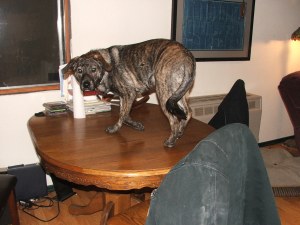
Clear body language for a dog caught in the act

Clear body language for a dog caught in the act

When I watch an actor who does a marvelous job of bringing that language of the body to life, I find myself thinking – how would I describe that so it would be seen to the reader? How would I describe it without it overwhelming the message in the dialog?

Another thing I like to do is sit in a parking lot with music playing so that I can’t hear what people are talking about. Or watch people in a busy restaurant where the ambient noise makes it difficult to pull out individual voices. In those types of situations you can watch body language without being distracted by the words. And again, figure out how you would describe what you see and what you think they are talking about.

Finally, during an edit process I like to hold my hand over the dialog on the written page, look at the movements I’ve given a character, and see if those movements tell me anything or if they are just filler.

But like I said, that’s all in the editing process. For the most part, in the first draft, I have a bunch of bobble heads nodding and smiling. Or nodding and frowning. Or nodding and teary. Blah.

When Music Returns

This compulsion called writing is a strange thing. The last few months working on book three has been very difficult. I was beginning to think the story had escaped me, had moved on to someone who might be able to tell it better. But I’ve been doing this long enough now to recognize that fear.

It’s not writer’s block because if I do sit down to write, the words are there; I just can’t put fingers to pen or keyboard. Maybe it’s a lack of trust in the story and the characters. Maybe it’s a lack of trust in myself. I’ve only had this problem the last six years, which makes me wonder if sometimes my brain goes back to its radiation days, moving away from the creativity. Because this feels like a weight. I wouldn’t call that weight sadness but I suppose it could be that. It’s a sense of just not having the energy to start, exhaustion.

I’ve learned however, that if I just keep pretending, if I talk like I know what I’m talking about, if I go through the motions without actually working on the story, eventually that weight goes away.

I used to try and force the story during these time periods, but then learned the only thing that came from that was throwing away a lot of words. The story knows when you’re faking or trying too hard. And that will also show up in the writing. I can read a draft and point right to the spot when the weight descended and I started trying to force the words. The voice changes, everything becomes stilted, unfamiliar. I know now instead of forcing the story, I leave it, and just pretend to others I’m still working.

So this evening, finally, the weight went away and the words came back. Why? I have no idea other than that this time, I put music back on. The familiar tunes I used to write to. Before radiation I always wrote to specific music. It gave me that restless melancholy, that ache that’s needed to write. After radiation, when I was learning to be me again, music was a distraction and I needed silence to be able to hear the characters.

Now I’m wondering if finally, finally, I’ve returned to who I was before lymphoma. Because tonight the music was there, the weight was gone, and the characters took me by the hand and showed me the story that’s been patiently waiting.

This may not be the final fix, the last cure. I’m sure that struggle will come back. Maybe it has nothing to do with the past few years. Maybe this weight is actually a waiting space I need to inhabit during each story, in order for it to grow. We’ll see. No matter how long one writes, the process is always evolving.

Or maybe it’s simply the return of music.