Ode To A Tree

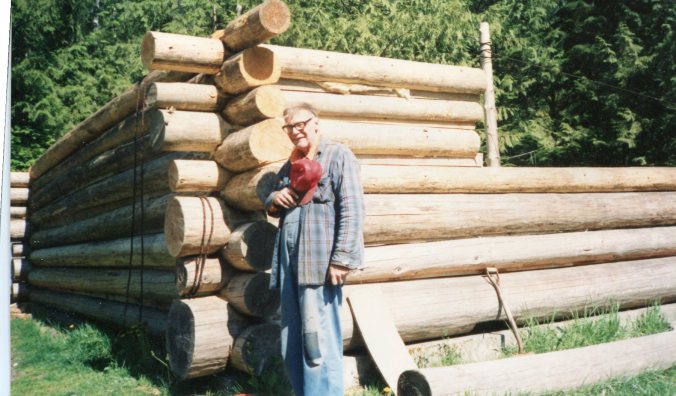
In the 1980s my father decided to build a log house. We’d just moved from farmland to the woods and with no money, we decided to make a house the hard way.

The first tree was a tall, straight Douglas fir. I didn’t know that at the time. It was just a big evergreen. Dad was experienced and cautious so it took a long time to cut the notch and make sure the tree fell in the right direction. I was bored, holding my field guide to North American trees. Looking around, I realized I also needed a field guide to native plants. My father eventually said that I needed a field guide to field guides. Because stepping into those woods opened a whole new world.

DSCF2204

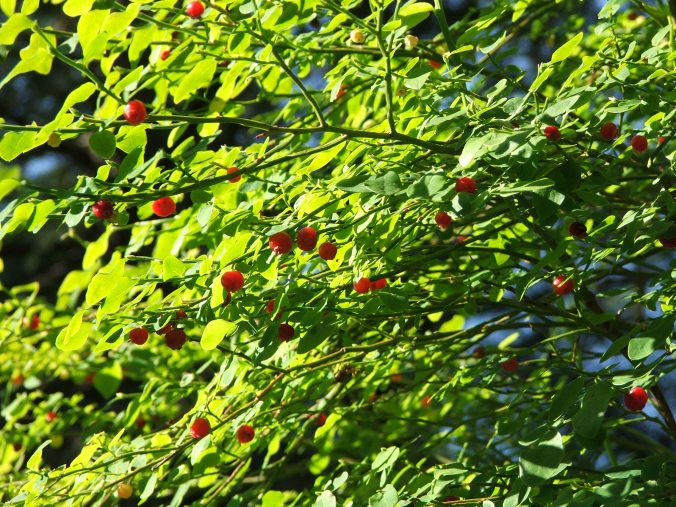
Huckleberries

My first task was to lean way back, craning to watch the far-away top of the tree for tiny tremors that said the tree was thinking about giving up. When I saw those minute movements become more defined, turning into swaying, becoming a distinctive lean, I was to warn dad so he could get out of the way.

Except that he had a chainsaw running and ear protection on. I remember jumping up and down, waving the field guide, screaming, ‘it’s going!’. He heard in time to get away.

When it hit the ground, the fall was the sound of thunder rolling up through the canyons, bouncing off the ridge, echoing back. It was the avalanche explosion deep into the ground that hit the soles of your feet and slammed upward through your spine. And that was just the initial impact. The tree bounced upward over six feet high, coming down to earth again with the thunder and echoes and impacts.

The air was full of the sharp smell of crushed needles, torn bark, sap, and flattened salal, ferns, and Oregon grape.

spring 10 002

Japanese Cedar

While dad took a break to smoke his pipe, I climbed onto the trunk. With a tape measure, I walked the length of the tree, hanging on to and weaving among upright branches. There was a whole micro-universe in those branches. Bird nests and spiders and squirrel holes and woodpecker marks. Moss that made the trunk slippery. Licorice root in its symbiotic relationship with moss and wood, and adding its anise scent to the air. Lichens that hung like gray beards.

spring 10 004

Silver-back Fir

In a small notebook I recorded the length of the tree. I measured the width of the butt end. And I flipped through the field guide until I found the name.

That first one. A Douglas fir. With the limbs cut off and the tree bucked into lengths, we got three long, straight logs.

With the old truck and a winch, the logs were laboriously pulled out of the woods where I then had to peel them. I quickly learned to do that immediately after felling. If the tree sat even a day, the bark dried and tightened and then you had to chip it off.

But fresh, the bark slid off in long strips, exposing a layer similar to snot, which is why the bark came off so easily. As I worked, that inner layer changed color. Reddened.

trees 003

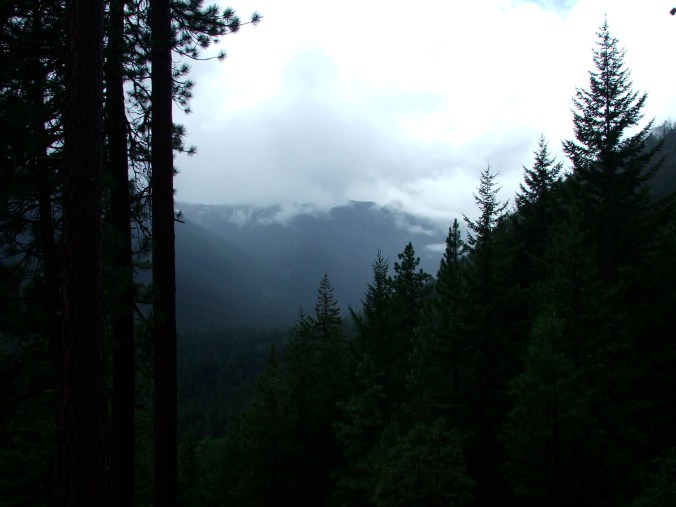
Fir, cedar, alder, big leaf maple, vine maple, spruce

That first tree taught me to see my surroundings, to identify the differences in needles and bark and foliage. To name what I touched. To watch for those first small tremors. To mourn.

We cut a lot of trees for that log house, that never came to be.

Dad

That bottom log was the first one. Dad with dreams.

And then I started planting trees. Fir and cedar and oak and sequoia and shore pine. I moved on from evergreens to plant filbert and hazelnut and prune trees, sourwood and cascara, willow and dogwood. To will them to grow tall and strong.

property 035

The first sequoia many years ago

Back in those woods, there are now trees reaching thirty feet tall. Northern flickers and woodpeckers bore holes for bugs. Brown creepers run up and down their trunks chirping their autumn songs. Moss catches on. Roots sink deep into ground. Branches reach for the sky.

I wonder if, in their long, slow, dreaming seasons, they forgive.

icicle creek 022

Las Vegas Shooting Question

I know we’re going to be swamped with articles and thoughts on this horrific shooting. Normally I don’t post about things like this because there are a lot of people out there who can say things much better.

But I was just there with my family. I got home last week.

We stood crammed shoulder to shoulder with strangers in the heat of the night in front of the Bellagio watching the hotel’s water show. The Strip was packed with cars inching along. The sidewalks were so full of people it was difficult to stay together in the family pack. And at the time I wondered why there’d been no mass shooting there. It was a scary thought because in looking around, I realized this. There was nowhere to go.

I had to forcibly turn off those thoughts. Tell myself ‘it won’t happen here’. Turn back to the family and all the laughter.

You never think it will happen to you.

I know politicians are now going to get their names out there by talking up for and against changes to gun laws. Once again they will spout opinions on both sides of the argument until the shooting is no longer in the news. Then those politicians will go back to whatever else they can come up with to keep their names in the public eye.

But here’s the question I keep asking that I want answered. Isn’t there anyone versed in society, some therapist, some anthropologist, someone, who can tell me this?

Why is it almost always men?

I know there are the rare female mass-murderers or serial killers. But the key word there is ‘rare’. I also know that those who rush in to save people are also mostly men, although there are a lot more female police offers than there used to be. I know my friends who are police officers would head straight into the line of fire, without thinking about it, if we were in danger. So this isn’t a post about hating men or making generalizations.

Yet, I think of news photos after disasters when people are looting, burning cars, etc. It’s almost always men, and most often young men in their twenties.

Why?

Maybe instead of listening to useless politicians gain their five minutes of fame by spouting off how they want to change, or not change, gun laws, we should have someone stepping up to explain this.

Because maybe, if we can figure out the ‘why’, we can figure out an actual solution.

So someone, please tell me why you think this is. Otherwise we’re all going to continue having our hearts broken as those we love are gunned down in senseless mass shootings.

A Vietnam Vet

My sister-in-law is dealing with Hurricane Harvey and the flooding. While nowhere near as devastating, I was reminded of the first flood I went through after moving to the woods. Which reminded me of the first Vietnam vet I met.

Flooding in this area hits hard and fast. Whitewater rivers are forced between canyons and boulders and drop steeply, unlike the farming area where I grew up. There, the water rises slowly and spreads out, and sticks around. A whitewater flood takes trees and houses and roads, and then drops fast.

miscellaneous 097

Someone’s trailer a couple days after a flood

galena rd 029

Our road after a flood widened it

This first one flooded the road I lived on. The road is two lanes through the forest with no shoulders and just big trees up to the edges. It was night as I came home and out there it’s pitch black at night. No streetlights or house lights. Just my headlights in the little Subaru Justy, reflecting off moving water.

I got out of the car to see if I could tell how deep the water was, or if I could make it across. There were tree branches floating in the reflected light. As I stood there in the dark, a big man came out of the trees and stepped up beside me.

“I don’t think you’re going to make it,” he said.

I seem to remember being frozen, probably not even breathing.

“But I’ll go across and check for you.”

And off he went, wading through the moving water, followed by a dog that also came out of the trees.

On the other side, he raised a flashlight, waving me forward, and disappeared back into the trees. I drove across slowly, with water sloshing up high on the car, knees shaking, wondering if that had really just happened.

kayaking 011

The river on a calm summer day. See those rocks in the back? They’re underwater in a flood.

He lived rough somewhere in the woods during those years. I regularly came across him, with his dog Katie, when I’d be out walking old logging roads or trails. He’d materialize from the trees, share my company for a bit, and then fade away.

Most times he was in this world. But occasionally something would send him back there, back into that war. One time it was a small airplane flying over. He told me not to be worried, that it wouldn’t stand up against his anti-aircraft missiles, and pulled out this huge old revolver.

haybrook road 014

The logging road where the revolver was pulled.

Living off-grid at the time, we had an outhouse. Since I was the only one living there, and the views of mountains and ridge were beautiful, I rarely shut the door.

Until the day, out walking with him, and he told me he’d found an old trail that crossed the ridge above my place, and how he could see our whole place from up there.

I closed the door after that.

outlaw creek 062

The ridge. The outhouse was on the other side of the cabin.


Eventually, someone got Veteran’s Affairs involved, and he was set up with counseling and resources, and even a little house in a nearby town. I missed him stepping out of the woods and walking with me.

One day, a couple years later, I was ‘down below’ at a grocery store and here he was, still big and bushy-bearded, pushing a cart. I saw people looking sideways at this man. I saw how they sidled away from him when he came right up to me and said ‘do you know me?’.

Of course I knew him. I gave him a big hug, asked after Katie, who was elderly and waiting in his friend’s car. I asked about his little house, which he thought was okay most of the time. But some days, he said, he had to get out into the woods.

I left, wondering if he’d found someone else to walk with out there, or if he remained in solitude with his past.

lookout point 001