Photography as Art, Part 1

Following is an interview I did with photographer Jane Speleers of Royal Squirrel Photography (http://theroyalsquirrel.com). I’m always fascinated by what draws us to specific forms of art. And photography, like so many forms of art, tells a story.

Besides being a photographer, Jane is an adventurer, horse woman, climber, and all around very nice person. How do I know? I’ve known her for a few years now and she was very nice when my dog peed on her new carpet.

Vala - the carpet-peeing slob

Vala – the carpet-peeing slob

Jane asked me to edit her comments as she worried about English being her second language. I chose not to for two reasons – I didn’t see anything to change, and I prefer to have the words remain true to the voice. Hope she doesn’t mind!

When you pick up the camera, and your subject is before you, what are the first things that come to mind?

What I think is: “Who is she? What is she feeling? Does the camera make her uncomfortable?”. I try to not affect my subject with my presence. I try to understand and relate to my subject’s emotions so I can act/interact in a way that would make them feel that I’m part of what they already know, their environment, and keep them comfortable.

It seems like light and shadow could be manipulated to tell the story and I know those can be used to illuminate or create depth. But how do you know to use those tools? Or, more simply, how do you know how to use light and darkness?

Light and absence of light can be manipulated to intensify emotions in an image. These are perceived by our senses like music in horror movies. If you cover your ears while watching a suspense movie, you might not get scared at all. If I use artificial lighting when taking a picture of a living room, it will make it look bright; all the furniture, built-in features and details will stand out as a “whole” since they all receive the same amount of light. It might even look spacious. In this case you can see it all. Maybe this image would be used for a home ad. However, if I take this same picture without studio lighting, with only natural lighting coming in through the window…you will only be able to see what is within the light reach. Or not even that…you might only see furniture silhouettes. In either case, many questions would come up to your mind, like.. “Is that a chair or is there someone behind the table?” “Is that an abandoned house?”, “Is that a haunted house?” The absence of lighting changes the concept of this picture from ‘A nice living room’ to ‘a haunted/abandoned living room”. I’m not saying that absence of light has negative connotations. When light is absent in some parts of the image, this increases the tension on whatever is brighter and leaves more room for the imagination to complete the image based on what this is able to decode.

Your photos, especially those that are taken outside, always look unrehearsed, as if your subjects are part of their surroundings. How do you pose them to get this natural connection with their surroundings? Or do you pose subjects?

It depends on the subject. It normally takes me about twenty minutes to understand how my clients think, how they verbally communicate, what subjects makes them laugh and the way their bodies unconsciously communicate. This last is the most difficult to understand and direct. I would say that I usually manipulate 50% of the image by choosing the location and directing the photo-shoot. Ideally, the other 50% is natural and spontaneous. Some clients are a bit nervous at the beginning and later on they get super creative and silly during the shoot, which makes the most fantastic portraits. Plenty of laughter, playful poses, and some people even dance in front of the camera! I want my clients to enjoy not just the final product but the photo-shoot as a great experience and the portraits as a souvenir from that memorable day. However, for some people it’s hard to be spontaneous when there’s a camera capturing every move they make. And I can include myself in this group. For which I am in constant communication with them, joking around and explaining to them what I’m doing and what my vision is. When they feel that I’m being honest with them, that I am aware of their emotions and I explain to them that there’s nothing to be worried about. They seem to feel a lot more comfortable because they understand that I’m working with them and for them. And looking at the camera is not an issue any more. They share thoughts and memories with me and this leads to making spontaneously happy and meaningful portraits.

As you go about daily routines, what kinds of things catch your eye and make you think, ‘that would be a great photo’? A similar question would be the more traditional ‘what inspires you?’.

Most days, I’m inspired by my dogs, Frida and Whiskey. Their body language, facial expressions, silliness, naiveness, and the way they communicate with me. I could photograph them every day of my life and there would always be something new to smile about.

Other than that, nature with natural light in the early morning.

Storytellers ask themselves ‘what if’ and that question can be the well that stories spring from. It seems to me that this would work for photography, too. Do you have questions that you ask yourself as you move through the process?

I ask myself “what if” every few minutes. There’s many, I even dare to say “hundreds” of ways to capture one moment in time. You can only choose one. I do it and I continue with the following “What if”.

When I go to bed after a full day photo-shoot, many of those ‘What if.. I did something different about that one” come back to me.. and I try hard to let go.

It seems that photographers, just like painters, musicians, and writers, hope to elicit emotional reactions in their audience. Do you think about what sort of response you want as you take photographs, what you hope the photo translates to the viewer?

I hope that every one of my images say “I feel alive”.

Have you ever been surprised by someone’s emotional reaction to a photograph?

Yes, many times. It was precious.

Do you have a preference between taking photos of landscapes, still life, animals, people, etc.? What draws you to that specific preference?

Professionally, I love capturing people when going through strong emotions. Weddings are the best for these. My favorite moments are when the bride walks down the aisle and when the bride dances with her father.

Personally, landscapes & natural events that show how alive the earth is.

Have you ever thought about why photography speaks to you over other art forms?

I’d say that photography can speak to you in a particularly intimate way because this can bring back and revive a real moment from the past, but this time it’s frozen, for as long as your mind wishes, allowing you to explore it, relate to the subject, and think about the possibilities. Even though it doesn’t exist any more. It can contain plenty of visual information to be decoded.

But I’d say that Video can speak to you over other art forms.

What are one or two questions that you wish someone would ask you about photography?

Personally, what do you love and don’t love of being a photographer?

I love to capture life for my clients to remember it, but I don’t love feeding people’s vanity.

Thanks, Jane, for taking the time to feed my curiosity. If anyone has questions for her, you can post them in the comments below or contact Jane directly through her website, noted above.

I called this post ‘Part 1’ as I’m hoping to convince another photographer friend, who has a different type of photography business (think on the yard line face to face with Seahawks) to answer similar questions.

The Art of Storytelling

Not too long ago I edited a children’s story called Tallulah’s Flying Adventure, written by Gloria Two-Feathers. I was impressed enough that I asked if I could interview her. I have no doubt that this story will be published and will be the beginning of great things for this author. She says below that she has no musical ability. I don’t believe her. I could hear the singing and the drumming as I read the story.

And after reading her answers below, I do believe she must be a kindred spirit of one of my sisters. Please read the interview and make Gloria welcome in our writing world.

1. Can you give me the background how you came to write Tallulah’s Flying Adventure?

About twenty-five years ago I was visiting a friend in Oregon. She lived in a rural area outside of a small town. I was setting on her front porch steps that faced an open meadow. I noticed several very small spider webs floating on the air. Each one had a little spider clinging to it. As each floating web would twist and turn in the sunlight it would become visible then invisible. As I watched this amazing sight I realized there were hundreds of these tiny webs traveling across this large open meadow. It looked like each little spider was navigating its web.

I remember thinking, “That’s how spiders travel great distances. They don’t crawl they fly!” My second thought was, “that would make a great story book.”

It took me a few years but at last, Tallulah’s Flying Adventure came to life.

2. How did you choose to write children’s stories?

I actually was interested in being a better storyteller. I had the opportunity to study with Nancy Mellon in CA. Nancy is not only a master storyteller she also instructs teachers at the Waldorf School the craft of storytelling, which is a part of the school’s curriculum. Several Waldorf kindergarten teachers were taking this course also. There was always a lot of conversations and study around children’s stories. For our final project of this yearlong course we had to write a story. I remembered all those little spiders floating across the meadow and Tallulah’s Flying Adventure was created.

3. When did you realize you were a storyteller?

I came from a family of story-tellers, who used analogies, oral history and jokes to teach me and my six siblings. From hunting, to canning, to the history of our family’s South Dakota homestead, each topic came alive in the telling. We lived in the Black Hills which is rich in Native American culture, Western history and stories – lots of stories. The beauty of living in such a special place is, I could read a story and actually drive to the area they were telling about. Such as the book Black Elk Speaks, a reference to Harney Peak, and of course Deadwood and the gold mine. Having a huge impact on my life path, Lakota Elder Buck Ghost Horse instructed me over a 20-year period about spirituality, ritual, ceremony, and culture — eventually giving me my name. This connection to Native American culture resonated strongly with me, reinforcing my sense that everything is alive. I try to bring this sensibility to the stories that to flow through me.

Not South Dakota but in the neighborhood.

Not South Dakota but in the neighborhood.

4. Your stories are very lyrical and beg to be read out loud, or even sung. Do you have music in your mind as you write?

I wish I could say yes. But no I don’t. Actually I’m not very musical. It’s just the way the story flows through me.

5. What brings joy for you?

I’m a fairly simple person and I love nature. I receive a lot of joy watching a beautiful sunrise or sunset. The smell of fresh air, and I need a lot of quiet. I live out where I’m surrounded by trees and watching the path the wind takes as it blows through the trees. How it shapes the way trees grow. I receive a lot of pleasure observing the hidden communication of all living things.

My husband Jim is my life long friend. Our dogs Charlie and Isabella are my constant companions and bring me a lot of joy and happiness and just make life more interesting.

Tree growing with granite

Tree growing with granite

6. What brings sadness?

Cruelty in the world, especially to the helpless beings. Such as, I have observed many people killing helpless spiders just because they are a spider. Not because of anything the spider is doing or has harmed them. There are other choices to make, they could put it outside or just leave it alone. I see this kind of senseless cruelty being done to many living creatures, plants, trees, human beings and the Earth herself; it always bring sorrow to my heart.

Tallulah?

Tallulah?

7. What story do you remember from your own childhood?

The first story I can remember has always enchanted me. When I was about three years old my father brought home a book with a story of a Persian Prince who was sent on a quest so he could win the Princess’s hand in marriage. His companion was a magnificent horse that had magical powers: he could talk and fly. To be able to marry the Princess the Prince had to return with a feather taken from the Phoenix, a fire bird that was the color of flames. The pictures in the book were black and white. But the description bought the color alive and real in my mind. I was always asking someone to read that story to me over and over. I must have heard it a hundred times.

8. Why do you think that story has stayed with you all these years?

As a child I believed in a world where we have animal companions who have magical powers and could communicate with us. And they would help us accomplish what seems like impossible tasks. All Native American stories and beliefs are based on everything the Creator created is related. Which means everything is in communication. In Shamanic Journey work this world is referred to as non-ordinary reality.

In ordinary reality I also grew up in a time of Roy Rogers, his horse Trigger and his dog Bullet, The Lone Ranger and his horse Silver, Lassie and Rin Tin Tin. And Strong Heart who was not just an animal movie star but a decorated war hero. Watching these shows had a great influence on me. I decided if they could do it, I could do it and I developed my own animal communication skills. Once you enter that world all of nature is ready to communicate, trees, plants, wind, water, moon, sun and stars the Earth herself. There are no limits only the ones you put on yourself.

Today this is a part of every day life. We have police, military and rescue dogs, service animals of all kinds, as well as horses who are used in therapeutic health care. All of whom have extraordinary powers and high levels of communication. The animals do this because they love us and they remember we are all related.

The internet and television are full of videos of people capturing inner species communication and friendships. The ancient ones always knew this and left the message in stories. As man advanced he forgot and thought it was just myth. But the animals always remembered and waited for human beings to raise their consciousness to a level of awareness of what our ancestors knew. Now I find myself living in a world that I always believed was real when I was a child.

Puppy communication

Puppy communication

9. Can you share something about your daily life, who you are outside of writing?

I enjoy working with women who wants to develop their Spirituality. Those who are asking the archetypal question, “Is this all there is to life? What is this calling and stirring inside of me”? I do this by teaching Energy Healing as well as personal transformation and development programs. I teach these programs in small schools, colleges and at my home.

10. What would you want readers to know about you?

I love to laugh. I have friends and family members that are so humorous we keep each other laughing all the time. I mean that full belly laugh that brings tears to your eyes and takes your breath away. I believe we are supposed to experience that sweet indulgence as often as we possibly can.

I Mentioned I Love Questions…

If you haven’t yet visited Maryn’s blog, The Well, please take a moment and drop by at http://www.thewellspringblog.com and you will find it well worth the time. Maryn recently answered questions posed by Twyla Tharp’s The Creative Habit, and passed those questions on to me. After reading Maryn’s responses I am going to look into this Habit a bit more.

But anyway, Maryn suggested I respond to the same questions.

1. What is the first creative moment you remember?

Kindergarten, show and tell day. I’d forgotten to bring anything. So I told the class about seeing two men with gas cans going into woods where we kids played and built camps. I said I followed them, saw they were going to burn our woods down, and managed to save the day. The kids were in awe (the teacher less so). Even though I was too young to put the feelings into words, I can still remember clearly that moment of realizing something powerful had just happened. Little did I know it was opening my eyes to the strength of a story.

2. What is the best idea you’ve ever had? What made it great in your mind?

I find this question really difficult. I’ve had a lot of good ideas over the years. Such as ‘let’s have a baby’ and ‘let’s find mice in the field and make them into pets’ (my brother broke his nose during that one). But I think to answer this is to talk more about a realization rather than an idea. The gradual realization that I belong in the woods. That there’s something about being in the forest, surrounded by trees, that brings out my creativity and releases something inside so I can write. All my daydreams happen in the mountains.

3. What is the dumbest idea?

Possibly catching mice. Followed by the idea, cemented over many, many years, that I am homely and of lesser value than those around me. I’m chipping away at that cement, but it’s pretty set.

4. What is your creative ambition?

To capture the stories surrounding me and get them on paper before they are gone. To honor those stories and tell them in the way they want to be told.

5. What are the vital steps to achieving that ambition?

Oh, great question. To achieve that I need to value my writing time as being just as important as the things I see as responsibilities. Which also means needing to value myself a bit more.

6. Describe your first successful creative act.

Successful as in finishing a manuscript, having it edited, and putting it out into the public view would be The Memory Keeper. It started as a way for me to answer a question of my father’s, and ballooned into a fictional mystery I didn’t expect. But my first complete manuscript was another mystery dealing with green garnets and Bigfoot (A Place of Wild Things). Someday I’ll resurrect that one and rework it.

7. Describe your second creative act. How does it compare to the first?

The Memory Keeper was extremely difficult to write because I was in the midst of what I called radiation fallout. Just coming off treatments for Lymphoma. The creative side of my brain was dormant as I was in survival mode, and many, many times I thought I would never write again. The anger inside was terrifying. The struggle for each word was unbelievable. Luckily my husband held me up through that. So then the second book, Sparrow’s Silence, was like a celebration, a triumph, proof that words still flowed.

8. Which artists to you admire most, and why? What do you have in common?

For writing, Elizabeth Peters, Meg Gardiner, and Elly Griffiths. Each, in their unique style, have this amazing power to transport me to other worlds. In music, Lisa Gerrard and Loreena McKennitt for the ability to inspire me to write with just their voices. In art, Lisa Hsia (www.satsumabug.com) for her honesty in portraying her struggles and successes in her creativity. What do I have in common with all of these? Not much. But I strive to.

9. What is your greatest fear?

Returning to those days of living with no stories inside.

10. What is your idea of mastery?

My wonderful friend Kathy called me one day, crying, and read a passage to me that had spoken deeply to her. She said it was from The Memory Keeper. I thought she’d made a mistake; I thought, clearly, ‘I didn’t write that’. Then I returned to the book and realized I had. And I thought, just as clearly, ‘where did that come from?’ For me, mastery is those moments when words that have come through me touch someone. I see that as a goal to still be reached.

And now I’d like to follow Maryn’s lead and challenge all of you to answer these questions no matter what form your creativity takes. And let me know when you do so, in order for me to learn from your answers like I did from Maryn’s.

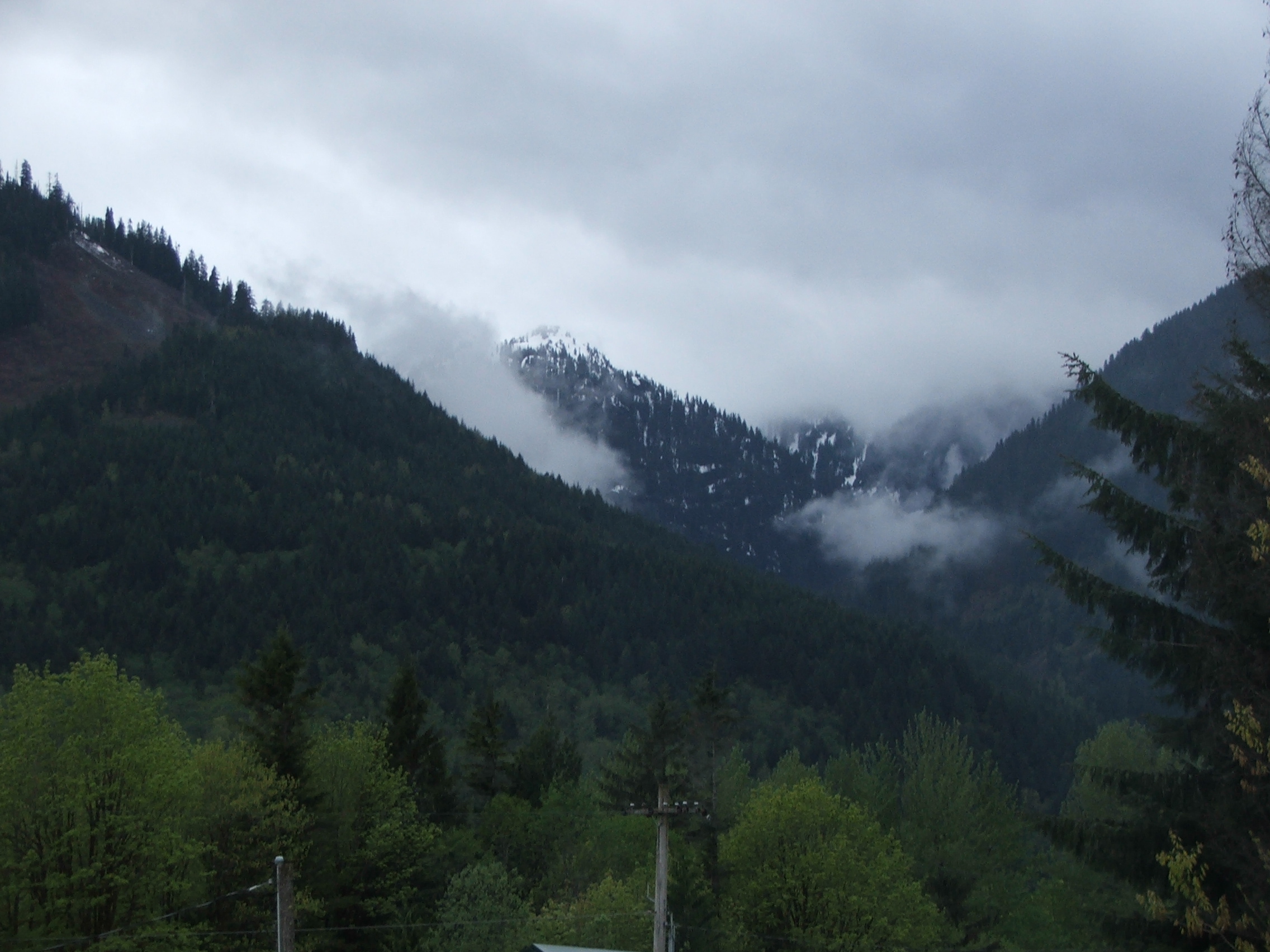
The view from my back yard

The view from my back yard