A Woman of Grace

I asked a friend if I could interview her, and then had to say, ‘breathe, Pat, just breathe’. Even though this thoroughly terrifies her, she answered my questions with the grace and joy she shows to all around her. A poet, and much more, Pat is known as the soul of the writer’s group I attend. While this is long for a blog post, I am not dividing it up as Pat’s words flow  together. Please take the time to read the responses of a gentle soul, and please encourage her in her writing by posting a comment. Don’t let her tell you otherwise; she writes amazing poetry. I am honoring her terror by not using her full name until she can draw in a breath that is not panicked.

Lisa: I know you are tentative about doing this interview. Would it be too invasive to ask you what it is that scares you?

Pat: This is an easy question, though probably not an anticipated confession! I would shy from your interview because I am IGNORANT about poetry. I just write it! What do I know?  I could not even pass a grade school exam, or readily or accurately even define “iambic pentameter”!! There were a few little issues of anonymity which I have since worked out – mainly by remembering not only YOUR good will, but that this is the twenty FIRST century, where there is not a House Unamerican Activities hatemongering Senator’s group, or Birchers quick to condemn first and never question or learn after.

Lisa: How have your poems changed since you began writing poetry?

Pat:  I don’t seem to feel any change in my own poetry from when I began nearly 40 years ago. I still like some of my first pieces best! I’m no good at analysis; could never be good with critique, just too much into my own experience I guess. I think that how I approach any subject of a poem might change, but I’m not sure how, and it feels no different in the process or end result, even with consistent format.  I just finished finalizing a year of work, ending 1999. I hadn’t finalized in some 13 years. Neglect!

Lisa: Has the meaning of poetry changed for you over the years?

Pat:  I have no concept of poetry per se, as I grew up with such condemnations of it. I could put in some examples, but – Yuk. Ugly. I didn’t start out TO write poetry, that’s just how it came out, and I needed feedback to figure that one out. Once I accepted what might be true, then I worked it through, studied poetry, and found wonderful affirmation of the process itself.  Best source was Shelley’s IN DEFENSE OF POETRY.

Lisa: Are there certain emotions or environments that inspire poetry for you? For example, music, walks, anger, joy, etc.

Pat:  Intense emotions and the entire realm of Nature are first inspirations, which are also the first senses I have that a piece could come if I welcome it. I learned with intense relief in after-study, that poems just cannot be WILLED.  (I think of Rollo May’s wonderful Love and Will). I remember that first fall, clearing all my decks to be ready for work with NO distractions, and I SAT there, on my empty facilities throne. That was a GREAT lesson to me.  I can prepare, but there’s no real planning that works for me.

Lisa: Are there poets that have inspired you?

Pat:  I was writing awhile before I thought back to what might have set the stage of this emergence for me, so utterly unintended were poems; it was more a back alley accidental exploration after everything else I’d thought to do had failed. There wasn’t much; just vague memories, then I wrote out “favorite poems” I could remember with pleasure, of Robert Service, Robert Frost, EMILY DICKINSON, and then others that came later, after I began writing:  Langston Hughes, Maya Angelou. What really moved me in youth and life, addressing huge issues, were the Rogers and Hammerstein musicals, beginning with “South Pacific”. Music, as much as the words themselves, worked on me to set the stage for poems later on, and utterly unforeseen then, when I was some 30 years of age.

Lisa: What makes you choose a poem as the medium for your words?

Pat:  Journaling just didn’t cut it for me as actual creating, more like “reporting”!! After I realized what I was doing, then a journal has often been interactive, with pieces leading to them, and sometimes I need journaling to come out of them! Poems take up little space (mine anyway) so that was a wonderful logistic when riding in a car; I could scrawl on any little piece and capture the moment, like a photo might, or a wonderful painting, or an exquisite piece of music. These assets of the process sure were encouraging of pieces themselves. Plus, like I heard so perfectly put in your writing group, I just don’t have the staying power of a book, or play, or even an article. My poems are like a jigsaw puzzle, with hopefully some solitary experience of each piece’s own, then of a whole mosaic of human experience.

Lisa: What do you find easiest and hardest about writing a poem?

Pat:  Initially, the hardest part of writing a poem was just accepting that that’s what I was doing. Then, working out logistics and ordering it so it wasn’t all scattered bits driving me crazy. It was satisfying to get that worked out. The easy part after I realize I CAN, making that welcome, setting the stage, securing safety, is just exploring with the words, to see where they lead; I often don’t know where I’m going, but with a sense of “it’s OK” then the joy comes, even if I’m NOT sure I like what I end up with! But, more often, even surprised, I am enchanted that this vaguest sense in the beginning arrives, even after words pin it down, that it still conveys this initial amorphous inkling.

Lisa: Do you see the meaning, or intent, of your poem change when it is read aloud by someone else? How could you avoid that happening?

Pat:  I’ve almost never heard my pieces read by anyone else. My first reader has such a lovely voice (she was a trained musical vocalist in her youth) that I am enthralled to HEAR it! I never think how it might change anything, as I always presume that the beauty of poems, like songs, or pictures, can mean different things at different times to different people. Even from the beginning, I felt that it’s the reader or hearer that ultimately determines the worth of what is received, that as creator, that reception is something I would never even want to control or determine (except of course to avoid giving offense or inciting violence!). That old saw about sticks and stones, but words can never hurt…well, they can, and Do. That would be an outcome I would work to prevent or avoid being held accountable for… thus posthumous publishing has ALWAYS appealed to me! The ultimate escape!

Lisa: What would you like to tell me about poetry?

Pat:  I might actually say to you, Lisa, to not “Worry” about poetry. At all!  It will survive, or NOT.  I don’t see it as any more worthy than ANY other form of creativity, including comics, or movies, or even inoffensive graffiti!  I could only hope it ever competes with philosophy, or a symphony, or suspense and intrigue, or really engaging beauty at any level, even models, sculpture, photography, not to mention the stunning awesome compelling experience of Nature all around us, especially where you live!! Where I was privileged to be a guest while you visited the sere enchantment of eastern Montana in winter, and near where you read a Christmas entry of my journal a few years ago, and I think I never heard anything so lovely!  What a joy to be So received.   “If the poet has a dream, it is not of becoming famous, but of being believed.”  Jean Cocteau

Kaylan Doyle Interview, Part 2

Continuing with author Kaylan Doyle, the first question in particular I found interesting as Kaylan and I had totally different reactions to Margie Lawson. I blogged about her courses here before. Now, listening to Kaylan, I wonder if Margie is a person who presents better in person compared to the written, online courses. Anyway, Kaylan has a lot of interesting things to say here.

Lisa:  Your pacing is fast, the story moves quickly – beginning to end – and still adds a lot of rich detail. How do you manage to keep up the speed, keep the reader in the moment, keep the pages turning?

Kaylan:  My biggest struggle is with pacing. Several years ago an agent remarked that she loved my manuscript, but it read like a slow-moving promenade. Definitely not good. She also said if I revised, she’d love to read it again. Panic struck! I had no clue – either how to identify my problems or how to fix them. I found a local two-day workshop taught by Margie Lawson. I learned so much that I went on to complete her lecture packets and attended her Master Immersion workshop. The tools Margie taught me took my writing to the desired level. She’s the best, in my humble opinion! J

For ‘descriptions + speed’, I search for dual-purpose adjectives. These not only identify and describe an object, but also limit the number of words. An example would be something like ‘the cut-crystal ceiling’. In four words, I have a mental picture of looking up through a clear faceted sparkling ceiling at the sky overhead. It’s a little added work, but I believe the results are well worth it.

Lisa:  What do you do to identify pacing problems? And what are the fixes?

Kaylan  In my first edit phase, I do a ‘search’ (and destroy) on key words – finding and replacing passive words with powerful ones. They are: not, had, was, that, would, could, which.

This is my short list and I weed these mercilessly. My rewritten/reordered sentences are always more powerful than the original. I also apply a secondary list of ‘weak or overused words’ to make sure each sentence is as full and rich as possible.

Lisa:  Can you share that second list and explain what you mean by weak or overused?

Kaylan:  Sure! J They are: it, they, them, were, some, really, turn, stood reached, lifted, picked up, bent, might, very, feel, sometimes, even, indeed, maybe, look, smile, said. The second part of this includes a search for words ending in *ing* or *ly*. These often prove to be adverbs which almost always weaken the sentence rather than amplifying it.

In the overused/weak category, these are the comfortable words. Take smile, for example. If you search your manuscript for it – you may find several usages in the same chapter. Okay, maybe on the same page. J The challenge is to avoid substituting a synonym like ‘grin’ and continuing on. How many times does your character ‘look’? Instead – using non-verbal body language – we can paint a mental picture of the character’s actions in our reader’s mind.

Lisa:  In your novels, do you always have a strong female protagonist? If so why, and do you have those     you use as models?

Kaylan:  The women in my family, my friends, and women I admire all have steel spines. Whatever the task or challenge, no matter how difficult, I’ve seen them take a deep breath, gather their internal resolve, and make it happen. Or accept and cope with dignity. My female protagonists, modeled on women I know, are a composite of traits. But the single common denominator they all share is core strength. Based on adverse circumstances (for which I am responsible … J), my women may question themselves, or appear weak. Forced to dig deep within, they always find untapped reservoirs of strength and purpose to save others or themselves.

Lisa:  There is a comedic twist, dry humor although the subject matter is often dark, bloody. Do you draw on people you know or where do you find it?

Kaylan:  You know those people who always seem to laugh (or find humor) in those inappropriate situations? Like when someone takes a tumble, and they could be injured, but the fall was so incredibly funny that your head almost explodes from trying NOT to laugh? That would be me. I have always seen the ‘black’ or ‘gallows’ humor and I just let it out to play in my characters.

On a serious side, people often use humor to lighten terrible subjects, to stave-off fear, or to distract others from uncomfortable or dangerous situations. Just another way, I believe, that we deal with the horrible when we have to. Because we do this in our everyday lives, I love developing my characters’ senses of humor – no boundaries, no hurt feelings (well, except for another character). J

Lisa: Have to admit, in my own writing, the things that make me laugh out loud are usually rather black! I love Kaylan’s word search. I do the same thing, and my favorite word, used way too much, and cut ruthlessly is ‘that’. I rarely find a sentence that isn’t stronger without it. Except maybe the one I just wrote.

Thanks so much to Kaylan for taking the time to do this interview. Words of wisdom, shared with humor. Doesn’t get better than that.

Interview With Author Kaylan Doyle, Pt. 1

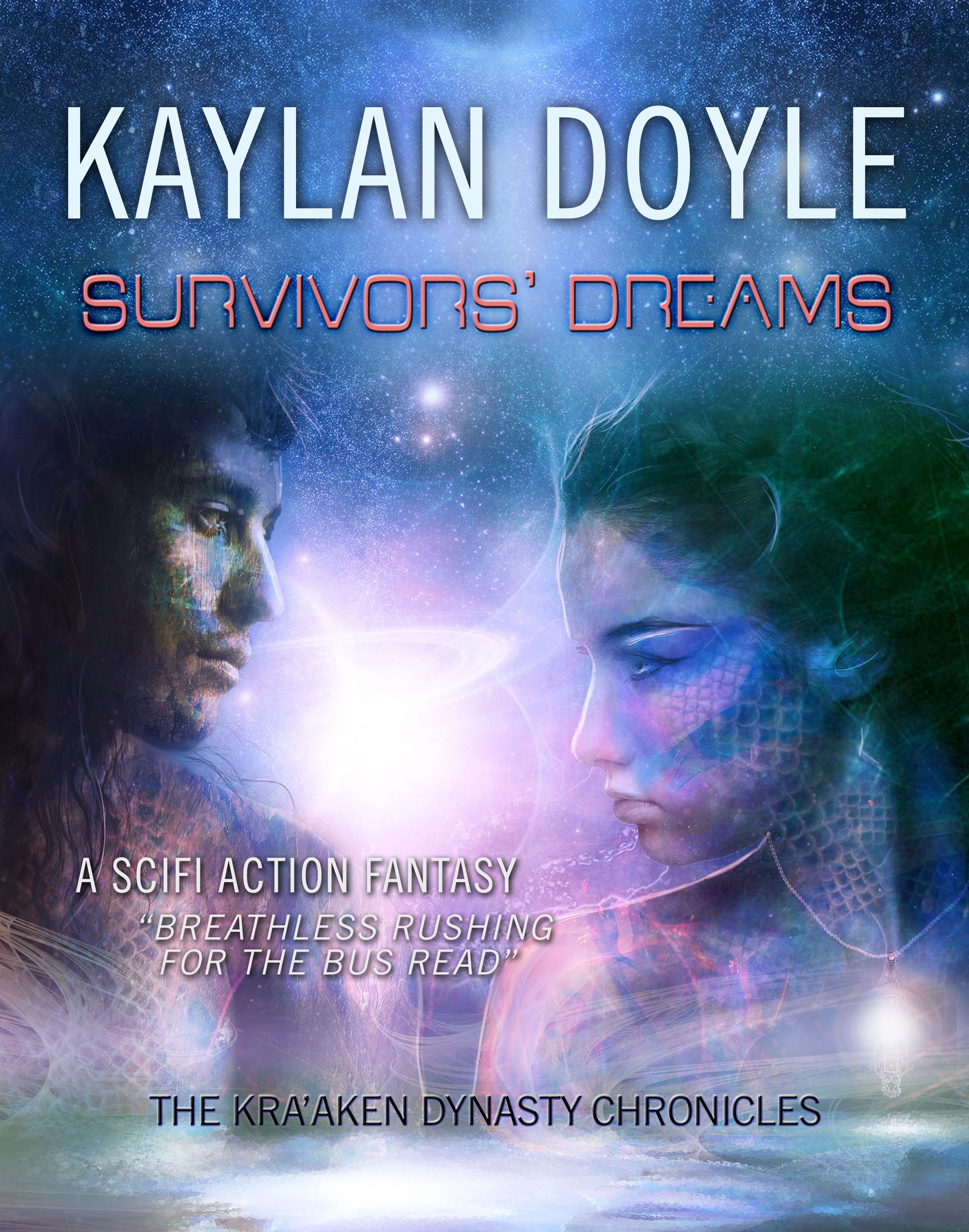
Following is part of an interview with Kaylan Doyle, author of Survivors’ Dreams.  I caught up with her not too long after her return from a very successful book launch at DragonCon. Please feel free to ask her questions and leave comments. I’ve always thought writing science fiction would be extremely hard, but Ms. Doyle makes it sound like a fun challenge.

Lisa: How do you come up with names when writing science fiction/fantasy?

Kaylan: I generally think of a personality type which relates to a given name – often a nickname comes first. With Rak’khiel (Kel), I knew my female protagonist was warrior race, a “killer”, if you will. Kill became Kel, and with the Kra’aken language using a double letter separated by an apostrophe, Kel became Rak’khiel. I work phonetically so that there is a rhythmical, melodic feeling to the names. I admit Prince Helrazr was a tongue-in-cheek pun– because he is a handful, and a favorite with the ladies.

Lisa: On a related note, how do you keep them unique without being too different, so that a reader struggles with pronunciation or feels pulled out of a story?

Kaylan: By using nicknames whenever I can – they are short, and it doesn’t slow the pace for my readers. I’ve read enough science fiction/fantasy to be aggravated by unpronounceable names thirteen letters long – I try very hard not to do that.

Lisa:  I can build a world where I live that will be unique to some readers, but still have a frame of reference. If I write about a tree, readers will picture what that means to them. Yet when world-building everything is original. So how and where do you start, and yet still give readers a frame of reference?

Kaylan: Oh, you’ve hit on the fun part! Take a tree – some of mine are red and silver – there are no limits. I reference the standard item – so my readers know what I’m describing and then I let imagination run crazy. I always try to include the senses – the sight of leaf color or bizarre shape of the tree, the touch and feel of the weird colored bark, the smells can be anything from nice to nasty – cinnamon to burning ozone.

Lisa: Do you find building a character that lives in a different universe harder, or are the principles the same?

Kaylan: It’s the same, truly, but with such complete freedom. Aliens don’t have to be nice, or kind, or helpful.  Their culture, their rules, their rights and wrongs – they can be perfectly awful by our standards and great guys by theirs. So yes, I use our structure, but I often twist their societal requirements or customs.

Lisa: The idea of not just creating a story, but creating a whole unique foundation for that story fascinating. When writing this type of fiction, where do you stumble, what comes easiest, what do you most look forward to, what do you most dread?

Kaylan: Oh boy. I knew what the problems between Kel and Razr would be, and I knew the planet of Olica would be hostile to them. What I didn’t know was why, or who. To arrive at that, I wrote Kra’aken history and backstory until I found an old enemy species. To be honest, the only parts of the story I find difficult to write are the serious love scenes. What I truly love are the scenes where my strong female protagonist, with true justification, kicks backside with extreme prejudice.

Lisa: Two of your main characters come from a world, through a portal, and end up in proximity to each other, even though they are in no way similar. You’ve written this in a very believable fashion, but did you at any point worry about the plot becoming a coincidence, and how did you avoid that pitfall?

Kaylan: No, the possibility of coincidence never entered my mind. It probably should have – it would have been easy for the story line to feel contrived. J But when Kel and Razr told me their adventures, they also presented the logical “how” that they managed to wind up on the same world at the same time. Lucky for me!

Part 2 will soon follow…