Present Tense aka Book Review

Have you ever come across one of those books you can’t escape? I did with The Crossing Places by Elly Griffiths. The first time I saw it was at a thrift store. The title caught my eye, the cover of a stormy gray beach did, too. It looked like a book I’d really like. Until I picked it up and glanced inside. It was written in present tense. You know…’I sit down’ instead of ‘I sat down’.

I don’t like present tense as it seems to keep me from immersing myself in the story.

Some time later I saw the book at the library. I thought ‘great title’, picked it up, and then thought, ‘oh, it’s this one again’. That happened several times. Finally I got the message that maybe I should give it a try. Within the first three pages I read this:

‘The wind is whispering through the reeds, and here and there they see glimpses of still, sullen water reflecting the grey sky. At the edge of the marshland Ruth stops, looking for the first sunken post, the twisting shingle path that leads through the treacherous water and out to the mudflats.

At the henge circle, the tide is out and the sand glitters in the early morning light. Ruth kneels on the ground as she saw Erik doing all those years ago. Gently she stirs the quivering mud with her trowel.

Suddenly everything is quiet; even the seabirds stop their mad skirling and calling up above. Or maybe they are still there and she just doesn’t hear them. In the background she can hear Nelson breathing hard but Ruth herself feels strangely calm. Even when she sees it, the tiny arm still wearing the christening bracelet, even then she feels nothing.

She had known what she was going to find.’

I read the book, and the next one, and the one after that. It took only a few pages for me to no longer notice the tense it was written in. There are a few reasons for this.

One, the author does an excellent job of making the setting a character in the book. The crossing place is that area between sea and land, and in Griffith’s hands the area becomes as vital to the story as the people. I felt the haunting magic and the ancient mysteries and loved how the story was strong because of where it took place.

Two, the characters were so real. With their flaws and humor and fears and loves. I wanted to spend time with them, which is why I bought the sequel. I cared about what happened to them all, even the ones I didn’t like.

Three, Griffiths wrote present tense in such a subtle way that I quit thinking about it. As I read I no longer felt it cumbersome and quit looking for mistakes. Present tense is very difficult to write because it’s not the way we speak and I don’t think it comes naturally to a writer. It would be interesting to ask Griffiths why she chose to write that way. Whatever the reason, she handles it with a deft, gentle pen so it is no longer a tool or affectation, but simply how that story had to be told.

Don’t get me wrong; I still don’t like present tense and would never consider writing that way. But Elly Griffiths has figured out how to make it work and I hope she keeps it up.

I also wish I’d bought the book in the thrift store when I first saw it. If I’d listened to my instincts I would have saved some money…

An Occasional Story of Snow

A friend was recently talking to me about taking their child sledding and it brought back a memory I want to share.

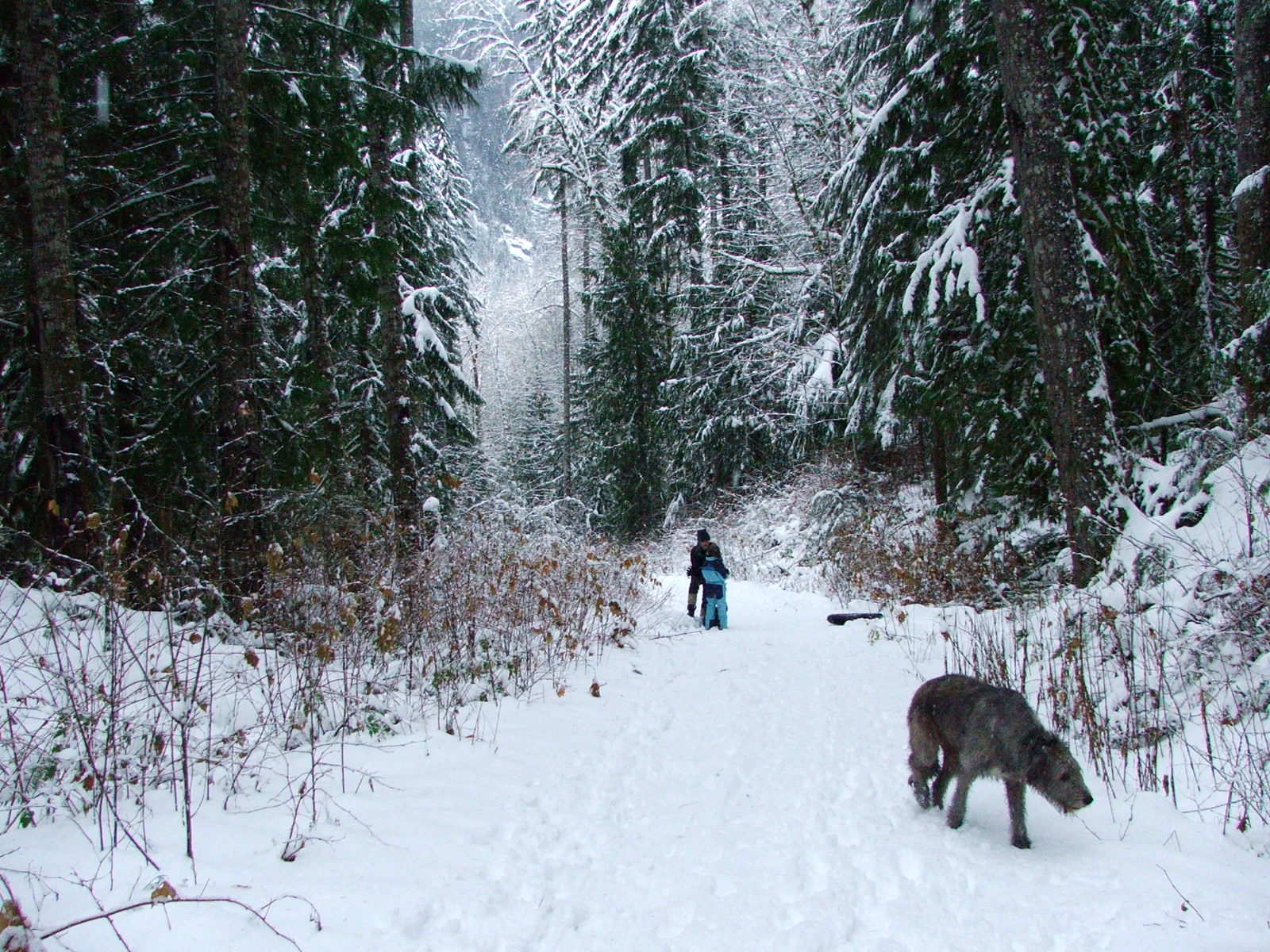
We have the coolest sledding spot around. We drag sleds partway up a gated logging road, to a place where it’s steep enough for speed, has some corners, and shallow ditches for crashing into brush. There’s no traffic and few people because most don’t want to go to the effort of hauling everything way up there.

But the trade-off is a spot in winter woods where you can shout and slush through snow and fly fast under the trees.

One winter my friend and I were up there with a bunch of kids. Her husband waited at the bottom of the road. He had a fire going, with hot dogs and snacks. When it started getting dark and all the hot chocolate was gone, most of the kids quit sledding and headed down to the fire.

My friend and I weren’t ready to go yet, and neither were her daughter and my son. We put the two on our sleds and hauled them up the logging road, hiking into the winter twilight. It was that deep quiet that falls under trees in snow. Just the sounds of the sleds, our breathing (some huffing and puffing as the road gets steep), cracking of branches off in the woods, and the sounds of sluggish cold water in the stream.

We hiked high in the woods until it was dark and then my friend and I sat on the sleds with the two kids, and sledded our way back out to the fire and laughter, taking our time. We wanted to prolong the magic of the winter forest as long as possible.

Those moments when we were pulling the kids behind us were beautiful. The still woods, the sense of life hibernating, the deepness of winter, and that shadowy light under the trees when it’s near dark, all made me feel as if I’d stepped into sanctuary.

I treasure that memory.

I tried to post a video of sledding in that area, but couldn’t get it to work. Instead I’ll just pop in a photo.

For a good winter book, try The Snow Child by Eowyn Ivey.

Kids and the wolfhound

Kids and the wolfhound

Degree of Separation

I belong to a mystery book group on the Shelfari website. We just finished a discussion on Val McDermid’s book, The Mermaid’s Singing. One of the discussion points was around the difficulty of reading scenes of torture. My response has continued to nag me, so I’m going to broaden the response, here.

I read the book, and also watched the television show based on it. For the discussion group, I said that reading a torture scene troubled me a lot more than watching it on TV. I felt it was because watching something allows a greater degree of separation than reading.

Reading allows no separation between the reader and the story. We’re up close, physically and mentally. Our imagination allows us to be more deeply involved because we picture everything the way we need or want it to look. We have the tactile experience of holding that story in our hands, either in print or within an e-reader. The outside world is held at bay because we are within our own mind, even though we are reading the words of another.

With television, we have the physical separation, nothing to touch but the remote, and distance between the couch and the box. We are also not so intimately involved because there are others around us in the form of the actors. We are observing only, not engaged because our imagination isn’t needed. The scene, setting, and characters are chosen for us. And the emotions conjured by the scene are only those emotions the actor shares with us. In contrast to the emotions a character is given by a writer, that I, as a reader, can project on to and picture the way I want that emotion to look.

So, watching a torture scene in a thriller on TV may be disturbing, but reading it, for me anyway, was so unsettling I considered not finishing the book. I love Val McDermid’s writing, and a testament to her strong skill is her ability to raise very strong reactions and emotions in me. This is one example of her skill. She pulls me into her story and eliminates all barriers between me and the characters.

Television just isn’t the same.