The story goes that she drove by a house with a chimney fire. She stopped to tell the people and found a single dad raising a teenage daughter. This was in the late 1940s. She ended up staying as a housekeeper for grandpa and raised mom. There are underlying whispers of other stories. That there might have been more going on between Aunty and grandpa. That they might have married except for his heavy drinking. The nights when he would be drunk, yelling at mom and Aunty and throwing slices of bread across the table at them.
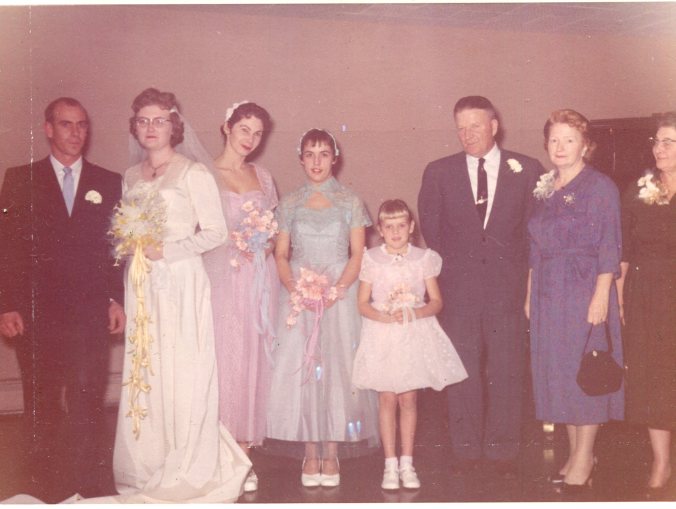
Mom’s wedding. Grandpa in the suit, Aunty on far right.
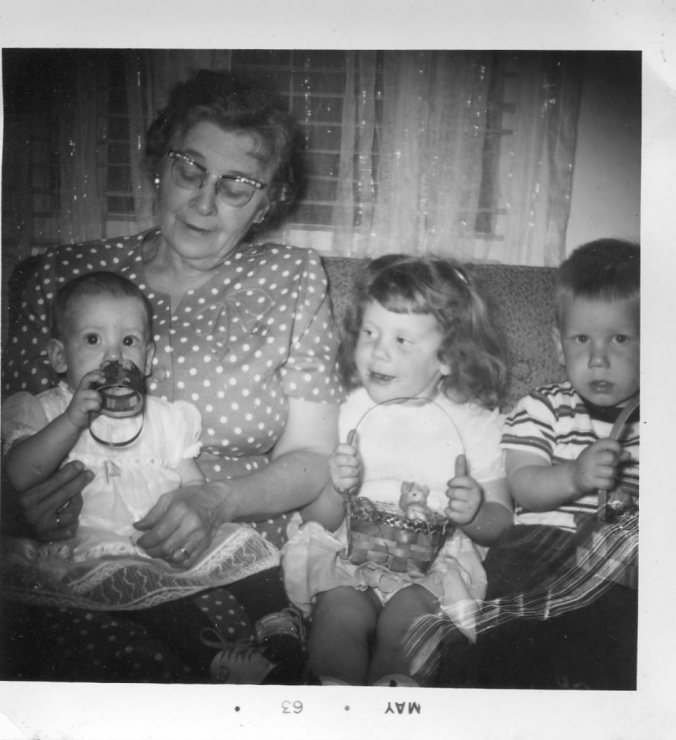
She said she was Canadian and was very proper. She never left the house without coat, hat, skirt, gloves, purse, all matching. When we were born she told mom to have us call her ‘Aunty’ because ‘those children have enough grandmas’. She was a nanny to well-off Seattle doctors and lawyers but never had children of her own, even though she was married four times. It was so sad that, as she told us, all four died of pneumonia. As I got older it dawned on me to wonder about that. I wore the wedding rings from her marriage to Ben, who, she said, was her favorite. And hmmm…lived the longest.
She was small but with these awe-inspiring huge breasts. And her arms had long flaps of skin that she would let me flip back and forth while sitting on her lap.
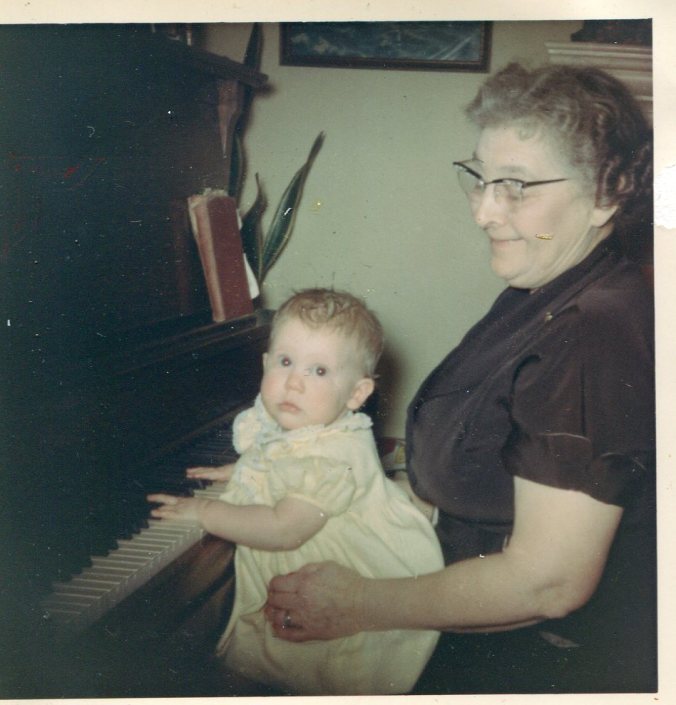
Cooking for her was a handful of this and a pinch of that. Amazing platters of fried chicken and, oddly, platters of fried smelt as a side dish. She would take little Nilla wafers and painstakingly frost each one, then add sprinkles, for us. Stewed tomatoes and dry toast for breakfast. A glass of carrot juice with Metamucil stirred in. Hard ribbon candy stuck in solid lumps in little crystal bowls. Glass bowls with layers of different colored Jello flavors, with fruit in between. Collections of salt and pepper shakers.
Her windowsills were full of jars of plant cuttings that never got planted. Her clothesline had mason jars of rose cuttings hanging from it. She swore that was how to root roses, that the motion of the wind moving the jars of water made the cuttings root. She always had beautiful roses.

And of course she was feisty. One time young men moved in across the street and started harassing her. They would park in her driveway and block her in. Stand outside her bedroom window at night and smoke, so she could smell it and know they were there. She started sleeping with a bowling pin next to her bed.
And then she recognized one. The son of a doctor she’d babysat. She stomped across the street and lit into him in front of all his friends. Phrases like ‘I wiped your bottom’ and ‘I taught you better’ and ‘you should be ashamed’. Mom was horrified, afraid there would be retaliation. But they never bothered Aunty again.
There was the day when we were in her boat of a car, huge with tail fins that always smelled musty. She sat on a pile of pillows with another pile behind her, to see over the steering wheel. There was a group of teenagers in the middle of the road with their bikes. She stopped and waited. Honked. They laughed and didn’t move. She honked again. Nothing. She gassed it and drove right through the middle of them, right over their abandoned bikes as they scattered.
Each summer she took one of us on a trip. We were special, singled out, and didn’t have to share her with siblings for one whole week. We’d get to ride a bus and go someplace we’d never been. The youngest spent the whole week homesick but still wanted to go. We all wanted that adventure with Aunty.

The upstairs of her house was exciting to sleep in because it was scary. A narrow old staircase that creaked loudly. A big bed three of us shared. A sloping roof with narrow windows at each end. A bookshelf crammed full of moldy smelling Reader’s Digest magazines. And, across from the foot of the bed, right were the roof angled down, were three small doors. If you were brave enough to kneel and crack one open, a blast of cold, stale air would come out. You’d see nothing but pitch black. You were left with only your imagination to show what might live behind those little doors.
I had a very vivid imagination.

and freckles
She told the same stories over and over until we became bored and tuned them out. I wish now I could remember them. The one that sticks with me was about a black horse (in my memories, a stallion). She thought she could ride him and ended up galloping down Main Street out of control. She survived but got in trouble. The story was supposed to be a moral for us to listen to our parents.
I like that image though, of Aunty when she was Ethel Ellen, before she was prim and proper with the sagging breasts and sagging flaps of skin of old age. Before she took in a lonely teenage girl.
Back when she was young and free and riding a wild stallion.



 Lisa Stowe - The Story River Blog