Relationships Between Characters and Readers

A recent course assignment dealt with the relationship between characters and readers. The instructor said a character doesn’t have to be the reader’s friend, or even be someone the reader likes. The premise was that women fear writing characters that aren’t nice. I’m sure there are women writers like that; it’s a topic for another post.

The instructor’s opening statement about being friends with the reader, though, led to a good discussion with my friend, author Susan Schreyer.

If I don’t like the protagonist in a book I rarely finish. But what does it mean to ‘like’ the character? Is that character seen as a friend? Or is the character someone you relate to? And how important is that to a story?

In The Heart-Shaped Box by Joe Hill, the protagonist is not someone I liked at all. But I kept reading. Why? Well, because he got a ghost off eBay. Seriously, because the author did an excellent job of slipping in tidbits of character that made me hope the guy would be redeemed. The guy was a ‘real’ character with lots of flaws. Believable in other words.

Susan feels there’s a blurring of lines between liking a character and being able to relate to one. She thinks being able to relate is more important, and also easier to achieve in writing. The more traits a character has that are shared with a reader, the more the reader can relate. We also talked about the balance of a character having traits one can relate to with traits one can’t. That balance allows the reader’s opinion to be manipulated.

For example, in Susan’s current work in progress, the next installment in her Thea Campbell series, Thea is being manipulated by one of the characters. If Susan can swing the reader between liking and not liking this character, then the reader will end up feeling just as manipulated by the character as the protagonist is. That draws the reader into the story on a deeper, more emotional level.

Which is exactly why I continued reading The Heart-Shaped Box. I swung between disliking the guy to seeing a glimmer of hope. The author manipulated me, the reader, into sticking with the story by using that mix of likable and non-likeable character traits.

‘Being liked, or being a friend, to the reader feels less important than choosing character traits that propel the character through the story and sets them up with reasons to make the choices they make.’ – Susan

A writer’s responsibility is to create a compelling story. Which, of course, is done through compelling, believable characters. But do you set out to create a character that’s going to be liked? No. If a writer is more concerned about making sure the reader likes a character, then the writer isn’t being true to the story. Or to the character.

Whether a reader sticks with the story, in the end, will be more about how their emotions are manipulated by the story and the characters, than if they feel that character is a friend. And even more so by character traits the reader can relate to, even if there are traits they don’t like.

It all boils down to writing multi-layered, believable characters.


Bubble Outlines

Susan Schreyer and I talked a while back about outlining, a subject that actually comes up a lot. She outlines; I don’t. So I said. But Susan suggested that I do outline and challenged me to think about what my outlining process is.

And guess what? She’s right. I’ve blogged about that on this site but it’s worth bringing up again because I also recently read an article by Ruth Harris on the same thing.

So if I don’t outline, how do I outline? Well, as I’ve said before, I daydream a story. I’ll go for walks in the woods and let the subconscious take over. In daydreaming the story I watch it in my imagination similar to watching a movie.

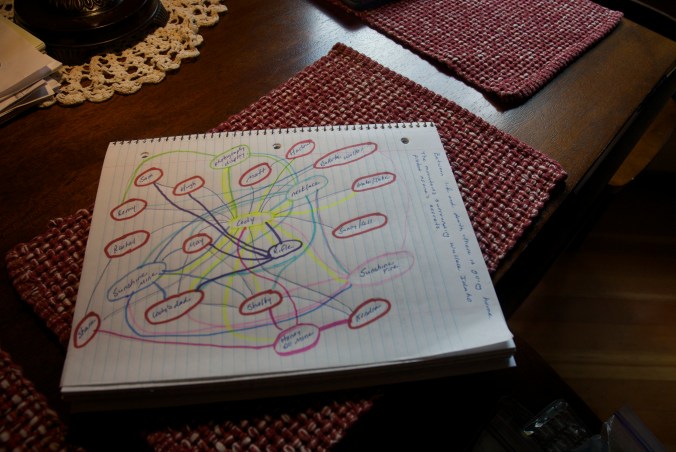
Then there’s this. Typically, about half way in to the work in progress, I draw some bubbles. It’s about the point in writing that I start feeling like I’m losing control of plot threads, or getting a bit confused about subplots.

Here’s what I pause and do:

dsc_0219


Remember, I’m not artistic. I can’t draw. Some of my artist friends would make something prettier. But this works for me.

In the center is the protagonist. Around her are bubbles for each subplot and each character. The subplots get a color. This allows me to quickly see any subplot that doesn’t connect to the protagonist, or to the main plot. Each character also has to tie to the protagonist. In this current drawing, some characters have a color because the character is a subplot, too. This also allows me to quickly see if the character exists for a reason.

For example, in the bubbles above, which you may not be able to see very well, there are two characters, Sunny, and Cell. They’re kind of floating out there by themselves, with only a line to the protagonist. When I drew this out, I realized that they are in one scene specifically to give Cody a moment of respite. They don’t tie into any subplot, or even the main plot.

I can tell from this that I need to find a reason for them to be in this story that’s stronger than me simply enjoying these two characters from past books. If I can’t fit them in somehow then, during the revision stage, that scene of respite will have to be rewritten. Sunny and Cell may just have to wait until the next book.

When I draw out these bubbles at about the mid-point of a work in progress, I end up feeling more in control. Or at least, as much control as my imagination/subconscious will allow. Now, as I continue writing, I will periodically go back to these bubbles to remind myself who needs to be involved in a scene, where a subplot is headed, etc.

So there’s how I outline.


Back to School

A few days ago I heard about a writing course offered by the University of Iowa. The course is called ‘How Writers Write Fiction 2016: Storied Women’. In reading the course information I could tell it was way above my level of writing. I made a comment about that and received a response saying that I shouldn’t worry, even undergraduates took the course.

schooldeskrowwebsternewyork

Back to school (image from wiki commons)

Talk about a plummet down the steep slope of lack of confidence. Immediately the inner critic jumped into action. Normally I name the inner critic ‘mom’ but I think I need to rename it ‘Super Antagonist’ as it’s my single biggest source of conflict.

I heard these things. Well, there you go; you’re not even an undergraduate. You’re not good enough. You’ll fail. You’ll be seen publicly as not being able to write. You call yourself a writer but you only took one creative writing college course and hated it. 

In my defense we were told to write about a peanut and then failed if it was humorous rather than existential. An existential peanut. Think about that a moment. My peanut was not existential.

On and on and on. Same old familiar tune.

So what did I do? I got smart. I told my husband.

Why is that smart? Because I have learned over the years that he is a master at talking me into things. This is what he said. That he knew me and once I started the course I’d love it. That I was better than I believed. That he knew my author friend Susan Schreyer would be my support and back up during the course. And so on. The kind of pep talk I needed.

I signed up.

I then emailed Susan to tell her my husband talked me into registering because she’d be my support system. And how did she respond?

By telling me that my husband had now manipulated her into signing up. I thought she’d already registered but it turns out she’d been hesitant, too.

He got us both. Two for one pep talk.

And now my Super Antagonist is whispering ‘you can always quit if you have to’. But hey, I’m registered. And so is Susan. So we’re good. Right?

steep_slopes_an_caisteal_-_geograph-org-uk_-_776774

Those steep, slippery slopes. This is An Caisteal in Britain, from wiki commons