Well – Loved Books

A friend loaned me a book today. Rosemary Gladstar’s Family Herbal, and between the pages was one perfect pressed leaf. Once home I flipped through the book, not looking for specific herbs, but looking for mementos of a well-loved book. Or a well-used book. Which is probably the same thing. I found leaves I recognized and others I didn’t.

Arts birthday & climbing 063

Big Leaf Maple, Vine Maple, some Alder

Many years ago when I started baking bread, one of my sisters gave me the Tassajara Bread book. I opened it to old bits of flour, squished and petrified bits of dough, and scribbled notes throughout. She knew that this would mean more to me than a brand new version. The recipes stood for years of her not just following them, but learning, tweaking, and experimenting. I still have the book and still use it.

I found a book at the second hand store that I haven’t read yet and really don’t have any desire to. I bought it because, throughout the pages, there are little tart comments in shaky, elderly lady handwriting. Rather like one of my books that is full of my grandmother’s commentary in the margins.
DSCF2847

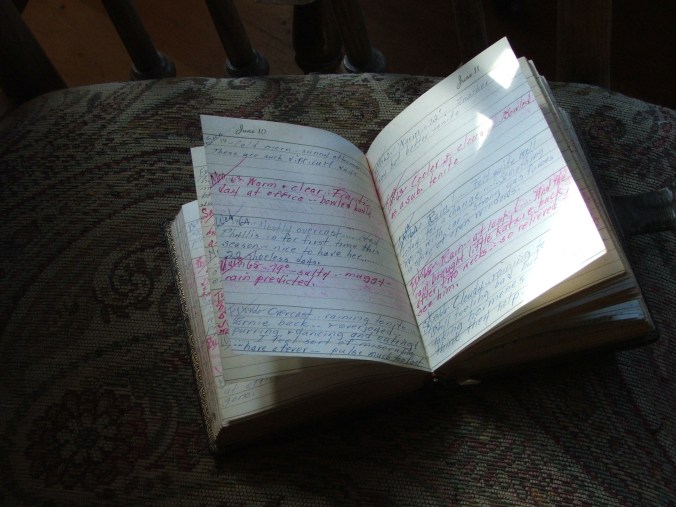
An elderly friend’s diary that I inherited.

Do you write in your books? Do you leave mementos? Do you dog-ear a page that has words that mean something special? Do you make the book your own?

I don’t do that with all the many, many books of fiction in the house. But I write in books on writing and other non-fiction books. I mark pages I learn from, pages that grab my heart and pages that sing to me with beautiful language. Oddly, Barry Lopez’s book, Arctic Dreams is heavily highlighted, underlined, starred, and dog-eared. I say odd, because I did not expect a non-fiction book on the Arctic to read like poetry.

But it’s more than just signs that someone was moved by something on that page. The pressed leaves, the bits of flour, the fading penciled old-lady words are like ties that bind me to the readers. There’s a connection with that old lady, even though I will never know who she was. The herbal with its pressed leaves shows me another wonderful personality trait of my friend. It’s like walking an old path with companions, touching what has been, sharing the words.

I’m sure I’m going to enjoy the herbal and learn from it. But what warms my heart and makes me love the book before I even start reading, are the leaves that someone took the time to pick up, dry, press, and lay between pages, with the words, waiting.

Writing Fears

Jessica Page Morrell is one of my favorite authors of books on writing. Three of her books that I return to often are Between the Lines, Writing Out the Storm, and Bullies, Bastards, and Bitches.

In Writing Out the Storm, there is a chapter called Beyond Fear where she lists out common negative thoughts of writers and notes that the root cause of all of them is fear. It’s a great chapter. Are the negative thoughts I carry around relating to writing truly from fear? I’m not sure.

To answer that question I have to be very honest here, in a public forum. That’s fear in itself. But here goes.

I’m an awful writer. I’ll never be a good writer. People compliment my writing just to be kind. I’m wasting my time. These authors are so much better than me. I can’t get what I feel onto paper. My characters are all alike. My characters are cardboard. My words are cliches and corny. Why bother? Why not just give up and quit trying to write? I’m too old. I’ve found some typos in my books – proof I’m awful. If I was any good, wouldn’t I be selling books?

Maybe I need to stop. I’m realizing I could go on and on in the same vein and it’s getting depressing.

Jessica is correct that it all comes from fear. It also all comes from lack of confidence and a willingness to believe that awful inner critic.

If any fellow writer told me those things, I’d list many reasons they were wrong. For example, the bit about basing how good you are as a writer on how many books you sell on Amazon – well, go look at the millions of books for sale. Trying to become visible in that deep, dark ocean is practically impossible. It has nothing to do with talent. But do I believe that when it is applied to me? Of course not.

So why do we let those writing fears cling to us when we try to wipe them off the shoulders of fellow writers? Why do we hang on to them almost as a form of self-torture? These fears don’t necessarily push me to try harder. If I dwell on the fears it’s the opposite effect – they become a weight bearing me down that I can’t rise up from.

What does, then, push me to try harder? What allows me to bunch up my shoulders and turn my back on those fears?

Other writers, for one thing. Being able to talk about writing – not necessarily the fears, but the craft, is always uplifting. Whenever I’m around other writers I leave full of excitement that I can go forward, jump in, try again, and get better.

It’s when I’m alone that the negativity creeps in. Or, as Jessica Page Morrell says, the fear.

Writing is a solitary endeavor. The creating part of it. But entering that solitary environment of writing, I believe, requires a healthy dose of life. To be able to bury those fears during the solitary moments of creating, writers need to first pull them out into light and air and community. I don’t mean that when I’m with other writers all I want to talk about is these negative things. Those fears are never expressed so openly.

What I mean is that being with other writers, talking about the challenges of a current work in progress, brainstorming plot ideas, editing each other’s work – in other words, the actual work of writing – that’s what buries fears for me.

At least for a short while.

To quote Jessica, ‘Fear is merely a bad habit’.

We all know how hard bad habits are to break. But they can be broken. A first step for me involves figuring out how to apply the words I give others to myself. And letting go of fear.

To Rewrite

I’m struggling with rewriting a story.

Editing I can do. Revising I can do (after all, revising is a lot like editing, right?)

But rewriting is a whole different game.

I’ve spent a couple months with some health issues which meant I didn’t get any work done on the new story. I know it’s going to be easy to pick that thread up again but right now the energy I have for writing isn’t streaming toward creating. So I pulled out an old story I wrote almost twenty years ago.

I love that story but there are serious structural issues with it. Not enough characters, so that the antagonist is glaringly obvious. Not enough conflict. And not enough subplots. Well, let’s be honest. There’s basically one subplot and that’s it. Which, as any writer of fiction knows, won’t support a novel-length story.

demolition 09 001

Symbolic of structural issues, wouldn’t you agree?

So I decided to use this time of healing to rewrite that story. And I’ve discovered it’s actually hard. I’ve been trying to come up with something to compare the process to. And the closest I can get is baking.

Have you ever baked a cake, finished the batter, poured it into the pan, and then realized that you forgot something vital, like the eggs? So you dump it back into the mixing bowl and try to add what you forgot, but it just doesn’t mix up quite the same. And doesn’t bake quite right.

Rewriting is like trying to add those darn eggs after the cake is baked.

Arts birthday & climbing 003

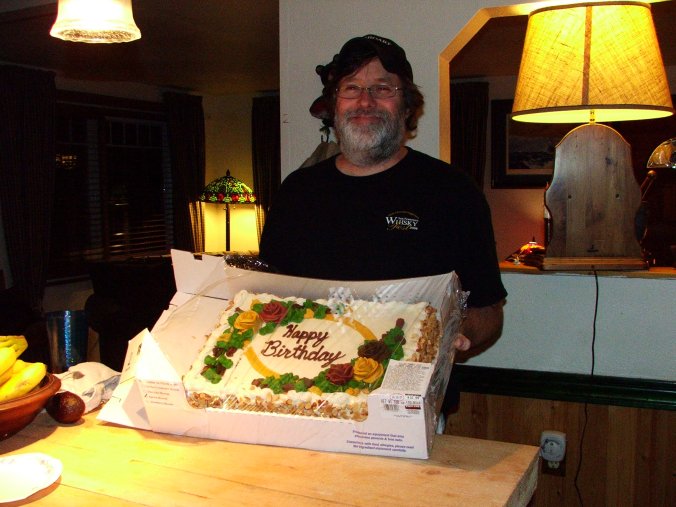
Guess this is the only photo I have of a cake. Obviously not one I baked!

So much energy is invested in creating and editing and polishing. And then there’s the process of letting go so the story can go out into the world. Rewriting is also like trying to pick up that energy after it’s long dissipated. Trying to find the mood that story was written in.

It’s challenging to find spots to slip in new characters or new dialog. That seems much harder than adding in bits of internalizations. Then there’s trying to figure out conflicts and subplots for secondary characters that I’ve now realized I never knew.

There’s too much in the story that’s good to just toss and start all over. I’m not even sure I could start over and end up with the same spirit that’s in this version. I definitely don’t want to lose this version.

So I’m plugging along – literally – plugging in bits and pieces as I go. I still like this old story. But my writing has changed since back then.

The process of rewriting is more challenging than I expected. Luckily I like a challenge when it comes to writing.

We’ll see what happens.