The Big ‘Why’?

Typically I have no problems coming up with story ideas. And typically the question ‘what if’ sends me gleefully off to the writing space.

With book three waiting only on cover art, two manuscripts that need heavy revising, a stand-alone story just starting the first draft process, and a current editing job, I am busy with words. Yet I need to start book four and this time I only have a glimmer of an idea, which is a first for me. Another first is that I’ve tried out some ideas, floating them to my editor and friend, author Susan Schreyer, who has very kindly given me feedback. Most aren’t going to work. I’m not surprised because even as I was telling her my ideas I felt no bubble of excitement. You know, that urge to rush gleefully to your writing space. Instead I shuffle around and look for dirty laundry, dirty dishes, or as an extreme last resort, dust bunnies.

You know how it is when you try too hard to pin an idea down, and it squirts out from under the pin and jets away? That’s how this current idea is acting. And instead of the ‘what if’ question that has always, in the past, spurred me on, I’m finding the following word taking up a lot of space in the writing brain.

Why?

I’m trying to figure out why someone would deface or vandalize a memorial to a group of miners who died in a mine fire. I’m looking for a deeply personal reason that will tie past to present, and goes beyond the simple act of protesting what either the memorial stands for or the mining business.

If I can figure out who would do that act, I’ll have my reason. But then I pause and think, well, if I have the reason then I’ll have the character. I’m currently stuck in the loop – if I find out this then I’ll have that, but I need that to find out this.

Probably what needs to happen is that I stop talking, stop worrying, work on the other writing projects, and let this idea ‘daydream’ its way through my subconscious. A walk in the woods, where I can just let thoughts go and let that inner writer wander as well, will also help.

In the meantime though, I’m wondering, why?

The following photo, from wikicommons, is of the Sunshine Memorial, near Kellogg, Idaho. The miner is surrounded by ninety-one miniature headstones, each with the name of a miner who died in the mining disaster of 1972. I was down in the Sunshine mine just a few years after this fire and have a healthy respect for anyone who can do that job.
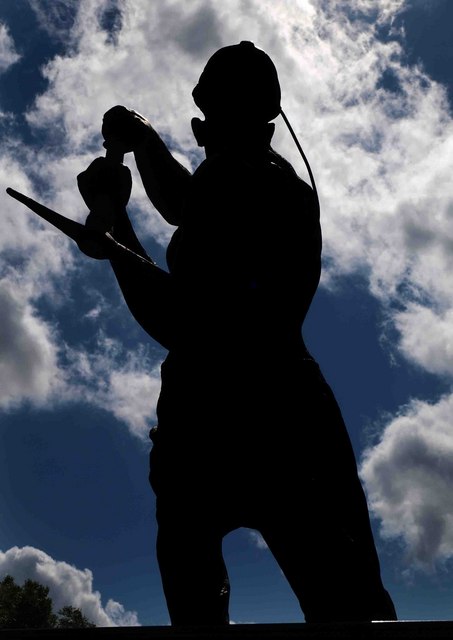
A Sunshine miner

A Sunshine miner

The Theme of Blurbs

I’m struggling to write a cover blurb. You know, those little bits on the back of a book that make you want to read it. I swear the dang things are harder to write than the whole novel. They have to do so much with so few words.

One of the things they must at least allude to is the theme. Or maybe it’s the premise. I get them confused. So yesterday I went back to scraps of paper all writers have. Where you hear something, read something, think of something…and jot it down with no idea what you’ll do with it later. I am really bad at not also jotting down the source. So unfortunately I can’t attribute the following quotes to the very wise person who wrote them. I do know they came from a book on writing.

‘Theme is the central concern of the story, gives it focus, and is the invisible thread linking elements of the story.’

‘Premise is linked specifically to the conclusion, the truth proven by the story’s events and ending, often reflecting the protagonist’s journey of understanding and can be summed up in a simple statement – one character must be changed by what the premise proves. The premise and ending must always reinforce each other.’

You’ll notice that the explanation of ‘premise’ has a lot more words than the explanation of ‘theme’. I believe that’s because a writer is more aware of the premise while writing. It’s a tool used to tie all aspects together. The theme on the other hand, typically doesn’t show up until the edit process. Or for some, like me, four books into a series. When the thought bulb suddenly lights up and you realize that your stories all see to have the same underlying meaning. Plus, premise is usually explained in at least one complete sentence, where theme is typically explained in one or two words. A phrase maybe, if you’re lucky.

If I have an idea of the theme, and know the premise, those two tools give me the words that I know must be included somehow in the cover blurb.

The following statements and questions also help craft the blurb.

‘Is the protagonist ever in danger? Failure to solve the problem must seem to promise disaster.’ If you know the danger, the solution, and the disaster, you’ve pretty much got your key words for the blurb.

‘The inciting incident creates the first goal, upsets the balance, and is needed in act one.’ If you go back to the opening, find the inciting incident that starts the whole story rolling, then most of the time that also gives you the opening of the blurb.

So with all those tools and wonderful suggestions at hand, is my cover blurb done, perfect, and ready to grab readers?

Not even close.

But at least I know what one should look like if I ever finish one.

Here’s the view from the back door this morning. Much nicer to spend time gazing upon, than looking at empty pages with the nagging thought ‘finish that blurb!’.

The slope of Taylor and the backside of Frozen Mountain.

The slope of Taylor and the backside of Frozen Mountain.

Old Books

Yesterday while weeding out books for the thrift store, I came across two old books.

The first was The Every Day Cook Book and Encyclopedia of Practical Recipes, written in 1892 by Miss E. Neil. It’s a quirky little book because the printer, Regan Printing House, in Chicago, put the cover on upside down. And inside the cover is a sticker for Wrigley’s Mineral Scouring Soap, sold by grocers everywhere at five cents a bar.

Why do I keep it? Some day when the mega-earthquake hits, I might need a recipe for cooking cow brains. Yes, there is one for that. Seriously though, Miss E. Neil fancied herself a scientist of ‘cookery’. I love the tone of her voice as she talks about the cooking water for potatoes being poisonous. She gives very thoughtful advice on how the mistress of the house should keep a passbook where she writes down her shopping list and the grocer writes in the prices so she can make sure the maid isn’t cheating her.

And then there’s this from her introduction where she is giving tips on maintaining the wood stove fire: ‘Food of every description is wholesome and digestible in proportion as it approaches nearer to the state of complete digestion, or, in other words, to that state termed chyme, whence the chile or milky juice that afterwards forms blood is absorbed, and conveyed to the heart. Now nothing is further from this state than raw meat and raw vegetables. Fire is therefore necessary to soften them, and thereby begin that elaboration which is consummated in the stomach.’

Think about all the women who used this cookbook, worrying about chyme.

The book is a snapshot through the window of time.

Miss E. Neil's tome.

Miss E. Neil’s tome.

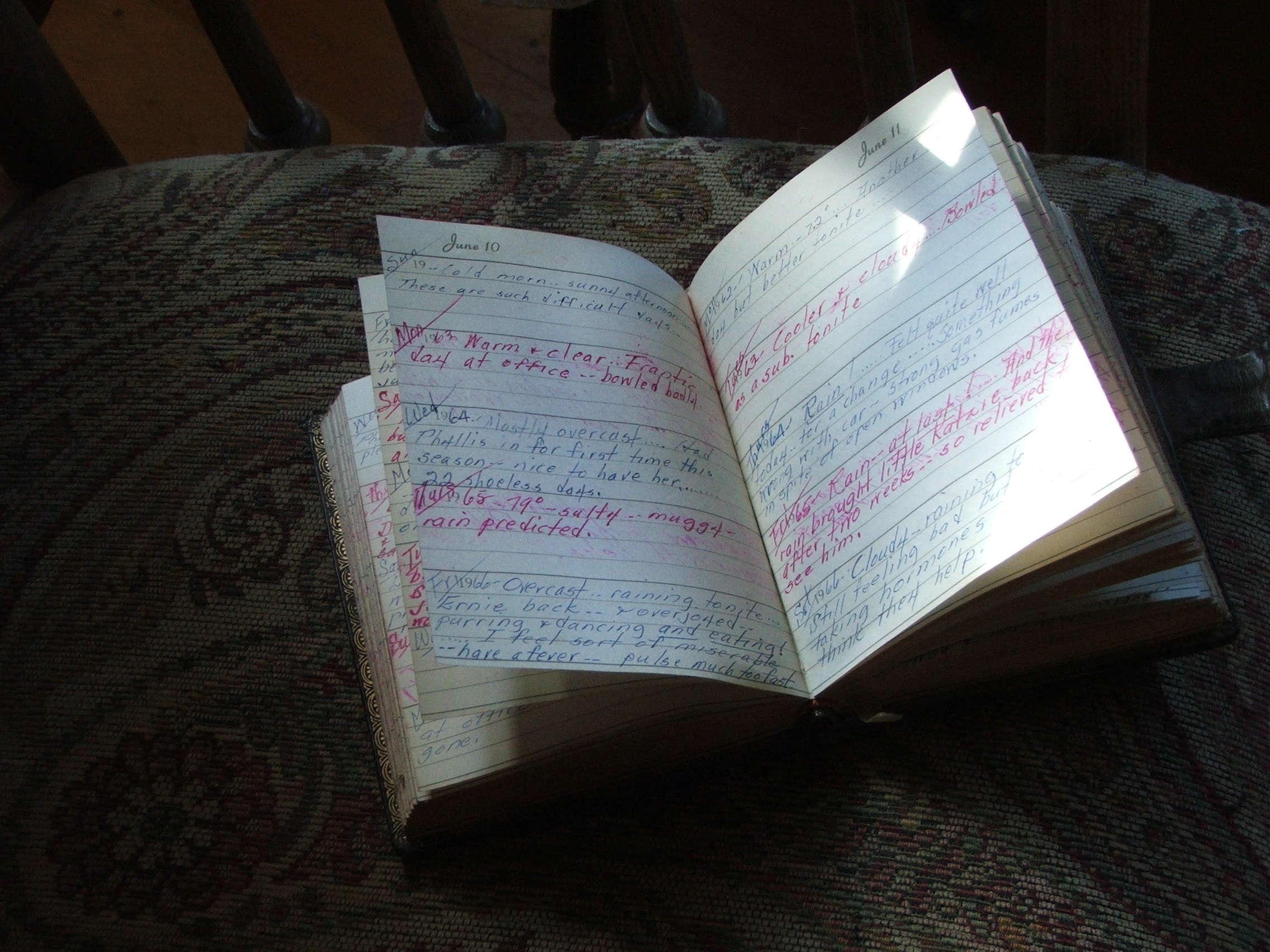
The second book is a diary of an old friend of my mother’s, Claire. I’ve posted before about her as she was a very unique woman who made a huge impression on me as a child. I planned to be just like her – a writer and hermit in the woods.

I admit to thinking diaries have to be these esoteric tomes where high lofty thoughts are left for those who follow. Probably why I struggle to write in one. But in reading Claire’s yesterday I realize that, like the cook book, diaries are also snapshots in time.

Claire's handwriting

Claire’s handwriting

Claire wrote about how many eggs she collected that day. What the weather was. What her weight was, her bowling score. How many days late or early her ‘shoes’ came. I used to wonder why she ordered so many shoes when I only saw her in men’s logging boots. I eventually realized ‘shoes’ were her euphemism for her monthly period.

She wrote about her daily thoughts, but in a five-year diary, which meant she had space for only a couple of sentences per day. Some days she simply said ‘A lonely day’.

And then I came across this, on Monday, September 9th, 1963. ‘Hot..89..Whew…all awash! Frank Nay died Saturday. Funeral Wed. 11th … a very sad thing…my arthritic bones all swollen & stiff.’

Why does that stand out to me with such gentle sorrow? I didn’t know until I read this that the day my father died was a Saturday of unseasonably hot weather. I think now of my mother sitting at the hospital with three children under age four, on a hot September day, waiting.

The details of daily life, jotted in a few sentences, can have such impact years down the road, beyond what the diary writer can probably ever imagine.