Archaeology Terms

Last week a person I work with told me a story. He said things like ‘I stepped up when no one else would’, ‘the bullying had to end’, ‘in the nick of time’, ‘down to the wire’, ‘I got in his face’, ‘they picked the wrong guy’, and so forth.

Last week I signed up for an online course in archaeology through Coursera. One of the first lessons was on terminology.

What does that have to do with the opening paragraph? The word ‘context’. In archaeology, it refers to where something is found. Obviously that can tell you a lot more than the object alone.

So the context of the opening paragraph? He’s an accountant type and was talking about a disagreement with an auditor. The context of the story dramatically changed my response.

I’m enjoying the online course a great deal, but I keep getting distracted by how it ties in with writing. Think about the context of a story. Dialog, as with the accountant, changes dramatically depending on context. So does physical movement, internalizations, emotional reactions…well, pretty much everything in a story. And while this seems very obvious, at the same time I have to admit to rarely thinking about it.

It’s so obvious I’m not sure I need to think about it. I mean, I know if a character says ‘Who said you could come in here?’ the line will have a completely different meaning if the character says it standing in the kitchen, to another person, or standing in the kitchen, alone, speaking to the fridge.

Where I need to think more, and where I regularly fall short in writing, is context related to scene setting. If I have a character sit at a table, it’s not enough to say a ‘wood table’ or a ‘littered table’. Is the character sobbing? Then, context beefs that action up. Is there a box of tissues sitting conveniently next to her, or does she hold a crumpled corner of tablecloth? And that’s where I need to work more. The tiny material things that add to the context, bring depth to the character or scene, and that, on their own, might seem trivial but are, in actuality, vital to making writing original and believable. I tend to ignore the little things. At least until the editors point out my characters haven’t put clothes on for 200 pages.

So, look around you and think about context. What is near? What does the context you are in, at this moment, say about you? What, in your proximity, do you value? And for you writers, do you remember the value of context, or do you, like me, forget?

Look at the photo below. Would the rocking chair have the same significance if found alone, as it does found next to the spinning wheel? The context, the proximity, begs a story. Who sits there? Where did they go? What happened to interrupt? The chair by itself, I think, would just look lonely.

Actually, I just wanted to post a photo of the free flooring I was given, that got installed in the writing space of the cabin…
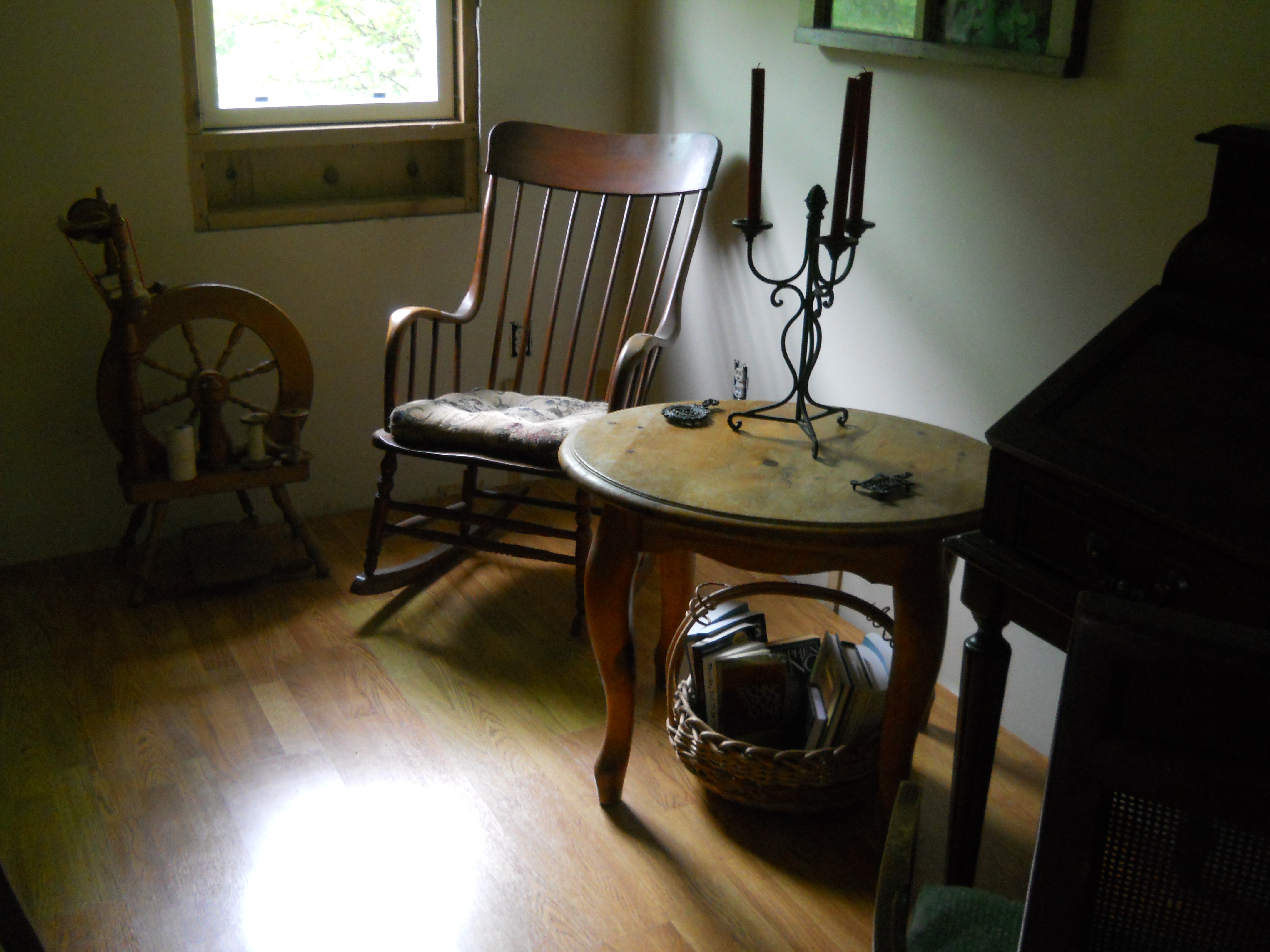
Writing space continues to improve.

Writing space continues to improve.

Chapter Titles

The last post was rather intense so I thought something lighter was in order.

A few  years ago I read a book, or rather, started to, where each chapter had a title. I’m sure you’ve seen these. ‘In Which Our Intrepid Hero Finds His Long Lost Daughter’. At first I was irritated. By chapter 3 I was annoyed. By chapter 4 I gave up. Instead of reading the book I just read the chapter titles and got the story.

Some people do this writing device well. I’ve seen some chapter titles that were excellent teasers. One or two words that raised questions so that you had to read the chapter to get the answers. I’ve seen some books where the chapter titles didn’t actually have anything to do with the chapter, but instead offered little ‘aside’ clues to the story or to a particular character.

Then there are the chapter titles that are quotes from poems, songs, movies, or other books. I like those because they are usually quotes I haven’t heard before and occasionally lead me into reading a new book. But when the pace is whipping along in the book and I’m anxious to find out what happens next, they can slow me down. Mainly because I have a hard time skipping them and going back later. So I’ll be hanging from the cliff of the previous chapter and have to hang on a few seconds longer in order to read the quote.

Finally, there are other authors that simply number the chapter. No messing around, just number and move on. That process reminds me of dialog tags. You know how ‘he said’ disappears into the dialog and doesn’t take the reader out of the story? That’s what chapter numbering does for me. The numbers disappear into the story itself.

Personally I number, rather than name, chapters. The biggest reason? It’s hard enough to come up with one title, let alone thirty.

What do you think about chapter headings? Do they annoy you as a reader, or do you like them? As a writer, do you use them? I’m curious.

The Touch of a Wild Animal

Warning: this post has nothing to do with writing, and is sad, without a good ending. I’ll understand if you can’t read further. 

Yesterday someone hit a young deer and left her dying and alone on a rainy road in the forest. A friend of mine came along, and instead of driving by, stopped. Seeing how badly the deer was injured, she went for help. She called me since I live within a few hundred yards of where this happened, and then found her husband and his gun, in case that was needed. I agreed to meet them, but instead beat them there. 

The baby and I were alone for a few minutes. It was clear she was dying and I will spare you how I knew. Her beautiful large eyes saw me, her dainty legs tried to run. I spoke to her, trying to keep my very human voice from terrifying her. ‘It’s okay baby, it’s okay to let go, I’m sorry this happened, I’m sorry for your terror, it’s okay to go.’ 

No one should die alone. 

And she didn’t. I saw her death, seconds before my friend arrived. She and I waited in the rain, but there were no more heartbeats, no more breath. My friend bent to touch her side, to make sure. I think it was a touch of hope because we knew the signs. And yet she touched, just in case. A warm, caring hand over a still warm body, a still heart.

Together, we took hold of the baby’s legs and pulled her to the edge of the road, back to the forest she’d come from. Dragging her left her head cocked at an unnatural angle. My friend gently lifted the head to a more natural position. A more comfortable position. We stayed with her a moment longer, then hugged and went to our homes. 

I cried. A lot. And called my oldest sister to ask her to speak to the deer for me. I needed to know that my presence had not terrified the animal more, hastened her death. I needed comfort. As all big sisters do, mine knew exactly what to do and how to help dry tears.

Both my friend and I can’t lose the sensation of touching the deer. I hope my friend writes a poem about it because she is a beautiful poet and I know her words will be healing. 

When I came home I could smell the deer on my hands. The musk, the wild, the fear. I washed immediately and now wish I’d held that remaining scent of life a little longer. I can still feel the roughness of her hair against my fingers. And the weight of her, so slight, as we pulled her off the road. 

I have never touched a wild animal. I’ve been close to them, to bears and cougars in particular. But not to touch. It’s not the same thing as a petting zoo, this touching one that is truly wild, in its own home. It’s so wrong that it happened this way. 

I understand accidents happen, that this driver came around a corner on a narrow forested road, probably going too fast, and didn’t have time to stop. But the driver made the choice to keep going, to leave a living being to face death alone. Yes it would have been scary and I get that the person may not have been able to deal with it. But they left it to others to deal with it, to carry that touch, that smell, those dark eyes, forever. So for that, I have one word for the driver.

Karma.