Passion or Knowledge?

There’s a wonderful quote over on the sidebar about writing what your passion is. I think every writer out there has heard the phrase, ‘write what you know’. How often are we told to write what our passion is? And are they the same? I wanted to write a western several years ago. The idea still sounds good and that western is still floating around inside. But when I tried to write the story, it kept dying. At the time I thought it was because I wasn’t writing what I knew. I’d never been on a wagon train. Research didn’t help.

The stories that work for me are set in the mountains. I figure that’s because it’s where I live and what I know. But it’s much more than that. I am drawn to mountains and whitewater and trees. Well, trees are really a passion. I live in the forest and yet plant more trees.

Earlier there was a discussion on voice and rhythm, and this kind of follows along the same line. Do I write stories set in the mountains because I know them, or because they are my passion, or because passion and knowledge are the same thing? I have no idea.

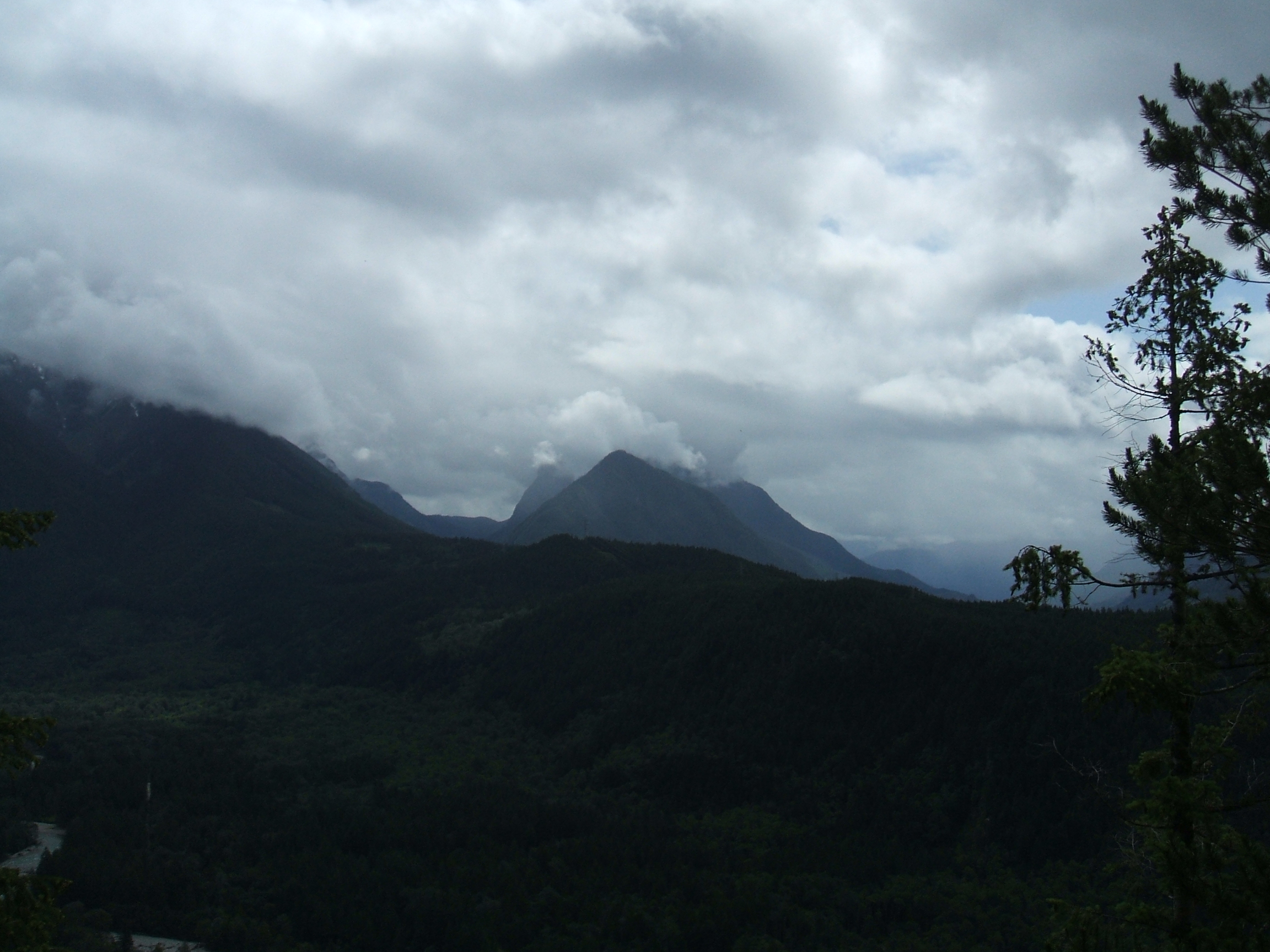
What I do know is that the mountains bring stories to me. They are mysterious, full of the unknown, of challenge, of scary things and uplifting things. When mountain tops are shrouded in sinking, rain-heavy clouds it’s easy to imagine Bigfoot up there. When you are alone in the woods and the light slants through the forest canopy just so, your heart soars. When you are alone in those same woods and something big and black moves through very close, grunting and foraging, your heart stops. The place is fertile ground for stories to sink roots and grow. When I have tried to write stories set elsewhere, they seem flat to me, missing that magic.

I’ve been to the high mesas and badlands of northeastern Montana, the rocky Oregon coast, northern Scotland, and Dublin, Ireland. All could be locations for stories some day, and I have drafts set in some of those places. But right now, what pulls words out of me is the temperate, lush rain forest of mountains. And the stories I write that are set there feel more alive, more compelling, to me.

Yes, the knowledge of place, characters, plot, etc. is important. But what is knowledge without heart? Like voice within rhythm, a story must have passion within knowledge. I know this must seem obvious to writers out there, but sometimes we need to restate the obvious in order to resurrect or honor that passion.


Occasional Story 2

When I first moved to the woods, I lived in a rustic cabin with no running water or electricity. It was summer and beautiful. I would eat breakfast on the old wood beams of a dilapidated deck, basking in sunshine, wind, scents of forest, sounds of the creek. I carried water from the creek, and learned about wildlife. One night I roamed with a flashlight trying to find the woman I’d heard screaming, only to learn later that cougars sound like women screaming…

And then winter came. I learned that it takes a huge amount of snow melting in a stock pan on the wood stove to make an inch of warm water. I learned that what looks like a huge amount of firewood when chopping it, shrinks to a tiny pile when stacked and needed. I learned a whitewater river can freeze if it gets cold enough. Those reading this that are locals will remember that winter of 1988 when the river froze. I quickly figured out that an outhouse in the summer, with the door open to mountain views, is much less romantic when the seat is covered with frost. The infamous words I said to my father still haunt me: “I’m not going to spend $200 on a heater that I’m only going to use a couple months a year!”

Remember leg warmers? An elderly woman made me a pair and she struggled with knitting so they reached from ankle to crotch. Picture that as you read on because this is what I wore, layered, to bed that first winter: heavy wool socks over two other pairs of socks, leg warmers, sweat pants, tee-shirt, flannel nightgown heavy sweater, robe, mittens, scarf, a cat under a big pile of blankets (living hot water bottle) and a dog on my feet, under her own blanket.

I woke up each morning with the blankets frozen to the walls and my breath turned into frost on the blankets. The cat’s water was frozen and the windows had a thick layer of ice on them, on the inside.

I bought a propane heater.

It worked really good, creating a glow that looked warm at the far end of my tiny trailer. It kept the cat’s water from freezing if I put the dish next to it. But it did nothing for the blankets frozen to the wall. I got used to that ripping sound when I got out of bed in the morning.

My parents retired and moved into the tiny cabin that I have been restoring recently, and have posted pictures of on this blog. My father, being a genius, built a water wheel out of pulleys and pipe caps and old single cell batteries, creating electricity. My brother, father, and I, put in 1500 feet of pipe down the ridge to get the flow of water needed to generate the electricity. We still used kerosene lanterns, but the electricity powered a refrigerator (in the summer I had used a small cooler powered by a car battery), and my father’s television. Reception was terrible, and he swore shows came in better when there was snow on the mountain.

And now, many years later, I have come full circle in a way, living there again with my husband and son. I know to stack lots of firewood. I know to have a supply of kerosene. I know to can and preserve and freeze to fill the shelves for winter. I know not to yell at cougars or to look for them with a flashlight alone in the dark. I know when the bears are in my compost. I know the haunting sounds of owls hunting at night, and the sight of stars not dimmed by city light pollution.

But sometimes I miss those days of self-reliance, of knowing how to live without. Well, I don’t miss the frozen blankets.

Here’s a link of last winter, on the road I live on. http://www.youtube.com/watch?v=kB9eN5SCoO0&feature=plcp I’m giving my son a lesson on driving in the snow, and the snow was actually deeper than it looks here. We were driving from our place into town in our big red diesel truck.

Rhythm vs. Voice

Last night I listened to a screenwriter talk to the writer’s group about creating screenplays. While I don’t write those, there were many things she said that translated to writing in general, and we had a fun, lively discussion. At one point she was talking about rhythm and how important that is. I asked her how rhythm was different from voice. She said that voice is within rhythm.

I confess that several minutes of discussion eluded me because I was still stuck on that phrase.

From a writing standpoint, I know two things. Voice is that distinct flavor of words that mark a story as coming from me. My writing voice is hopefully very different from yours. Okay, I get that point. Rhythm I connect to pacing. If I want tension, I know to create short, snappy sentences and to use punctuation to emphasize the tension. I know to read out loud during the editing phase because the ear hears what the eye misses. I know that careful selection of the right word, the right order of words, the right length of sentences and paragraphs, also create rhythm.

But I’m still stuck on that phrase. Voice is in the rhythm. Does that mean my writing voice has a distinct rhythm, too? That’s a possibility. A friend told me once that my stories suck her in slowly and inexorably until she wakes up to realize she’s trapped and can’t put the book down.  That kind of sounds like pacing.

I wonder if rhythm and voice are interchangeable, entwined, two words for the same thing. Or unique tools that I am not learning to differentiate between and use properly.

I wonder if there are definitions of each that I am missing, and because of that, if there is something missing in the writing. I’m not worrying, mind you, not going down that familiar writer’s path of thinking ‘I’m doing something wrong; my writing stinks’. I am curious though. I know I could research this on the internet and probably will at some point. Right now though, I’d rather pause and ponder.

Rhythm, tone, sound, words that sing, that sound right, that flow. Words as the imagery of sound.

Sounds like voice to me.

What do you think? Any words of wisdom?