Stories From The River Review

I just finished Ursula Hegi’s book for the second time. As I posted previously, the first time I read Stories From The River, I wasn’t sure I liked it. It made me uncomfortable. So when I came across it at the thrift store, I decided to reread it.

I’m still unsettled by the book.

Trudi Montag is a zwerg, a dwarf, living in Germany in the 1940s. She doesn’t fit in, she’s considered a freak, and even as a small child, she yearns to be tall. In some ways the novel is about Trudi coming to peace with who she is, and about her ability to be the story-keeper for her town. As I read the book, I understood, but didn’t always like, Trudi.

The book doesn’t end with everything neatly tied up. Some of the subplots are answered and some are not. For example, readers will never know what happened to one of the most important characters in Trudi’s life, who disappears. After all the suffering, I wanted a happy ending, and didn’t get it. That’s not to say there wasn’t peace for Trudi at the end. I just wanted more than that.

The first half of the book moves slowly, starting with Trudi at a very young age, dealing with a mentally ill mother. Sometimes the dialog and thoughts of Trudi seem far too old for her age. But that wasn’t enough to pull me out of the story.

There’s the temptation to skim past all this narrative that moves as slowly as the river in the story. But each little thing is skillfully woven into what is to come. If you skim, you’ll miss the meanings. Like I said though, it moves slow. You must be a patient reader.

One of the things that happens in this slow narrative is the reader is shown Germany during that time. How the people were brought up to be patient, to trust parents, adults, leaders, the government. To be orderly. The things that happen are tiny little trickles that slowly erode away the dam, allowing the flood that was to become Nazi Germany.

I think most people these days like to think that if they had lived during that time, they would have stood up, would have done something. But people now don’t understand the culture from that time period, the obedience instilled in everyone, even here in America, during the 1930s and 1940s. Especially in the women. In this book you see the ones who defied what was happening, and disappeared. You see the ones who embraced what was happening. The ones who secretly did what they could.

You see the racism, the ability of people to allow cruelty to others in order to keep their children safe. You see the slow, slow, slow encroaching of evil. So slow that most don’t even realize what was happening until it was too dangerous.

But at its heart, this isn’t a book about Hitler, or Nazi Germany. That time period is only about one third of the whole book. It’s a book about a child growing into a woman, absorbing stories, trying to find her life, struggling to come to terms with her difference. A woman who finds herself through all the stories that flowed into her from the people in her town. One who finds the power of stories.

I was uncomfortable reading about that time period and what everyone had to go through.

I was uncomfortable with parallels to the racism that still exists.

I was uncomfortable with the honest self-appraisal that I don’t know what I would have done in the same situation. I like to think I would have stood up for others, been brave, smuggled people out, fed the starving. Like the woman in the book who tosses a half-loaf of bread she’s just bartered for, to feed her family, into the train of starving Jews that passes through town. The woman is then arrested and never seen again. But the reality is I don’t know what I would have done, or would do, if my son’s life was in also in the balance.

In the end, I closed the book with this conclusion. Ursula Hegi is an amazing writer. She has created a story that got under my skin, that won’t leave me alone, that looked at life honestly, that looked at humanity honestly.

So no, there are no neatly tied up happy endings.

From near the ending, after the war is over:

‘They did not understand why Trudi Montag wanted to dig in the dirt, as they called it, didn’t understand that for her it had nothing to do with dirt but with the need to bring out the truth and never forget it. Not that she liked to remember any of it, but she understood that – whatever she knew about what had happened – would be with her from now on, and that no one could escape the responsibility of having lived in this time.’

Yes. No one can escape the responsibility of having lived in this time.

Stones From the River Quote

I am re-reading Stones From the River by Ursula Hegi. It was an uncomfortable book to read when it first came out and I wondered if now, a few years later, I’d still have that reaction. So I decided to try again. Once I finish the book, I’ll talk more about that.

But for now, this paragraph captured me. Trudi is the protagonist.

‘It was like that with stories: she could see beneath their surface, know the undercurrents, the whirlpools that could take you down, the hidden clusters of rocks. Stories could blind you, rise around you in a myriad of colors. Every time Trudi took a story and let it stream through her mind from beginning to end, it grew fuller, richer, feeding on her visions of those people the story belonged to until it left its bed like the river she loved. And it was then that she’d have to tell the story to someone.’

DSC_0016

Owls And Rivers

Owls, in some myths, are the keepers of stories. My sister once had a vision of me surrounded by owls during a period when, due to illness, I couldn’t write. I clung to that vision of hers as if it were mine, as if all those owls promised words would return.

I read a poem today. It grabbed my heart as hard as a poem I once read years ago. Both were about the river, with potent imagery. The one today was by a young woman, Annie, who has never written poetry. The one years ago was by a close friend, Sabrina. What ties these two women together besides poems about the river? Annie is part of the family who just lost Sam to the river. Sabrina is Sam’s mother.

Is. Not was. Always his mother.

Those two poems are stirring inside. I can feel their power, like wind through feathers, like strong wings lifting upwards. Their owls, taking flight, carrying the spirit of their words out over that whitewater. Returning their stories to the river. To float forever with Sam.

DSC_0006

For those of you who don’t know Sabrina, she’s a river spirit. She swims the wild river year round. She floats held up by the foam of whitewater. And she once wrote about how the light changes under water when summer turns to fall. How the river changes with the seasons. Until she wrote that, I’d never given any thought to light under water.

Annie’s poem is a tribute to Sam, but also a tribute to Sabrina. She talks about how Sabrina swallowed the river and a drop grew to become Sam. How the river runs through their veins.

DSC_0008

Now I sit here thinking of light and water, of rivers that give and take, of rivers that always, always, change the land around us, change the very mountains, change our lives.

Change Is Just Behind the Mountains by Sabrina Grafton

Late summer light comes with more orange mixed in, the mountains that line this valley glow with it early and late in the day with the middle fading through yellow to light blue.

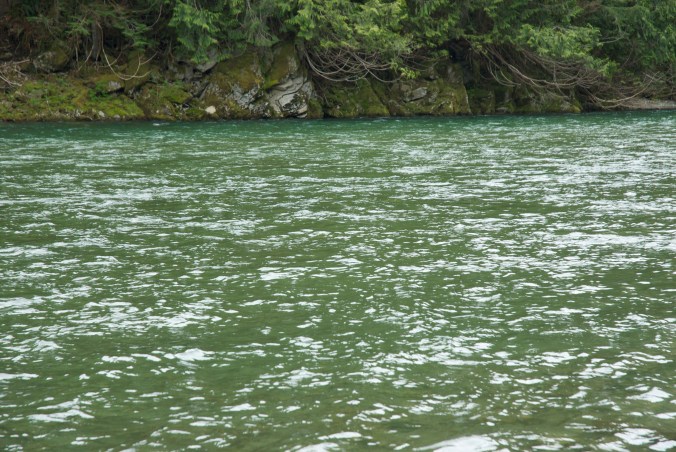
The river’s lost most of the current in our favorite swimming hole, green water is shallower and drifts past without much serious purpose in heading downstream.

Not like late fall water, which is all fattened up with ongoing rain and moves like it really has somewhere to go or the spring flow-runoff mixed with rain that belts towards the mouth, forty miles or so downstream.

Now it’s the slow time, before salmon return and the sprinkling of vine maple leaves that season the water with drifting red flakes.

When the rains move in the river water cools and even if the heat of summer returns for a late few days the river has already turned, readied itself for the next season.

There’s a few days, right at the end of summer when the days move so slowly that time is very nearly stopped and, the truth is, fall is hurtling toward you, unheeded but speeding on just the same.

Poised underwater, eyes open to the greenish cast that surrounds me

I glide silently along, just above the textured river bottom which is dappled in light that exactly reflects the pattern of the waves on the surface above.

Completely at peace

Fall can come

I surface, then quickly return to the green world below

To the bliss that is a perfect day in the river.

Today the wind blew steadily as I took my plunge, just before dark, at our favorite swimming hole.

The town bridge arches over the water like a great, breaching, concrete fish and a deep humming song like Tibetan tones resonated from the cables that stretch to the peak of the arch

Sounds so low that they seemed to come from the river itself

Deep songs of change

Weather’s coming in, the old timers say

I shiver as I dress, content with what I’ve had

But hoping that the mountains will catch the clouds up for one day longer

And give me one more perfect day.

DSC_0007