I was honored to be asked to edit a children’s book that is now published. Following is an interview with the author that I hope you will like. And for those in the area of Renton, Washington, Buck, the horse, and Gloria will be doing a book signing this coming weekend. The flyer follows here. I know this is long for a blog post but I hope you will take the time to join our conversation.
Now that you’ve been through the creating, revising, editing, and publishing process, what step did you find the hardest, and why?
For me it was definitely the publishing process. I chose to self publish. When I started that process I stepped into a whole new world. The self-publishing market is continually growing and changing. When you self publish it means you do everything yourself. I found this scary and intimidating. I do not have the skill level to do everything required to publish a professional quality book. It was not my intention, but I found myself creating a team to help me. My team consisted of a professional editor, illustrator, publisher and marketer.
My first step was getting my book professionally edited. That was when I found you, Lisa. As my editor you not only edited for grammar and typos; you recognized my voice and helped me develop my story. I loved working with you. Through your encouragement and skill you brought out the best of me and my story.
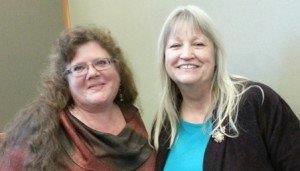
Gloria and I at an author panel
Then I hired an illustrator. He read the book and asked a lot of questions about how I pictured Tallulah, Buck, and Bird Friend. He offered suggestions and then produced the wonderful illustrations that are in the book.

I loved these illustrations – they’re in a similar style to my favorite books as a child – the Borrower’s series by Mary Norton
I met Joy Burke several years ago in a writing group. We became great friends and she helped me navigate the challenging world of self publishing. Then Joy launched her own publishing business, Crooked Tale Press, which provides services to help authors who wants to self publish. These services include book layout, cover design, ISBN number and uploading on CreateSpace and Kindle Books. I could have never done this without her expertise. The latest person to join my team is John who is helping me with internet marketing.

Great photo of Joy and Gloria
On a similar note, what was the easiest, and why?
The easiest for me was creating. In the Native American belief everything is connected. There are many worlds that exist – some of them visible and some invisible. But they are all real and we can enter them at any time. All my life I have often visited and lived in these worlds. Anyone who has meditated or communicated with a tree, or communicated with their dog or cat has entered one of these invisible worlds. Animal Communication is a big thing right now. The latest new thing on TV and the Internet is Inter-species communication. Most indigenous cultures around the world know these things are nothing new. They understand this is the way it has always been. Everything is connected and accessible.
My experience is when I enter one of these worlds through writing or storytelling my characters take on a life of their own and they pretty much tell me their story. I believe many others who write or tell stories have had this same experience.
Tallulah’s Flying Adventure teaches us to believe in our dreams and our inner courage. What was the inspiration for this story?
About twenty-seven years ago, I was sitting in a meadow after a Sweat Lodge. I saw hundreds of baby spiders in their web-sails flying across the meadow. I never forgot that moment when I had a glimpse into that mostly unseen world. I knew it would make a great story or a book.
Throughout the years I became a proponent of women’s personal empowerment. I have believed for many years that women have a very large role in what is happening in the future of the world on a global scale. And I feel it’s important to understand what personal power really means and what we can experience when we come together in community. I was drawn to develop and teach the programs, Gathering Your Medicine and Sisters of the Shield, as well as Energy Healing classes.
When I started writing the book, Tallulah presented herself and Tallulah’s Flying Adventure was created.
I’ve seen you captivate audiences with the oral storytelling traditions. Why do you think our love of stories is so deeply ingrained who we are?
I think storytelling is in our DNA. Stories have existed as long as humans have been on Earth. We use storytelling to explain the unexplained. As well as to entertain each other. Everyone has a story to tell.
Do you think society is losing that connection to stories with the advent of modern technology, or do you think technology makes stories more accessible to all?
I don’t think we will ever lose our connection to stories. I see modern technology as another way to access stories. Whether it’s listening to a story downloaded to your high-tech device, or a storyteller on the radio, or in movies, animation, or plays, or seeing a live storytelling presentation. It seems to me that there is something for everyone.
When we first met you didn’t think Tallulah would ever be published. Can you share how it felt to hold the story in physical form?
Ah, that seems like such a long time ago. I have to admit I wasn’t sure Tallulah would ever be published. So many times I had to turn to the book to keep believing and moving forward. When I finally held it in my hands it was one of those surreal moments and it was amazing! When I first saw it I thought , ‘My first born in the book world!’ I have to admit I teared up and held it to my heart. It will always be my first and I feel we grew up together. I love it.
While adults can enjoy your stories, too, what draws you to write for children?
Children are being raised in a world vastly different from the one I was raised in. It seems to me that young children face some of the same difficult challenges that adults face. To quote my Spiritual Elder, Paul Ghost Horse (Buck Ghost Horse’s son), ‘Our children come to the Earth with the answers we need inside them. We have to raise them in a way that they can give us those answers.’
If children can relate to a story where two completely different Beings, like a spider and a bird, who are naturally prey and predator, can be friends and allies, or a big horse who would usually never notice a small spider, can love and care for each other, maybe children will see the possibilities of their world a little differently. When Tallulah believes in her dreams, trusts Spirit, and develops her inner courage, it helps her see that no matter how young and small she is, she can make a difference in the world. And I think that is an important message worth sharing with children.

The stand-in for Buck, before getting dressed up for the upcoming book signing
What story would you like to share about the creation of Tallulah’s tale?
As I stated earlier the story pretty much wrote itself. It was me that needed to walk a mile in Tallulah’s moccasins. I felt very small and powerless in the big world of writing books and publishing. But I kept having big dreams. So I had to learn how to fly to live my dreams. I had to develop my inner courage and have faith that the Great Spirit had heard my prayers and would send me the help I needed. The Great Spirit did hear me. Spirit sent me the sense of Buck, the great storyteller and the Keeper of Sacred Life. Spirit sent me the wise Grandmother Spider, weaver of webs that connects everything together, in the form of you, Lisa. You soothed me, gave me direction, helped me find my courage and developed my skills. Spirit sent me Bird Friend in the form of my dear friend, Joy Burke, who flew into the adventure beside me, teaching me to fly and showing me the way. Joy helped me navigate in the dark and fought off the bats, that were my own dark fears. When the book was completed, she flew aerial somersaults and celebrated my success. And that is the back-story of Tallulah’s Flying Adventure. For which I will always be grateful.
Thank you Gloria. And for those who might be around Renton, here’s more information. And Tallulah’s Flying Adventure is available on Amazon.