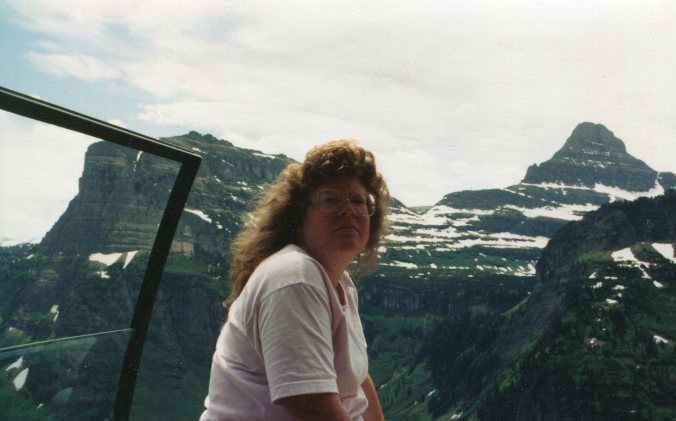
Labels
Fat and ugly.
I’ve carried those labels as long as I can remember. They were reinforced, unknowingly, by family, friends, and strangers.
Kids on the bus who spit in my hair and told others I came from ‘the Land of the Weird’.

7th Grade 1972
Friends who said ‘don’t worry, there are guys out there who value personality over looks’.
Everyone, every single person, who said ‘wow, you look so much like your mother!’. What they didn’t know was the conversations behind the scenes. Mom sitting on the edge of the bed telling me how homely she was, how she’d struggled growing up because of that. I heard her message, drank it in deep, and was reminded what I was every time someone said I looked like her. I still hear that message.

My mother, young

Mom at the cabin
I strove to never tell my child he looked like either parent. Let him be unique, himself, no mirror.
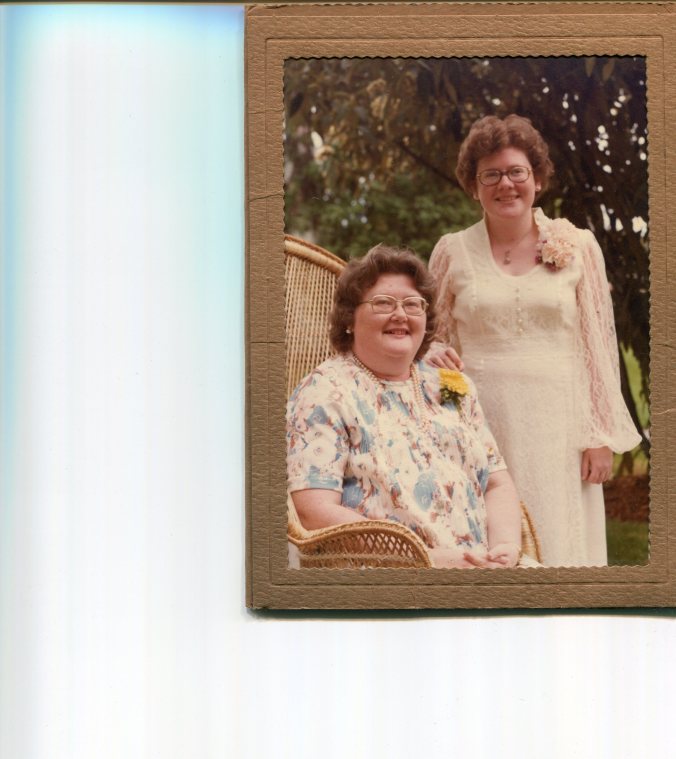
1978
It is so vitally important to me that my son (who is handsome by the way) never hears a negative message from me. That he never absorbs someone else’s opinion and makes it his own. I’ve never allowed myself that same grace.
Don’t get me wrong. I wasn’t angst-driven, depressed, traumatized. The labels were, and are, just a piece of the whole, just who I am, nothing to be done about it, nothing to stew over. And I’ve learned in a few potentially dangerous incidents that being fat and ugly can be protection. Rather like an odd sort of invisibility cloak. Well, there’s the opposite, too. One particular incident comes to mind where a family friend came to the house when my parents were gone, thinking I’d be desperate for male attention.
So I’ve perfected over the years looking in the mirror to check earrings or brush hair, without seeing. I avoid sitting where there might be a reflection visible. My husband rarely sees me naked. It’s hard to find photos of myself because I avoid cameras. Again, nothing I brood over, just a part of life.

Then, a couple of years ago I was sifting through photographs and found one of us siblings standing in front of the fireplace. I wore a burgundy dress that had been a favorite. Soft and flowing so when I went Scottish dancing, it swirled. I stared at that photo, shocked. I wasn’t fat. Busty, yes. But shapely. How could that be? I remember so clearly loving that dress even though I was fat. I knew I was. And yet, I wasn’t.
How could my self-image be so warped? So blind? At least, back then.

Another time period when I knew I was fat and now see I wasn’t as big as I thought
Ugly was still there. Nothing to be done about that. Though by then I’d adopted mom’s phrase of ‘homely’ as it seemed less negative. Easier to say. But not fat. At least, not back then, when I knew I was.
And that was the time period when I’d traveled with friends overseas and watched all the attention they received for being attractive American girls, while I was invisible. As it should have been, I thought at the time, because those friends were, and still are, beautiful, inside and out.
Life, the universe, karma, whatever you want to call it, has a funny way of forcing you to see. A few years ago I was diagnosed with lymphoma. The doctors told me it was in an unusual spot that they didn’t come across very often. The right parotid gland. Where is that you might ask? My right cheek.
Meaning a lump formed there that was visible every time I went out in public. Then a biopsy was done and it became even more visible. Then I started radiation treatments and everyone was focused on my face. That homely face. I still managed to avoid seeing it myself though.

Right after parotid diagnosis before lump got too big. Taken by a friend who made a calendar so sorry for the odd size photo.
Last year I developed a skin cancer on my nose. Surgery took care of it and for a week I went out in public with a big white banner bandage that said ‘look at this face!’.
Recently, the lymphoma has come back. In another odd spot that isn’t seen very often. At the base of my esophagus. For the coming month, everyone is going to be looking at my fat stomach. I mean, it’s even tattooed now, for treatments.
It dawned on me this morning that each time I’ve had this happen, it’s placed focus directly on the areas I despise. It’s directed everyone’s eyes to the places I wish I could hide.
What’s with that, universe? Some sort of sick humor? One last little poke at the weird one? Or are you saying, look? Look. Yes you’re homely (ugly), yes you’re fat, but how important is that in this short time we’re allowed to live?
I’m not a young teenager anymore who isn’t asked out to dances or the prom, or even visible to the eyes of crushes. I don’t waste time feeling sorry for myself, or even thinking about this very often. It’s just labels, a part of who I am, no more, no less, than my freckles or my height. So if it doesn’t bother me anymore, why does the universe keep pointing its cosmic finger at the worst spots?
I’m not sure what I’m supposed to do with that cosmic finger.
Besides raise my middle finger.
The problem now is that if I put these labels, these words, out there for someone else to read, I’ll get compliments. Friends, probably a little horrified, will feel the need to reassure me by telling me none of this is true, that I’m actually pretty (they won’t be able to peel off the label of ‘fat’). And I won’t believe them. I’ll love them for their need to care for me, to lift me up from what they perceive as sadness. I’ll recognize their politeness. What else can you say to someone who mentions these labels except, ‘of course you’re not that!’?
They won’t realize that I’m not saying all of this as some sort of backhanded way to get, or ask for, compliments. I’m simply saying, these are my labels. This is who I am. These are the facts. And the purpose of this whole essay is to also say, how ironic is the universe?
Oh, and let me be very clear. Just because I wear these labels doesn’t mean I’m a victim, or submissive, or shy like I was in school. I am a strong woman and I know it. I love who I am on the inside. I wouldn’t change a single atom of personality.
In other words, I don’t need the reassuring compliments. These are, after all, just labels I wear in the face of an ironic universe.
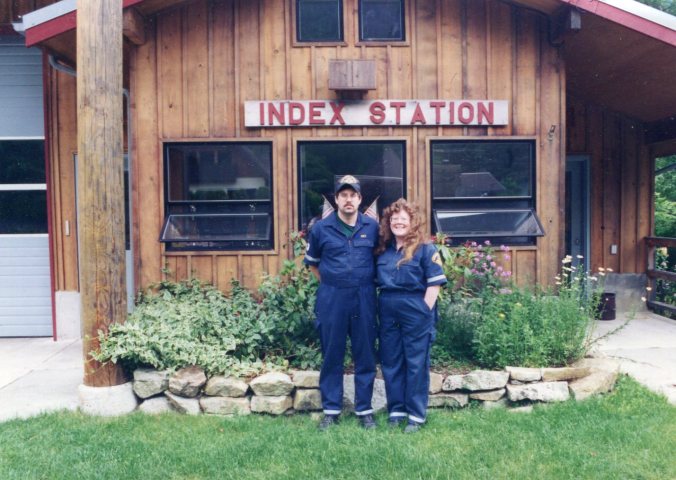
About 1995