Some of you know I enrolled in an online university writing course with a great deal of trepidation. There have been two classes so far and to be honest, I’ve struggled with how to get anything out of the class. I expected to be challenged (university!) but the videos held nothing of value. It’s not just me, either, other students have commented on the same thing.
So I did what I always do – talked to my husband. He helped me figure out what to do to learn from the course. I need to engage fully in the board discussions and critiques. Critiques of assignments are, so far anyway, done by fellow students rather than instructors. As Art says, network and learn there.
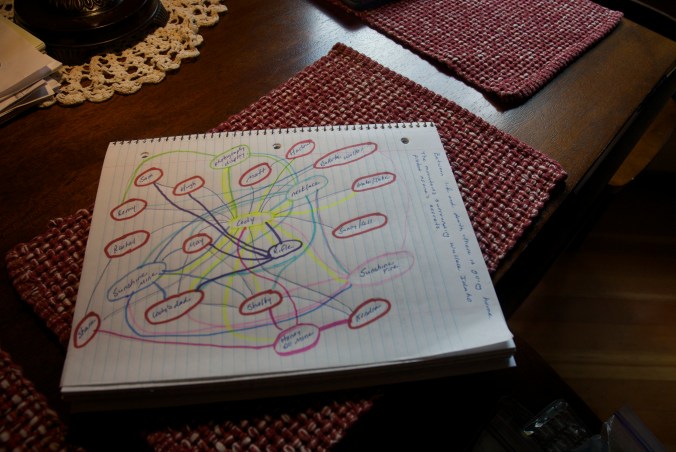
I then spent some time looking at where my challenges are as a writer and how I can use this course to help. One thing I struggle with are short stories. And both class assignments had short stories as homework. So while I gained nothing from the instruction, I am learning from the homework.
One basic thing all short story writers know is that the story doesn’t have to tell it all. And that’s my problem. I want to cram a novel into 1,000 words. I’m working on the fact that short pieces don’t have a beginning, middle, and end, with all questions neatly tied up.
If you’re interested, the first short story I submitted for the class follows. The feedback I got consisted of this variety (which of course is always nice to hear): ‘I really liked this!’ ‘I liked that character’ etc. Though I’d have liked the statements to have been followed by something like ‘The character works because of this…’ so that it was constructive feedback from fellow writers in a writing course.
I received one comment that was spot-on. A young man talked about how much he liked the story and then said he would have liked to see more dialog in one spot. Why was that so spot-on? Because he zeroed in on the exact spot that I skimmed over while writing. I cheated and he caught it and called me on it.
That’s what I’m looking for from this class. While the instruction segments are very simplistic and more about listening to an author talk about her process, the homework will, I think, be the best part. Even if there’s no instructor involvement.
Feel free to critique. I’m learning here.
Flow
“No messing around on the plane, Karen, you understand? Be polite.”
“Yes ma’am,” Karen said, gripping her backpack straps as she looked at the crowded waiting area in front of the departure gate.
“Your dad, if he’s not in total asshole mode, will be there to meet you when you fly in to Seattle. You don’t have to transfer or anything so just get in your seat and sit quietly. No chaos.”
“Yes ma’am.” Karen gambled that so many people nearby would keep her mother from freaking out. Meaning a question might be safe. “But what if dad isn’t there? What if he is in asshole mode?”
“Language, Karen. If he isn’t there, stay with the stewardess. She’ll take care of you. I won’t be available until tomorrow.” Elizabeth Johnson looked at her diamond watch and then ran a hand down her tailored skirt, smoothing its tight green material. “God, he better come through on this. If he screws up I’m going to be all over the divorce lawyers. I don’t have time to mess around with this conference coming up. I certainly don’t have time…”
Karen tuned her mom out. She knew the routine. The words flowed around her without penetrating, a trick she’d learned when her parents fought. By letting them flow, they couldn’t attach. Or worse yet, sink in and cut.
“Are you listening to me? It’s time to board.”
Karen tuned back in and gripped her ticket. She followed her mother to another woman standing by a podium. She waited quietly while the woman scanned the paperwork and then bent slightly to look in Karen’s eyes with a big smile.
“So, your first time flying? You’re small for twelve, but you probably get told that a lot, right? Well don’t be afraid, there are movies on the plane, and the staff will keep an eye on you. There’s nothing to be worried about.”
Karen loosened her grip on the straps. “I’m not worried.”
“Well that’s just great! Let’s get you to your seat.”
“Bye mom.” Karen waited, hoping.
Elizabeth patted her shoulder with one hand, texting on her phone with the other. “Remember what I said. No chaos. When I get done with this work call I’ll text your dad. Let the asshole know you’re on board.”
Elizabeth was already turning away. Karen sighed, hitched up the pack, and followed the woman down the tunnel to the plane.
She was the first woman astronaut to Jupiter, walking down the tunnel to the rocket. Crowds cheered outside. She could hear their muted voices and knew it was for her. No woman had ever done this before.
“Here we are!” the attendant said. “This is Jolene and she’ll be the stewardess taking care of you.”
Karen closed her eyes briefly. When she opened them the woman was gone and another had taken her place, this one tall and blond, in a dark blue uniform skirt and jacket. She followed Jolene down a narrow aisle to a window seat. Her backpack was stowed above but she clung tightly to her Kindle. Thousands of books at her fingertips, thousands of worlds waiting.
Seated and buckled in, she watched the plane slowly fill up. All sorts of people, total chaos. Her mother would be frowning and trying to avoid contact. Especially with the family coming down the aisle, single file.
The mother wore a long floral skirt that seemed made out of tissue the way it floated. Her top was long and beige, crocheted or knitted. Her hair hung in brown dreadlocks and she wore different long, beaded, earrings in each ear.
Karen tried counting kids but gave up after five. Some were older than her, some younger, and all dressed as unconventional as the mother. So was the man who trailed them with hands full of duffels. His hair, too, was long, but flowed free except for one braid on the side. Karen studied the group, fascinated.
The door to the plane had been a time portal. She’d stepped back into the 1960s. Woodstock and Haight Ashbury and flowers in your hair. She’d read the stories so she knew what it was like. No one seemed aware that she was from a different time continuum. She’d have to be careful, to fit in and not stand out until her mission was accomplished. Her boss had sent her specifically because she was the only woman who could pull this off.
Karen sucked in a deep breath and gripped her Kindle. One of the kids was sitting down next to her.
“Hi! Wow, look at your hair! I love that color. Kind of like coffee with red in it. I’m Rain.”
“Rain?”
“I know, right? All of us kids have nature names. I don’t mind except when kids tease me. Then I just punch them. Mom hates it when I ‘resort to violence’, as she calls it.”
Karen pushed back against the bulkhead of the plane. “Isn’t punching violence?”
“Probably. But I wouldn’t have to resort if I wasn’t provoked, right?” The girl sat and shoved a small duffel under the seat. “What’s your name?”
“Just Karen. Nothing pretty like yours.”
“You don’t like Karen?”
Karen shook her head.
“Well change it then. What name do you want?”
“My mom wouldn’t like that. She doesn’t like change at all.”
Rain made a production of standing up and looking around. “Is she here?”
“No. I’m flying by myself to see my dad.” Karen lowered her voice to a whisper. “They’re getting a divorce.”
“So she’s not here.” Rain sat back down. “She won’t know if you change your name. Pick something.”
Karen thought hard. Rain was right. She’d have to change her name to hide her identity. Otherwise the drug lords she’d testified against would find her. She’d been the only female detective brave enough to go up against the killers, but now she was on the run.
“Picked something out?”
Karen opened her eyes. “Victoria Clementine. Not Vicky. Victoria.”
“So Victoria, how come your folks are divorcing?”
“Dad’s an asshole and mom’s a bitch,” Karen whispered, then raised her voice back to normal. “That’s what they call each other anyway.”
The plane juddered and stewardesses started herding people along, telling them to buckle seatbelts. Most of the people milling in the aisle closest to them seemed to be Rain’s family. Karen stared, in awe at the whirls of color and movement. Then remembered. Victoria. She was Victoria.
“Is your family always so…”
“Crazy? Unfettered? One with the universe?”
“Chaotic,” Victoria said, choosing her mother’s favorite complaint.
“Always. Yours isn’t?”
Victoria completely forgot to be nervous about the plane, to watch the takeoff, to pay attention to the escape plans. Words flew around her, opened windows, led her away.
Rain’s attention wandered back to her family as the plain began its descent to Seattle. Victoria watched as Rain’s parents ruffled hair, hugged kids, kissed tops of heads, gathered belongings, reined in chaos. Somewhat.
The plane bounced on the tarmac, came to a stop. Victoria took hold of the Kindle she’d never opened. She stood and retrieved her backpack, watched people crowding into the aisle.
She was Victoria. She was incognito. She followed the stewardess through the door into the arrivals area and searched the crowd for her dad. Rain waved as they headed for the baggage claims.
The stewardess turned away, busy. Victoria followed people to the baggage area where suitcases and oddly wrapped possessions started to circle. She ducked behind a loaded trolley. She knew the terrorists were here. The head of national security trusted her to find them, find the bomb, before it exploded in the crowded airport. She was the only woman trusted enough to save all these lives.
She bent low when she saw the terrorist, tall, in a suit and tie, with ‘asshole’ written all over his face. He was searching the crowd, impatience pulling his face down into familiar tight lines.
It was a matter of national security. She had to escape before he saw her.
Victoria Clementine slipped through the crowds, found chaos, and went with the flow.