Relationships Between Characters and Readers

A recent course assignment dealt with the relationship between characters and readers. The instructor said a character doesn’t have to be the reader’s friend, or even be someone the reader likes. The premise was that women fear writing characters that aren’t nice. I’m sure there are women writers like that; it’s a topic for another post.

The instructor’s opening statement about being friends with the reader, though, led to a good discussion with my friend, author Susan Schreyer.

If I don’t like the protagonist in a book I rarely finish. But what does it mean to ‘like’ the character? Is that character seen as a friend? Or is the character someone you relate to? And how important is that to a story?

In The Heart-Shaped Box by Joe Hill, the protagonist is not someone I liked at all. But I kept reading. Why? Well, because he got a ghost off eBay. Seriously, because the author did an excellent job of slipping in tidbits of character that made me hope the guy would be redeemed. The guy was a ‘real’ character with lots of flaws. Believable in other words.

Susan feels there’s a blurring of lines between liking a character and being able to relate to one. She thinks being able to relate is more important, and also easier to achieve in writing. The more traits a character has that are shared with a reader, the more the reader can relate. We also talked about the balance of a character having traits one can relate to with traits one can’t. That balance allows the reader’s opinion to be manipulated.

For example, in Susan’s current work in progress, the next installment in her Thea Campbell series, Thea is being manipulated by one of the characters. If Susan can swing the reader between liking and not liking this character, then the reader will end up feeling just as manipulated by the character as the protagonist is. That draws the reader into the story on a deeper, more emotional level.

Which is exactly why I continued reading The Heart-Shaped Box. I swung between disliking the guy to seeing a glimmer of hope. The author manipulated me, the reader, into sticking with the story by using that mix of likable and non-likeable character traits.

‘Being liked, or being a friend, to the reader feels less important than choosing character traits that propel the character through the story and sets them up with reasons to make the choices they make.’ – Susan

A writer’s responsibility is to create a compelling story. Which, of course, is done through compelling, believable characters. But do you set out to create a character that’s going to be liked? No. If a writer is more concerned about making sure the reader likes a character, then the writer isn’t being true to the story. Or to the character.

Whether a reader sticks with the story, in the end, will be more about how their emotions are manipulated by the story and the characters, than if they feel that character is a friend. And even more so by character traits the reader can relate to, even if there are traits they don’t like.

It all boils down to writing multi-layered, believable characters.


Bubble Outlines

Susan Schreyer and I talked a while back about outlining, a subject that actually comes up a lot. She outlines; I don’t. So I said. But Susan suggested that I do outline and challenged me to think about what my outlining process is.

And guess what? She’s right. I’ve blogged about that on this site but it’s worth bringing up again because I also recently read an article by Ruth Harris on the same thing.

So if I don’t outline, how do I outline? Well, as I’ve said before, I daydream a story. I’ll go for walks in the woods and let the subconscious take over. In daydreaming the story I watch it in my imagination similar to watching a movie.

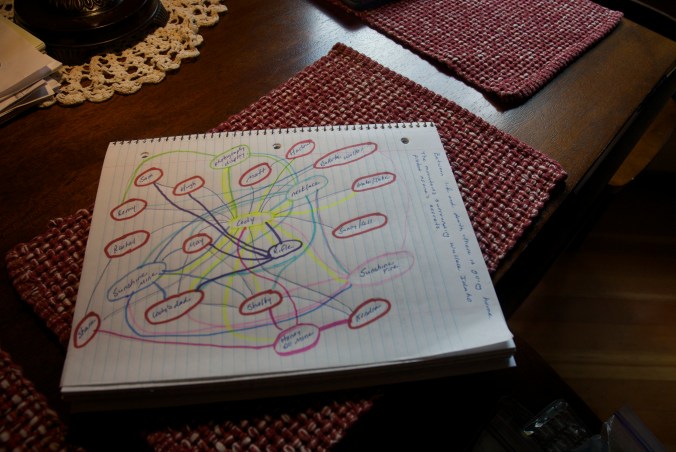
Then there’s this. Typically, about half way in to the work in progress, I draw some bubbles. It’s about the point in writing that I start feeling like I’m losing control of plot threads, or getting a bit confused about subplots.

Here’s what I pause and do:

dsc_0219


Remember, I’m not artistic. I can’t draw. Some of my artist friends would make something prettier. But this works for me.

In the center is the protagonist. Around her are bubbles for each subplot and each character. The subplots get a color. This allows me to quickly see any subplot that doesn’t connect to the protagonist, or to the main plot. Each character also has to tie to the protagonist. In this current drawing, some characters have a color because the character is a subplot, too. This also allows me to quickly see if the character exists for a reason.

For example, in the bubbles above, which you may not be able to see very well, there are two characters, Sunny, and Cell. They’re kind of floating out there by themselves, with only a line to the protagonist. When I drew this out, I realized that they are in one scene specifically to give Cody a moment of respite. They don’t tie into any subplot, or even the main plot.

I can tell from this that I need to find a reason for them to be in this story that’s stronger than me simply enjoying these two characters from past books. If I can’t fit them in somehow then, during the revision stage, that scene of respite will have to be rewritten. Sunny and Cell may just have to wait until the next book.

When I draw out these bubbles at about the mid-point of a work in progress, I end up feeling more in control. Or at least, as much control as my imagination/subconscious will allow. Now, as I continue writing, I will periodically go back to these bubbles to remind myself who needs to be involved in a scene, where a subplot is headed, etc.

So there’s how I outline.


To Rush Or To Plod

I just finished a book with plot twists, a protagonist that tricked me, lyrical writing…everything I wanted. It was so good I immediately bought the author’s second book (she has two out). I’m so bored. Half way through and I still don’t know the protagonist’s reason for being in the plot, which seems to be nothing but dull backstory. (Brunonia Barry)

Which makes me wonder if, because book #1 was such a hit and got such good reviews, the author felt the push to get book #2 out before people forgot her name. In this age of millions of writers it’s hard to be seen and harder still to remain seen. So the pressure is there to produce.

And that in turn makes me think about the speed of writing and the need to publish. Especially in the mystery genre where readers want to live in a series with regular installments.

My friend, author Susan Schreyer, is what I imagine as a balanced writer. One of those I fail at emulating, who outlines, plots, writes regularly, and puts out polished, well-written stories. She’s found the perfect speed. Her books are not rushed to publication, and yet come out in a timely manner.

Me on the other hand? I publish and write rather like I hike. Occasional sprints up hill that end in heavy breathing and collapse, followed by leisurely strolls where I pause to talk to trees, sit on boulders, watch bears, get distracted by the newly blooming minuscule twin flowers…you get the idea.

icicle creek 023

Icicle Creek Trail

I see Susan’s writing as the perfect balance between the author I first mentioned, who goes too fast, and me who, arguably, goes too slow.

Does that make me want to change? Well…no.

I used to stress over what I thought I should do when it came to writing. But then I realized that rambling walks through words is my writing process and I’m happy with that.

It may not be the way to success in this current publishing world of trying to rise to the top of the mountainous pile, but I do enjoy the stroll.

There are so many positives about publishing these days, the least of which is the ease of getting something out there. But sometimes that ease to publish ends up in a story being released to the world before its time.

Find that balance between the pressure to publish and the time the story needs to be born.