Stereotyping Litter

I walked to work this morning, along a forested road with encroaching woods and no shoulder. As I walked I listened to returning spring birds and the creeks, and wondered if bears were awake and hungry yet. And then I noticed the litter.

Beer cans and energy drinks.

I realized I had an instant mental image of the type of people who speed down this back road (because back roads have no laws, right?) guzzling and tossing. I could see the beater cars and pickup trucks from which the beer emerged. I could see the fast little cars with fancy hub caps and fins, driven by young men, from which the energy drinks were tossed.

Well, as an aside, since I live near a small town, I’m pretty sure I know the source of several of the beer cans, and he’s usually drifting along on two feet not four wheels. But I digress.

So of course my mind started wandering away from hungry bears to litter. I realized my mental stereotyping would be shocked to see an old pickup with a driver who tossed a Starbucks cup. I’d probably think I’d fallen into a romance story and just been passed by a cowboy with a heart. What if it was a Volvo and they threw out a bottle of Rolling Rock beer? Later I’d walk past that broken beer bottle and picture the local drunk again, not a driver of a nice Volvo.

I realized there are stories that immediately come to mind out of something as simple as tossing a piece of litter from a vehicle. All writers know to use object placement, to use things as a way to illustrate character. But think about how fast and simple something like this could be used to describe a person. Think of the story that you would immediately tell yourself if you saw a SUV drive by with a distraught young mother, tissue in hand, tossing out a baby bottle? Or that young man in his sports car, flying up the mountain pass with a snowboard on the roof of the car, tossing out his mother? Confess, you just laughed.

I have decided that litter is not only too easy to stereotype, but also way too much fun as a source of characterization and story ideas.

I’m going to walk home much slower.

More Than Words

Today I cranked the volume on a song called The Wind That Shakes The Barley. This version was sung by Loreena McKennitt. I wanted my son to hear the lyrics to this powerful ballad. Here’s a sample from the third verse:

While sad I kissed away her tears
My fond arms ’round her flinging
The foeman’s shot burst on our ears
From out the wildwood ringing
A bullet pierced my true love’s side
In life’s young spring so early
And on my breast in blood she died
While soft winds shook the barley.

The song made me think about history and how it is passed down, and how it has strength in its impact. If we read about this part of Ireland’s history in a text-book for example, we might skim, maybe get bored, worry about memorizing the important points for the upcoming test. But when that same piece of history is told in song or story, it becomes, once again, alive. We usually don’t feel tears on our cheeks reading a text-book.

When we can take a piece of history and bring it alive through telling of the lives of those who lived it, we not only remember those people, we honor what they lived through. I’m not talking just about this song’s time period, but about all history, from the ages past through to how our parents met. Or the birth story of our child.

I’m also not talking about that sad outcome of so many songs based on culture, where they have been sang so often they have become a cliché. Danny Boy  comes immediately to mind, to continue the Irish theme.

The power of history is in the stories, songs, and photographs that come directly out of the time period. I could write a story about wagon trains and it might ring true, but it wouldn’t have the power of the entries in Women’s Diaries of the Westward Movement. The power of the words is in the source, a story coming from someone who lived through the event. Or from those who remember.

Although I have to point out that sometimes the power is in the storyteller. The song above was written in 1800’s about an event in 1798. But still, I’m sure you get my point.

So think about the power of storytelling, oral and written, the human, intensely personal aspect that gives words life. In a way this is what all writers strive to bring to their work; words that ring true, that pull up deep emotional responses, and remind us of things that shouldn’t be forgotten.

It makes me feel like I have a long, long way to go to reach that place.

And it makes me feel very humble.

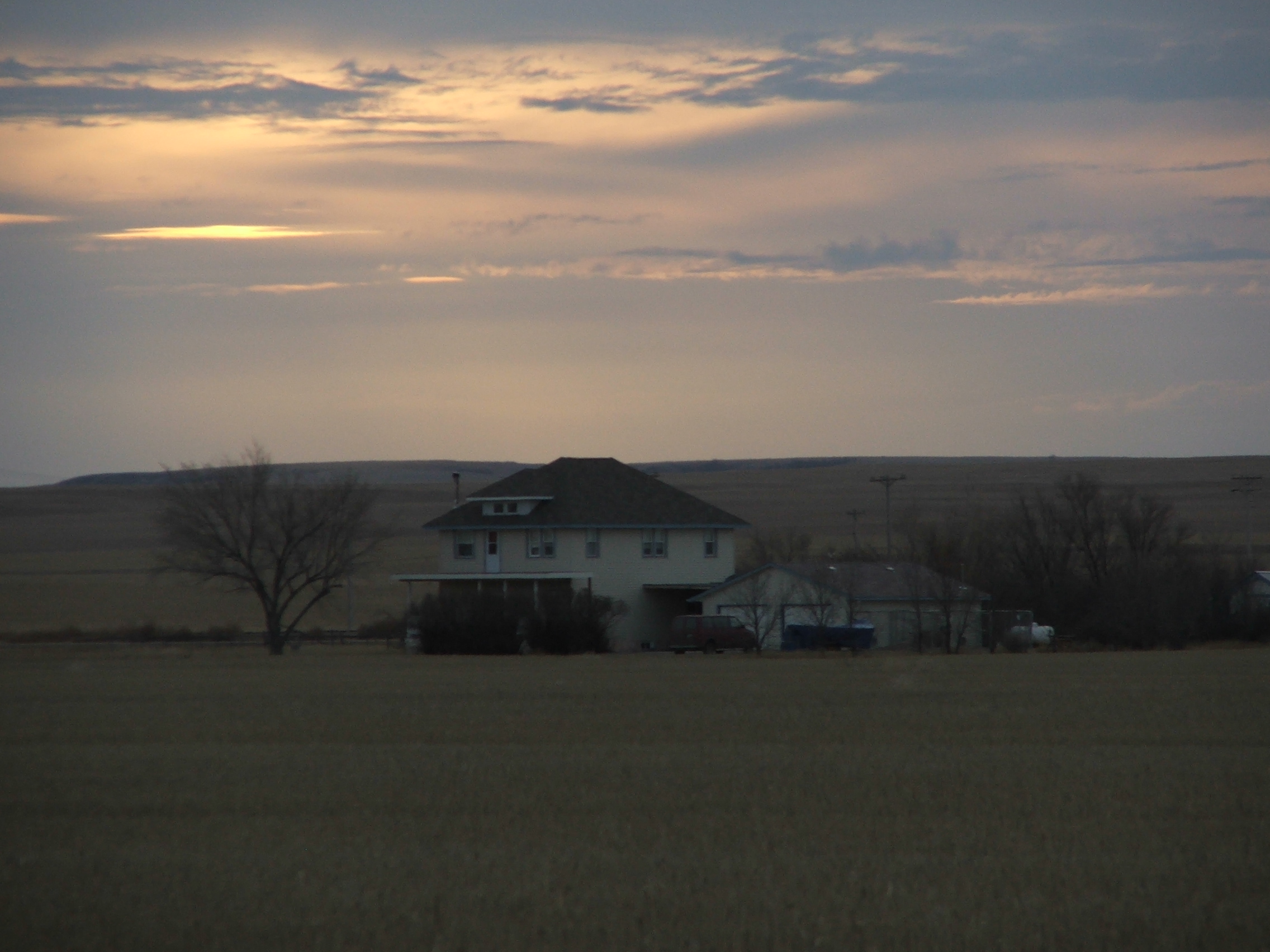
No photos of barley, but here’s a fuzzy one of my sister’s house in the wheat.


Groceries

While grocery shopping this weekend with my friend Jenni, I told her how it fascinates me to see what grocery combinations people buy. I think I would make a terrible teller because I’d be going slowly wondering about the items. I pointed out that in my cart I had french bread, ricotta, mozzarella, and Italian sausage. Someone looking at that would think, ‘aha, someone’s having lasagna for dinner!’

When I see the person in front of me buying NyQuil and chicken noodle soup, I’m going to stand back a few feet. When I see someone buying a home pregnancy test and a bottle of wine, I’ll stand in the line wondering if the wine is for the husband, the partner, to celebrate, to drown sorrows.

When I see the woman purchasing low-fat yogurt, fresh fruit, and a large Snickers bar, I wonder if she is rewarding herself, or buying it to sneakily eat on the way home. I imagine her virtuously eating the healthy food in front of her spouse. While he’s eating a burger and feeling guilty because his wife is so healthy.

I was very surprised to hear Jenni tell me that she has never tried to figure out what the combination of people’s groceries meant. I assumed everyone did that while in grocery lines. She told me she thinks it’s something only writers do, creating stories, asking ‘why’ and ‘what if’, and ‘how come’.

So I have to ask. Is there anyone else out there who tries to solve the riddle of groceries on the conveyor belt?