The Cost of Art

My  husband asked me to make a doily for his bedside table (built by his great-grandfather), that matched one I’d made for my bedside table. My crochet basket goes with me any place I wait. Since I’ve spent some time recently in a lot of doctor offices, I got a lot of crocheting done. It’s much slower when there’s IVs in the backs of both hands.

Then my husband asked me how long it took to crochet. I had no idea so I timed myself. His piece took roughly forty hours.
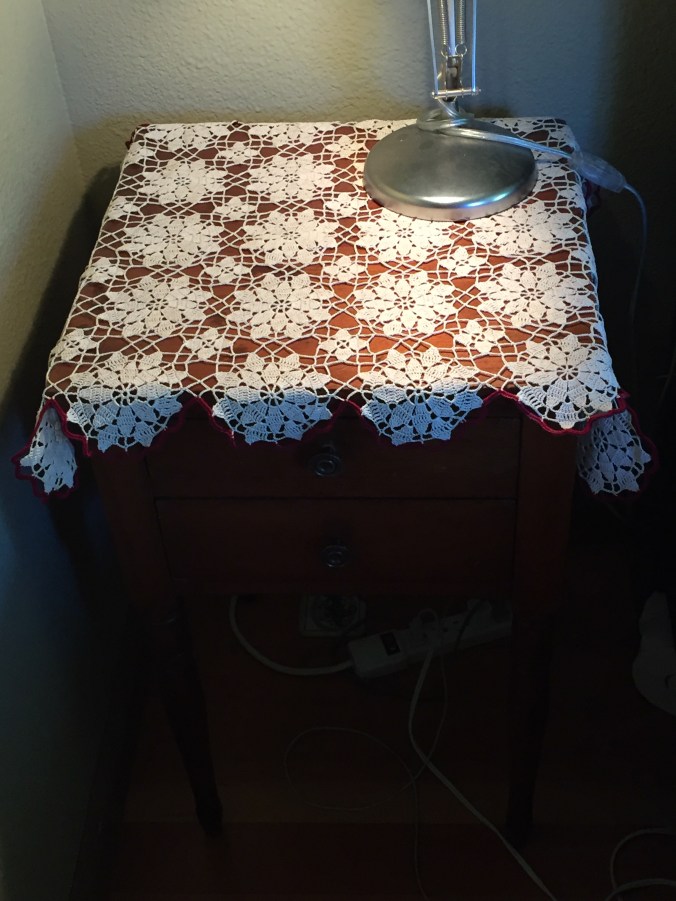
Art's table

Art’s piece. Pattern: Queen Anne’s Lace

The amount of time got me thinking about how you price on art. Or in this case, crafts. Even if I charged fifty cents an hour, no one is going to pay twenty dollars for a doily. You can get them in thrift stores for fifty cents. They’re old lady things; out of fashion. Taught to me by an old lady I loved, so I crochet in her memory.
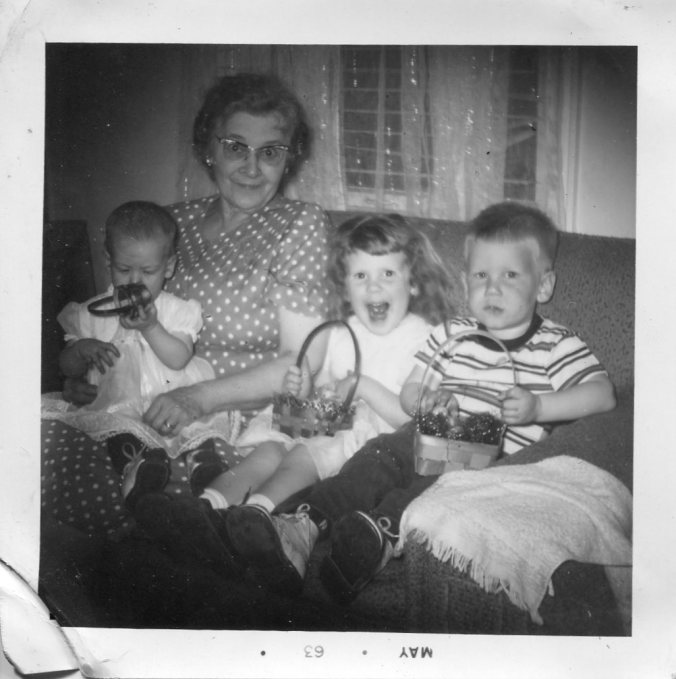
Aunty and us Easter 2

‘Aunty’ who taught me to crochet when I was nine. Plus me in the middle with siblings.

What about my friends who create beautiful works of art with glass? Or the friend who makes earrings (that I benefit from)? The friend who paints? The friend who creates amazing landscapes?

The writer?

If you charged even minimum wage your work of art would be priced out of reach for the majority of the people.

How do you price something that is a creation, something spiritual, something you’ve breathed your soul into? Granted, my crocheting isn’t anything like that; it’s simply a way to keep hands busy. But writing certainly is.

I’m a slow writer. I dally and wander and get distracted by the scenery. So it can take me years to write a book. I’d have to sell more books than I currently do, to make a poverty-level wage off of them.

We all know no one creates works of art in order to make money. And isn’t that a good thing? There are so many things I value, made by people I equally value, that would not be in my life if the artists were out to make money.

I just wish I could pay them as much as I value their work.

Steven mumps March 1965

Brother with mumps – and one of the few photos I have of Aunty’s crocheting

Then There’s This Question

Those who read this blog know I love any question that begins with ‘What if…’ and all the stories that question leads to. But over the past couple years I’ve been noticing a new question creeping in. Not sure I like it, not sure I want to ask it, definitely don’t want to hear the answer.

I think this new question has to do with the gray hair starting to come in. They both seemed to arrive at the same time.

‘Is this it?’

Not so much ‘is this the sum total of my life?’ or ‘is this who I am to be from here on out?’. Or even ‘is this all there is?’.

Those of course are deep questions that can be asked at any stage of life. But it’s not how I’ve been asking that question. It goes something more like this.

When a semi truck going way too fast on the narrow bridge over the Skykomish river confluence is way over into my lane and there’s no place to go but the river. That brief second before the driver gets the truck safely back into his lane.

When lying on the table with your breast covered in ultrasound goo.

When you’re feeling up your arm pit thinking, has the lymphoma come back?

When you’re standing in the pantry trying to remember what you went in there for, and then can’t remember if you even wanted to go to the pantry.

When you realize that the generation older than you is fading and you’re becoming that older generation.

It’s actually an odd thing to think about, but I assume as everyone ages they begin to wonder what their end will be like.

In a way, it’s a rather sick humor sort of version of the ‘what if’ question. That makes me laugh now that I think about it.

Don’t get me wrong; I’m not brooding or even worried. It’s just occasionally the question pops into my head.

Is this it?

Well, not today. Today all is good.

Except for the housecleaning bit. But even that’s not so bad when music is blasting and the husband is helping and the dog is protecting me from the killer vacuum cleaner.

The Full Book

‘Every person is born into life as a blank page – and every person leaves life as a full book. Our lives are our story, and our story is our life. Story is the narrative thread of our experience – not what literally happens, but what we make out of what happens, what we tell each other and what we remember. This narrative determines much of what we do with the time given us between the opening of the blank page the day we are born and the closing of the book the day we die.’

This is the opening paragraph of Storycatcher, by Christina Baldwin. The subtitle is ‘Making Sense of Our Lives through the Power and Practice of Story’.

I bought this book a few years ago because of the title and the cover, which is of sand and sea. It’s a book I’ve never read cover to cover. Matter of fact I don’t think I’ve ever finished it. And today I believe I’m going to pass it on to my great-niece, a poet.

I’m not quite sure why the book, as a whole, has never pulled me fully inside its covers. The snippets I take from it, I like.

‘In the tens of thousands of years before writing, before popular literacy, before we recorded what we know in books and on computers, story was the way we transmitted everything. Story was the carrier, the link, the way we taught each other how to be human and how to see each other’s humanity as we crossed paths on the long walk out of Africa to populate the world.’

Even now, as I flip through the pages, I’m having second thoughts about giving it away. Maybe I should read the whole thing. Maybe I’ve missed some bits I need to know.

Plus, as any reader knows, it’s hard to let go of a book.

‘Whatever detritus we leave after ourselves, story is what makes it valuable. Without story, the artifacts of ordinary lives quickly lose significance and preciousness. An old chipped teacup is no treasure unless you know this is Aunt Grace’s artwork; unless you know she had polio as a young girl, that her siblings pulled her around in a small wagon until the family could afford a wheelchair.’

I have a teacup. Milky white, so frail the light shines blue through it. It was once part of a set, collected slowly, piece by piece, by my great-grandfather when he bought burlap bags of flour. Each bag had a single piece of china buried in the flour, as white as the china.

So I read parts of this book, and remember my stories, family who have passed on. Reading brings back melancholy, smiles, regrets, all the emotions that are attached to those stories, those memories.

And sometimes, I don’t want to be reminded. I don’t want to feel those emotions. And so this book can only be read in tiny moments when it’s safe to spend some time in missing loved ones. Otherwise I’d ended up buried and have to battle my way back up to today.

So yes, I’ll pass this book on to my poet-girl. It seems like someone who writes poetry must dip into those deeper emotions with every line they write. Maybe a poet is wiser about letting go.

lincoln city april 06 006