A Home For Lace

Back in the 1980s I took a class for bobbin lace because it was a dying art and I thought it should be preserved. Unfortunately there weren’t enough people to keep the Lacemaker shop open and it closed before I moved much beyond the raw beginner stage. And then between moves and life changes, the lace pillow was packed away. Now that I have a home again and more time in my life, I have unpacked.

Bobbin lace is how lace was made before machines. If you research the history of lace you will find that the task of making it was so exacting only royalty or extremely wealthy people wore it. When a girl was born, her family commissioned a lacemaker at the time of birth, so the lace would be finished in time for her wedding. Young girls around age four began training to make lace, beginning by learning how to make the pricking, or pattern. These children were tied to chairs to keep them still for hours, and they worked around a large table with a single candle in the center. Each child had a bowl of water in front of them to help refract the light. Most were blind by the time they were in their early teens. Such was the value of lace.

Now, however, it’s a handicraft you might see at county or state fairs alongside spinning wheels, crocheting, and knitting. In the 80s when I started, there were roughly 3,000 lacemakers in the States. Now I’m sure there are many more.

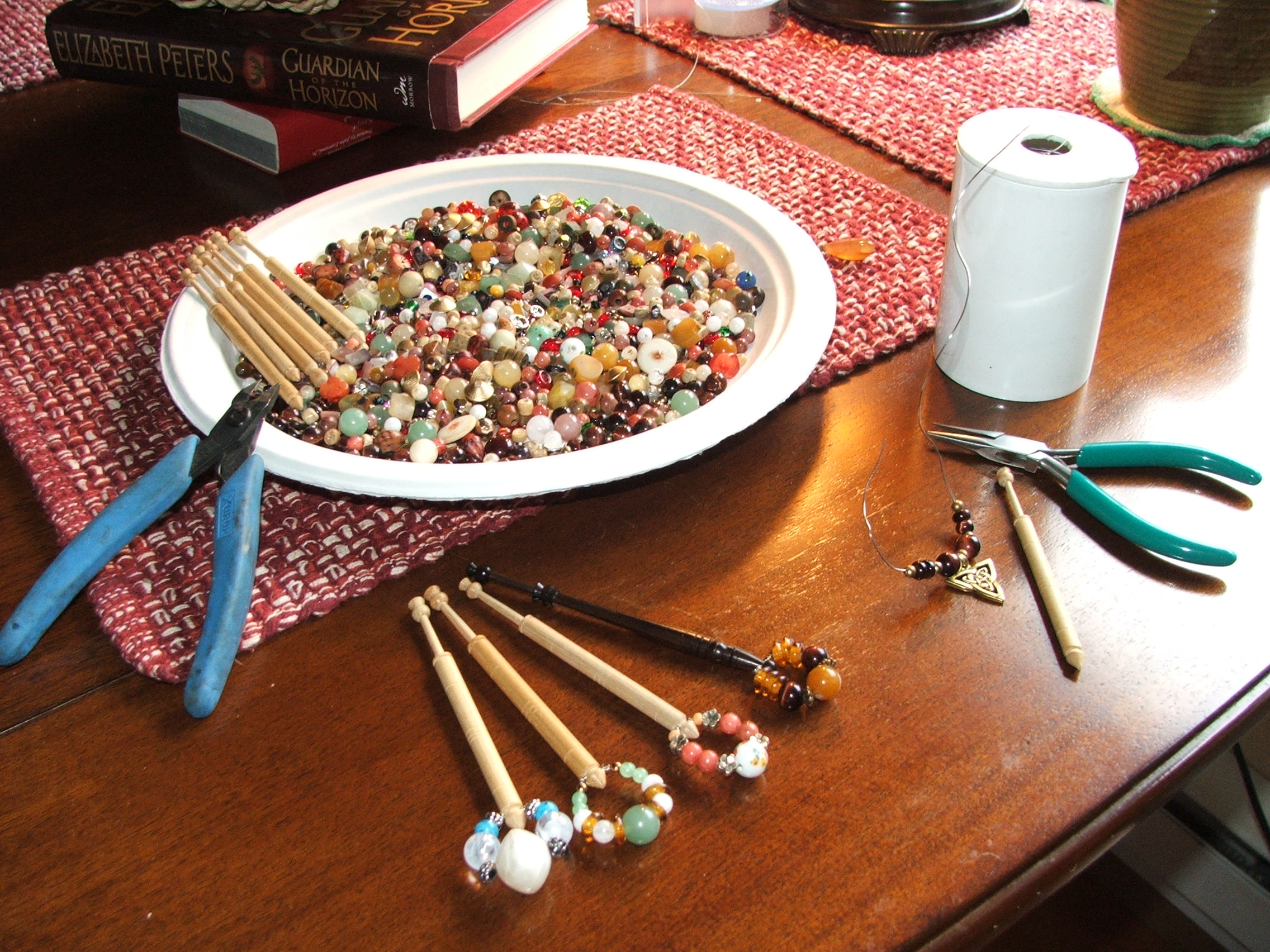
There are different styles of bobbins. I have both Belgium and English. Belgium are shaped like a pear and use the ‘bulb’ to weight the bobbin. I prefer English bobbins as they have interesting beaded spangles. In mediaeval times some beads warded off evil spirits; some brought luck. Then, as now, the beads work as weights to keep tension on the threads. Below, I am beading English bobbins. Rather than buying expensive beads at a craft store, I go to thrift stores and buy old necklaces and cut them up.

Old necklaces repurposed to English bobbins

Old necklaces repurposed to English bobbins

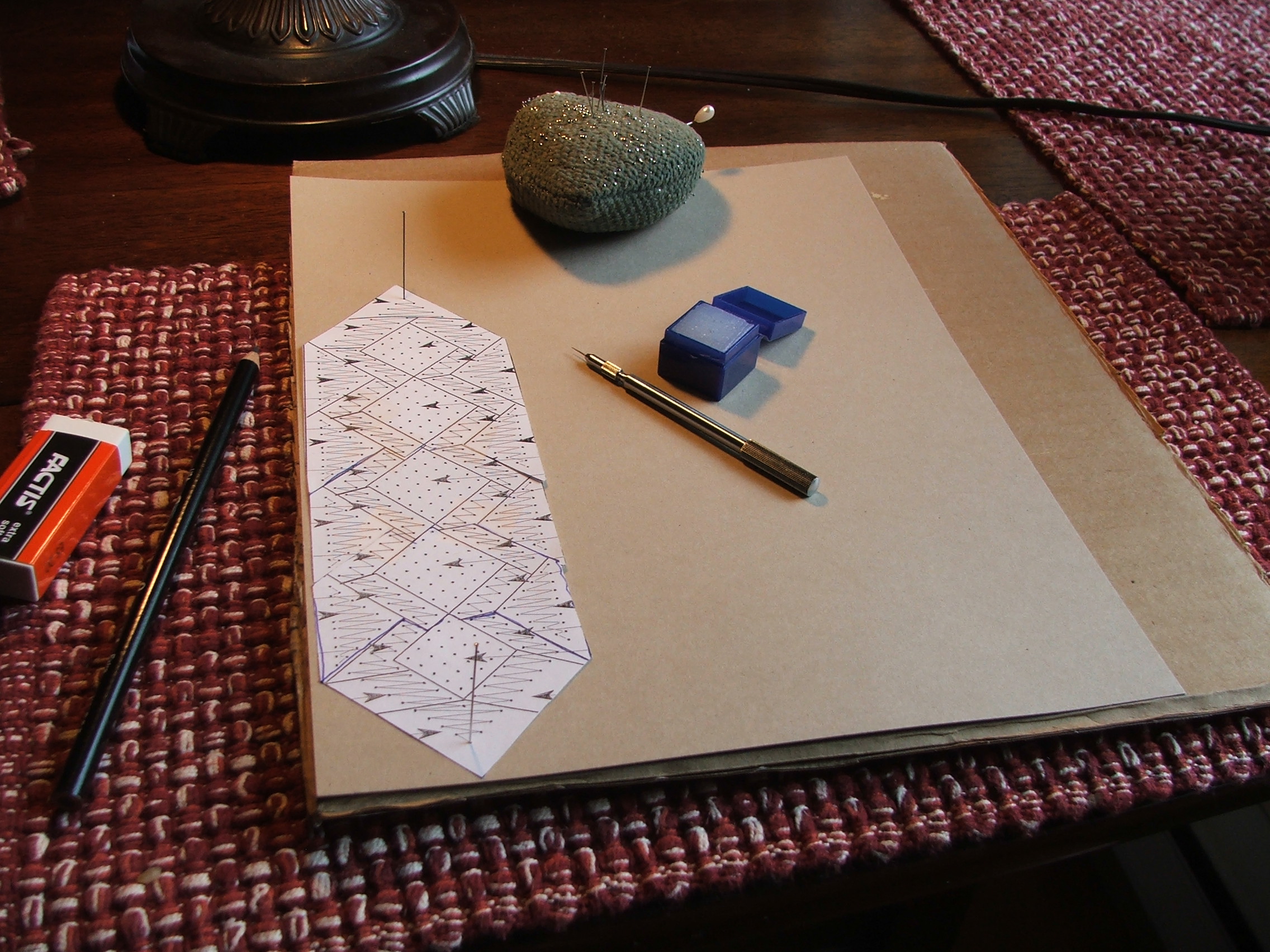
Next, a pricking is created. As I’m still a beginner, this is a Torchon lace pattern, meaning the lace is worked in straight lines. To make a pricking, a drawing on plain paper is attached to card stock. A tool called, originally enough, a pricker, is used to poke holes through the card stock. The card stock then becomes the pricking. Years ago I had a wonderful tiny wooden bowl filled with beeswax. All I could find now was a plastic box with candle wax. The pricker is stabbed into wax frequently to make the needle pass through the card stock easily. The lines on the paper version show which direction to work and will be drawn by pencil onto the pricked card stock.

Creating the pricking.

Creating the pricking.

The bobbins are then wound with thread. Because lace is done by working with pairs of bobbins, two bobbins are wound from each end of a length of thread and then secured with a slip knot to keep the bobbins from unwinding while using. Below I am using a bobbin winder which saves wear and tear on your wrists.

Tea helps with the winding process.

Tea helps with the winding process.

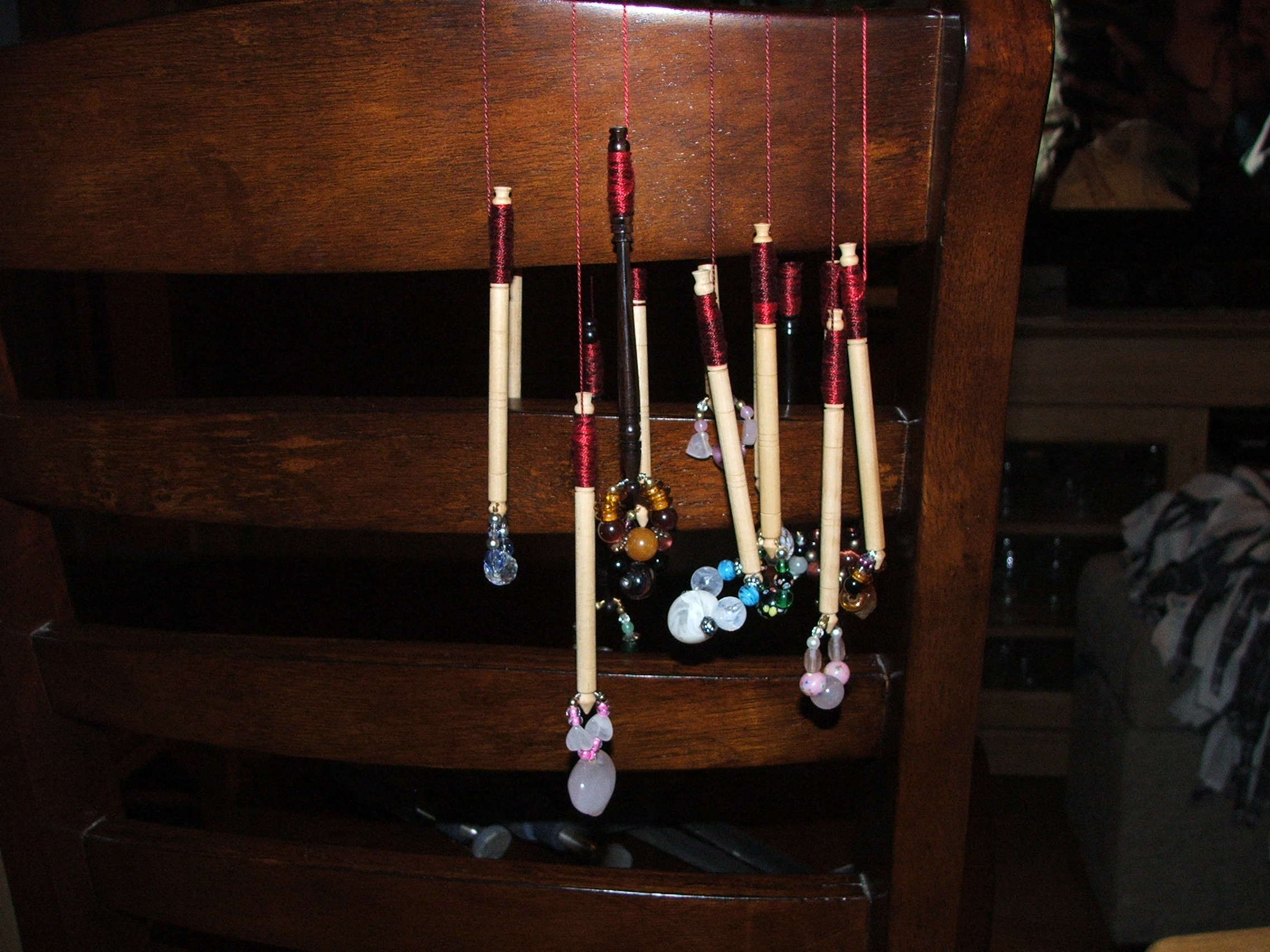
Another thing that helps is a place to hang the pairs as they are filled with thread. Years ago I had a handy wooden frame just for this. Now, a chair back works just fine to keep pairs from tangling.

Pairs on chairs

Pairs on chairs

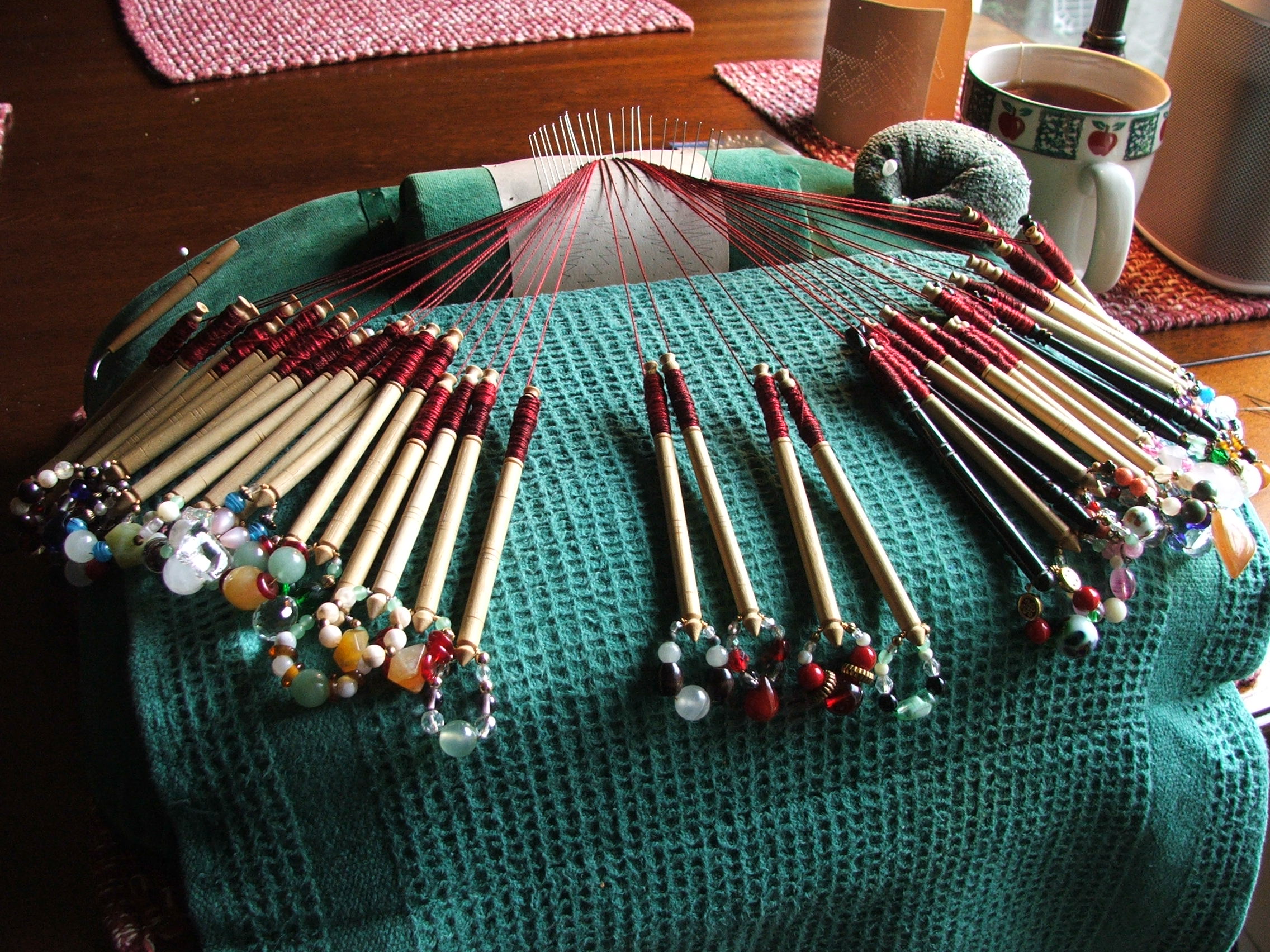
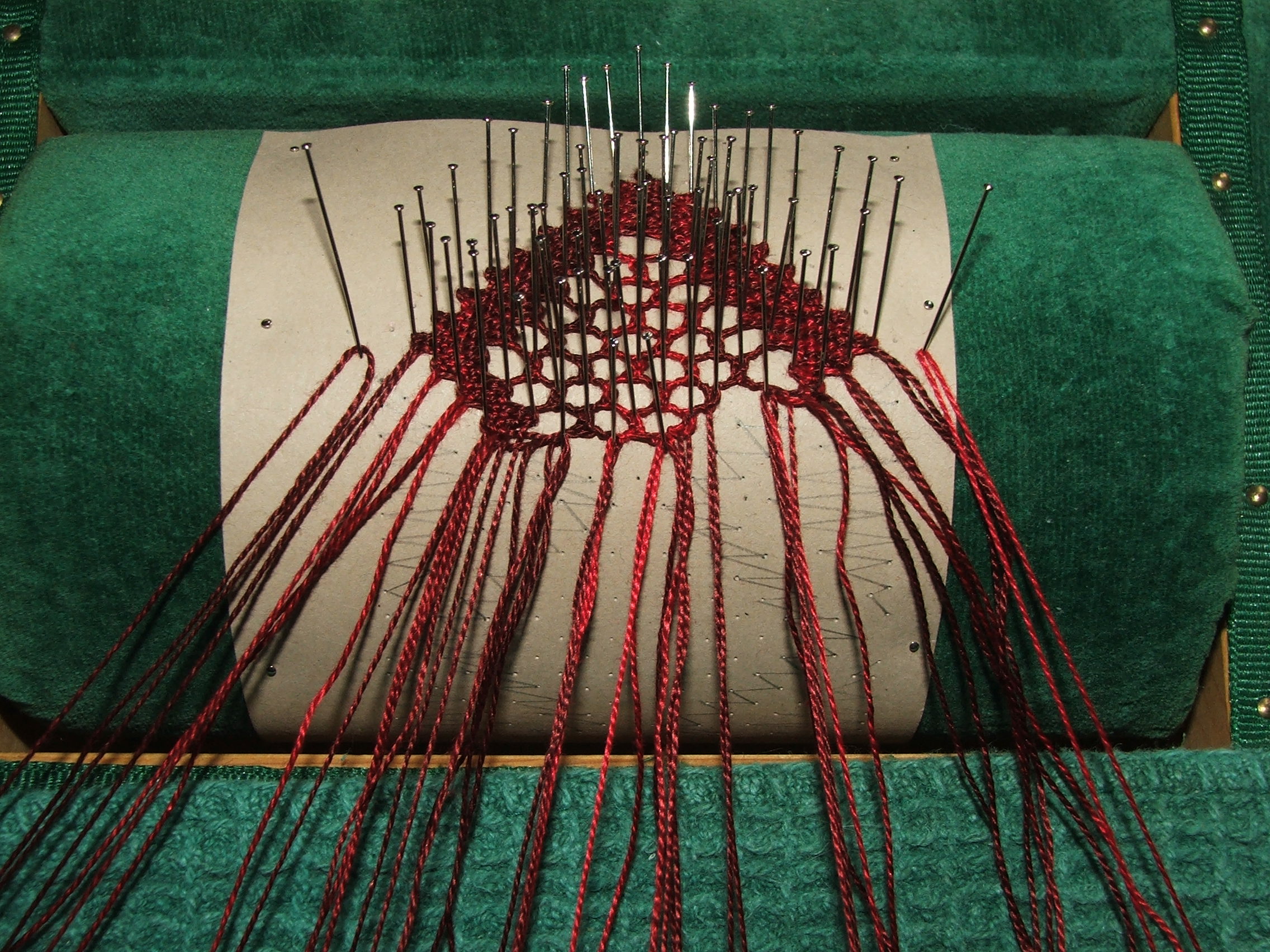
Once all is ready, the pricking is pinned to what is called a bolster, on a lace pillow. The bolster turns so as you work the completed lace feeds off the back. Holding pins are placed above the pricking to hold the bobbins ready to begin. You’ll see, next to the ever-present tea, another pricking. This one is a handkerchief edging I made in the 80s, curved from years pinned to the bolster. You’ll also notice four bobbins in the center, separated from the others. This is a worker pair and a weaver pair, ready for the first stitch. The stitches are done by weaving one pair through the other. After a pair is worked it is set aside and the weaver moves on to the next pair. To work the pricking, a stitch is done, a straight pin placed in the hole in the pricking, and then another stitch is worked to ‘close the pin’. The straight pins stay in place until at least an inch of lace is completed, then the pins from the back can be pulled and moved to new stitches in the front. This moving of pins allows the bolster to turn and the completed lace to feed off.

Lace pillow with pricking, pins, and bobbins

Lace pillow with pricking, pins, and bobbins

In spite of having the direction to work penciled on the pricking, I had to pull the stitches out three times because I went the wrong way. Remember, I never made it past the beginner stage, oh so many years ago. But below, finally, is the beginning of a bookmark.

A future lace bookmark.

A future lace bookmark.

Lost Friends

Do you ever think about people who have crossed paths with you over the years and wonder where they are? Have you ever had a transitory moment with a stranger and left thinking they could have become friends?

That happened many times traveling. Someone met on a train, a brief conversation in a bed and breakfast, those moments when there was a click, a recognition of the other, a knowledge that if there was just more time…

I’m not sure that happens as much these days as it is so easy to give an email address. I wonder if this generation misses out on the mystery of those ‘what if’ questions.

Then there are those we have lost contact with. There is never an end to those stories. We don’t see how they grew up, who they became, how they maneuvered through life. We’re left with occasionally having something remind us of a person in our past. We spend a few moments wondering where they are and who they are, and then we immerse back into our busy lives. These days we might even take a moment to type their name into a search engine.

When I was young, there was a boy. I’m only going to use his first initial. K’s mother was a friend of my mother’s. Even though K was my age, mom seemed to think he needed watching after. Or maybe she thought I just needed to make up for past treatment of him. Supposedly, when we were toddlers I would get in K’s face and scream loudly just to make him cry.

I remember one day, about age seven or eight, and mom sent me to the local grocery store to buy a loaf of bread. This was in Seattle in the 1960s and the store was a couple blocks away. These days I’d be labeled a ‘free range’ child and hauled into foster care and my parents prosecuted. But I digress.

Mom made me take K along and made me hold his hand. I don’t know if she was afraid he’d wander into traffic, get lost, or what. On the way we had to walk by my ‘boyfriend’s’ house. If you can have a boyfriend at that age. N was furious, yelling at me that we were never going to get married because I was cheating on him. Seriously. At age eight.

K was terrified.

N grew up to marry young and divorce, then marry again and divorce again. I lost contact with his family years ago.

Back to K. There was also the time mom made us play Candyland on the back porch on a sunny day. We played 26 games. I won 23. K cried. I got in trouble for not letting him win.

The thing is, he was a nice kid. In our teens we got along fine. But we lost contact in later teen years. I mean, the only glue there, was the friendship between our parents. He grew up and moved away as did I.

I did hear that in his twenties he was living in California, had a job as a banker, and was in a very happy relationship with someone and that they hoped some day to be able to marry.

Which is why I’ve been thinking about him lately. Wondering if finally, way too many years later, now that we are moving into a period where gay marriage is finally being allowed legally, if K is married and happy.

Okay, I also wonder if he has nightmares about a kid screaming in his face, or giant Candyland board games haunting him.

So many people who have passed through our lives, touched them so briefly, left an impression, a sense of opportunity lost, or even, in the case of N, a sense of relief they are gone.

Life is so fleeting.

Being Anonymous

Why is the promise of anonymity so powerful?

From a writing standpoint I know all the reasons authors write under pseudonyms, not the least of which is the need for their families to not see what they are writing. But I’m wondering about this from a more generalized standpoint.

This past weekend my husband told me about a social media site called Whisper. People can post similar to Twitter or Facebook, but completely anonymous. I told him I found that rather creepy. He said some people need that in order to talk honestly about depression, identity, etc.

That makes me wonder about a society where we need a safety net of anonymous in order to be honest about who we are. In an ideal world that net would not be needed. But of course we are far from an ideal world.

With that said, I still find Whisper creepy. Maybe it’s the name. A whisper implies something secretive, sneaky, maybe even slightly cruel. After all, why whisper unless you don’t want someone else to hear? Remember those awful middle school and high school days when you’d be walking down the hall and see two kids whispering and giggling and know, just absolutely know, that it was about you? Remember that feeling in the pit of your stomach? That’s what the word ‘whisper’ implies to me.

Which brings me back to my initial question. Why is being anonymous so powerful? Why does it allow you to say or do things, or for that matter to post photos or behaviors, that you would not do if your name was attached? In a way it lowers inhibitions. So why are inhibitions lowered simply because your identity no longer exists?

I understand there are instances where personal safety could be seriously compromised if your name was visible, but I’m thinking here more about societal norms than politics, terrorism, racism, etc. Anonymous simply for the sense of power, not for safety or causes.

I don’t understand, and possibly because of that, I am going to strive to always sign my name, and if I’m doing something I don’t want my name attached to, then I better think twice about what I’m doing and why. Otherwise I may lose my identity by the simple act of not claiming my identity.