A Beginning Writer

When I facilitated a writer’s group I collected resources into a giant three-ring binder. One of those hefty things that, when full, needed a commercial style refrigerator dolly with canvas straps to move. Or so it seemed when carrying it.

I used it to find topics to discuss in the group and then when the group ended, I used it to collect dust. Lots of dust. And cobwebs. And desiccated bug casings.

Then a few months ago my son made the mistake of asking me about plot development. I tried to hide my inner writer who was screaming ‘My son writes!!!’. I tried to not overwhelm him because it was obvious he was very hesitant about coming out of the writing closet. A feeling I fully understood. So I remained calm and answered his question.

badlands 2

Now twenty and writing

Then sent him home with the cobwebs and dead bugs. He was actually thrilled with the notebook.

It got me wondering why I didn’t keep it dusted because it really did have a lot of good information. Here’s what I realized.

My source for information in writing is now found within fellow writers and the internet. But especially those writers. I can go to them with any question. I can dump drafts on them and beg for polishing help.

And I don’t have to blow cobwebs off of them.

Then I started wondering what I did for help when I was very young and writing in secret. There was no internet back then. I knew no writers because I barely understood that I was one. I didn’t know the library had resources. I was nine years old.
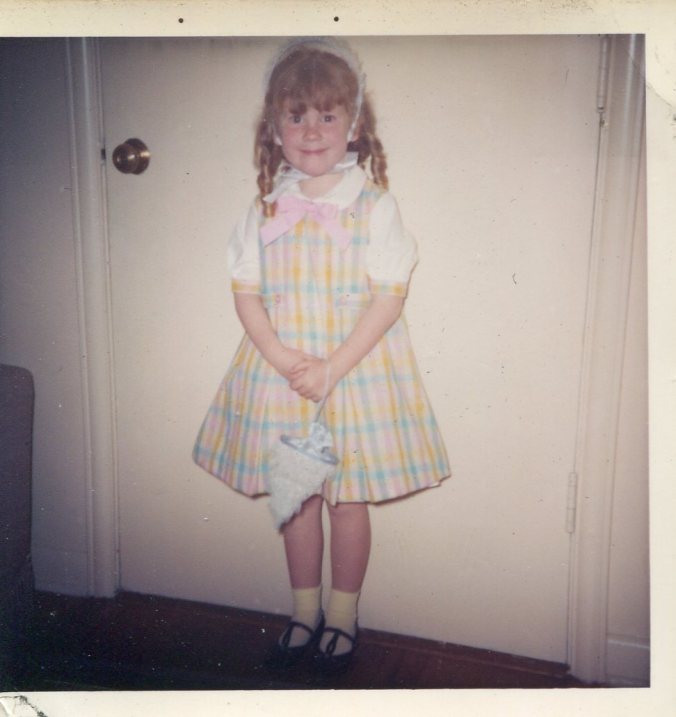
Lisa Easter 1965

Dressed up for Easter. There was paper in that purse.

I just wrote. Stories for myself. Eventually I shared them with my closest friends at slumber parties where we would laugh ourselves silly over stories we’d written. Later I attended a writer’s conference (huge mistake; didn’t write for months afterwards). And I finally discovered a fellow writer in someone I worked with and the writer’s group grew from that.

But the important thing is that I simply wrote. Alone, with no true understanding of what was going on. Not even a true understanding of why.

I know now that resources and support are invaluable. Not only to learn the craft but to share enthusiasm and inspiration. Whether the support comes from a few friends laughing in all the right places, a spouse who will clean the house, or a writer’s group that pushes you out of your comfort level. Or even if the only support is the quiet of moments alone with paper and pen.

In some ways I wish I’d been braver sooner and that someone had blown cobwebs off a notebook for me. Yet at the same time, I cherish those young years of sitting at a desk with ruled paper and pencil, words pouring forth in a horrible tangle with no concept of story structure or character development.

Just me and the words.

Writing Relief

I started working on book four a couple months ago. It dragged so blogged about it, and then met with my sounding board, author Susan Schreyer. I told her what direction I hoped to go with the plot. This one will touch on the Sunshine Silver Mine fire of 1972 in which 91 miners died. Because I know families of those miners and because I’ve been down in that mine, I also shared my worries with Susan. I didn’t want to write a fictional mystery that would be disrespectful to those who survived or to the families of those who didn’t.

Wardner&Kellog

Courtesy of Wikimedia. Historic photo of the Wardner/Kellogg, Idaho area where the Sunshine is.

But I’m still bored with the story. Still dull. Still dragging.

So last night I started analyzing why. And these were the questions I needed to answer and the answers I discovered. Which are good questions whenever a story starts to drag.

How does the plot idea tie to the protagonist? Realization: it didn’t.

Why would the protagonist care about what was happening? Realization: she wouldn’t.

How does the plot idea create conflict for the protagonist? Realization: there wasn’t any conflict.

And finally this realization. The story as written was going nowhere fast. I’d spent two months and was only on page 34.

There are two new characters I like. There were some bits of dialog I was pleased with as well as some interactions. But overall there was nothing to make me excited to sit down and breathe in this new story.

So this morning I made a copy of version one. I’ve learned over the years to never delete early versions. And then I started on version two.

I wrote this morning for a couple hours.  I’m up to page 37. I added a scene at the beginning that creates questions and a bit of nervousness for the protagonist. I discovered the connection between the protagonist and the murder victim. A connection that is going to cause her conflicts with multiple characters.

There are still questions I need the characters to answer for me, and I still need a way to tie an event in the 1960s to the mining disaster in the ’70s and to the present. But those are the kinds of things my subconscious plots out for me and I discover as I write.

I’ve given this advice to others in similar situations – that sometimes the story dies and you just have to start over. Today I listened to my advice and the excitement is starting to simmer.

I so love this process of discovery.

BurkeID

Historic photo of Burke, Idaho, courtesy of wikimedia 


Journalism and Honesty

We all know journalism has changed dramatically with the advent of the internet, reality television, and so on. Most ‘news’ seems to deal with celebrities or those who think they are celebrities. For example, I had to search for information this past week on the earthquake in Alaska. I had to sift through so-called articles on the Kardashians, on which city is the ‘sexiest’ and on women’s jello wrestling.

So I’m admittedly jaded on news articles these days. But one in particular really set my teeth on edge. An article in which the reporter interviewed someone who just happens to be the author’s spouse. Which was not disclosed in the article. (This was not a national-level news agency.)

And I am supposed to respect that journalist? Believe the article? Trust that it wasn’t written with a specific slant? And what about the readers who don’t happen to know that fact? They’ve all been cheated.

There’s such a thing as an appearance of fairness when it comes to journalism. Most professional journalists would have simply disclosed the relationship in the article and gone on with their opinion. That would have been just fine. But by not disclosing that fact, the appearance of fairness no longer exists.

What also no longer exists is any trust in the facts of the article. Because if the relationship between writer and interviewee had to be hidden, I’m left wondering what else is hidden as well.

And when you have to question the truthfulness of the writer, you’ve lost the reader.

What are your thoughts on this type of journalism, or the ‘new’ journalism?