Prompts, Exercises, and Those ’70’s Songs

Seems like writers can’t go anywhere without being challenged to do writing prompts or writing exercises. It used to be I felt they didn’t teach me anything, especially when compared to books on writing that made me learn the craft better. Then when artist Lisa Hsia sent me regular prompts, I realized they work great for warming up preparatory to working.

Yesterday, while trying to clean the office, I got distracted by piles of paper scraps – those vital pieces that aren’t organized so we can find them when we need them. And yep, I found a list of writing prompts/exercises. This one caught my eye: Seventh Grade Soundtrack.

Knock Three Times by Dawn. This was hugely popular and I was embarrassed when it would play. Why? Because what kid wants a mom who loves the same song they do? It would play on the TV and mom would sing along. She’d sit in her chair with dad on his end of the couch, puffing his pipe. I’d be lying on the brown and yellow shag carpet in the middle of the living room floor with siblings scattered around. We were the remote controls of the time.

Black Magic Woman by Santana. I liked this song but always felt a little uncomfortable, a little lost, knowing there was something I was missing out on, didn’t understand, didn’t yet know. Of course that meant I also felt just a little racy and grown-up listening to it. A future not yet grasped but on the distant horizon.

Mr. Bo Jangles by the Nitty Gritty Dirt Band. There was a deep craving when I heard this song, that I also didn’t yet understand. I was writing stories by then but didn’t know how deep that went in my soul. I only knew that when I heard this song I ached to know the story, what happened, why, what happened after. I wanted beginning and ending, not just middle. I still do.

He Ain’t Heavy He’s My Brother by Neil Diamond, during the year we’re talking about. I still listen to this song and it still brings up melancholy feelings, the hope for society, the sadness that we’ve never attained the goal; back then the realization that the hippy era was fading without having accomplished world peace. And now, the realization that so much time has gone by and we still haven’t. I wish this was a theme song now when reading the news about the refugee horrors.

Oh my gosh – One Bad Apple by the Osmonds, I Think I Love You by the Partridge Family, I’ll Be There by the Jackson 5. Instant flashbacks to slumber parties. With girls, now women, some now grandmothers, all still my best friends.
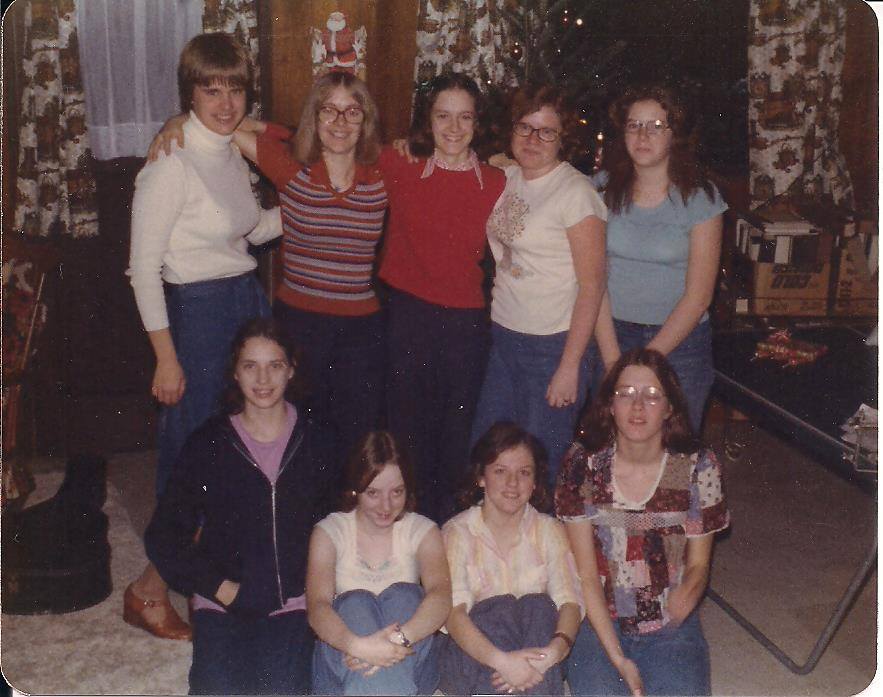
Slumber parties!

Slumber parties!

And way too many to write about all the memories attached to them. But I’ll list the titles here as my Seventh Grade soundtrack – the songs I loved as I transitioned to Junior High wearing the hated skirts and knee socks (no pants allowed, let alone jeans), cat eye glasses, freckles, not fitting in, horribly shy, blushing at everything, a story world more real than the real world, daydreaming on the school bus.

Indian Reservation (Raiders), Here Comes That Rainy Day Feeling (Fortunes), Ain’t No Sunshine (Bill Withers), Gypsies, Tramps, and Thieves (Sonny and Cher), One Tin Soldier (Coven), Sweet City Woman (Stampeders), Draggin’ the Line (Tommy James), Rainy Days and Mondays (Carpenters), The Drum (Bobby Sherman), Me and You and a Dog Named Boo (Lobo), Joy to the World (Three Dog Night)…

I need to stop. I’m starting to sing out loud. And now I’m warmed up to go do some writing.

How about you? What memories are attached to your seventh grade soundtrack?

Indie vs. Traditional Publishing, and Technology

I put a lot of thought into whether I wanted to be Indie published or traditionally published. Indie publishing gives you complete control, but traditional publishing adds a layer of respectability. Here’s how I made my decision, and the resulting issue I now have.

First, I received a letter from a well-known traditional publisher, wanting to publish a manuscript I’d submitted (for a story I have yet to publish). This publisher, while gushing in a very flattering way about my writing, wanted me to make changes. They wanted one character completely deleted from the story because ‘gay people don’t live in tiny towns’. (I know, I still laugh over that foolishness, too.) They also wanted me to remove all swear words from one character. I refused publication because I couldn’t do that to the characters.

Second, I spied on my friend, author Susan Schreyer. I saw how she had complete control over every aspect of her books through indie publishing. There are good and bad sides to that but it’s not the focus of this post. I liked the idea of control. I liked the idea of my characters allowed to be who they wanted to be.

Obviously I chose the indie route.

But here’s the aspect I didn’t consider – technology in this day and age.

To be successful as a published author you have to be ‘out there’. Platforms through blogs, Facebook, Twitter, your own website, etc. You have to be visible and accessible. That’s very difficult for me personally as I choose to live in that very little town with gay people because I like privacy. I try to balance my desire for privacy personally, with the need to be very public, professionally.

However, my real beef with the social media and technology aspect is the assumption by most that everyone has access. The assumption that every person out there can afford high-speed internet, smart phones, computers, iPads, and on and on.

How does that make one feel, who can’t afford those toys? And when did those toys become so immersed in our society that they are taken for granted and no longer ‘toys’ but ‘essentials’?

Yes, I am entertained by Facebook, although I dislike the amount of writing time it steals from me (I blame Facebook).

Social platforms would be required no matter which method of publishing chosen because traditional publishers don’t do the marketing like they used to for new authors. I’m not sure if the level of being ‘out there’ is the same. And we as a society would miss out on some amazing books, music, art, etc. if there was no indie route along the internet road.

But there are times when I wish I could shut the door.

And even more times when I wish people didn’t assume that everyone was on the same level of connectivity. I actually find that assumption to be, in a small way, prejudice. How difficult life must be now for those who cannot afford, or who don’t understand, all the toys.

And now I’m going to post this publicly, across all social platforms. What a conundrum.

When Characters Come to Life

I had a procedure done yesterday. I left the doctor’s office sore, a bit blue, and with bandages on my nose. From there I ran errands including a stop at a local butcher shop. There, a young man at the counter greeted me with ‘Cool! Did you get a tat?’

Immediately cheered up, I said no, that I’d had a biopsy. His response was ‘Dude! I’ll pray for you!’

When I got home and told my husband, his response was ‘Cell.’

My god. He’s right. Cell lives.

I can’t even say that I met this young man at the butcher’s before, and modeled the character based on him.

One of my characters, one that a lot of readers like, is living and breathing and working at a butcher shop. Pretty amazing.

Below is my favorite ‘Cell’ dialog. Florence is an elderly woman in the beginning stages of dementia. Rachel is her granddaughter, struggling with how to care for Florence. In this scene, Florence wandered away from home, which is a mountainous region of narrow winding roads and forest. Cody is the protagonist. This bit is from The Memory Keeper.

‘Cell leaned on the counter while Florence sat on it, swinging her slippered feet, drinking SoBe from the bottle and watching as Cell worked his faithful companion, the phone.

“But I don’t understand where the cord is, dear.”

“See, that’s the way cool thing,” Cell said, and jumped upright as he saw Rachel. “Hey! I was just calling you.”

“Granny, what are you doing?”

“She was hitchin’, dude,” Cell said.

“You promised you wouldn’t tell,” Florence said.

“Sorry, man. Forgot how much Rachel, like, scares me.” Cell moved back as Rachel reached the counter. “I just asked her if she needed a ride. Being neighborly, you know? I mean, she’s an old lady. Old ladies shouldn’t have to walk.”

“You were hitchhiking?” Rachel’s voice dropped, becoming quiet and almost calm.

“Well dear, technically, no. I wasn’t standing exposing an ankle or anything. I heard a car coming and I flagged it down. I was a tad scared to be honest. I don’t recall leaving the house. I’m afraid I wandered away in one of my less lucid moments. Did I frighten you badly?”

“Not at all,” Rachel said. “I’m used to having people I love just disappear.”

“Rachel,” Cody said, wanting to somehow thaw the ice in Rachel’s voice. But Rachel overrode her words, turning to Cell.

“And you didn’t think it was strange to find Granny in her nightgown? You didn’t consider taking her back home?”

“Is that what she’s wearing? I thought it was, like, some kind of old lady dress.” Cell pushed tendrils of black hair behind his heavily pierced ears.

“Oh my god!” Rachel pulled at her hair as if to keep her hands from reaching across the counter. “Where’s your brain?”

“Hey, chill! What’d you expect me to do? I mean, she’s an elder you know? You’re supposed to respect your elders!”’

And now I know what Cell’s next job is going to be. Though he’s vegetarian. This could be fun. He’ll lecture all the customers.