Sitting Around That Fire

Even though it’s mid June, the days are cold and wet. I built a small fire just to take the chill off, and thought about the sense of contentment that comes with sitting around a campfire and watching the flames. I’m sure you can remember something similar. The dark night, the cold air at your back, the heat on your face. The sparks hitting the tent roof…I wonder if we feel that because of an inherited memory of prehistory when fire meant safety, security, survival.

And not only that. While we enjoy quiet times sitting like that, listening to the flames eat firewood, most of the time we tell stories. It’s almost a cliché because it’s so common. Why? What is it about that atmosphere that makes us talk in low voices about childhood memories? Or huddle together glancing over shoulders while we listen to a scary tale? Maybe it’s the intimacy, the cloak of darkness.

We all become storytellers sitting near the fire. There’s some odd bond between flames and words. It’s almost spiritual.

Next Friday I am going to join a circle of women around a fire next to the river, for a ceremony of transitions for a few girls I care deeply about and have watched grow and become wonderful young women. I know we are going to tell stories about their childhood, about change, about life. And the fire will sanctify those stories like it has done for thousands of years.

I still want to know why though.

Passion or Knowledge?

There’s a wonderful quote over on the sidebar about writing what your passion is. I think every writer out there has heard the phrase, ‘write what you know’. How often are we told to write what our passion is? And are they the same? I wanted to write a western several years ago. The idea still sounds good and that western is still floating around inside. But when I tried to write the story, it kept dying. At the time I thought it was because I wasn’t writing what I knew. I’d never been on a wagon train. Research didn’t help.

The stories that work for me are set in the mountains. I figure that’s because it’s where I live and what I know. But it’s much more than that. I am drawn to mountains and whitewater and trees. Well, trees are really a passion. I live in the forest and yet plant more trees.

Earlier there was a discussion on voice and rhythm, and this kind of follows along the same line. Do I write stories set in the mountains because I know them, or because they are my passion, or because passion and knowledge are the same thing? I have no idea.

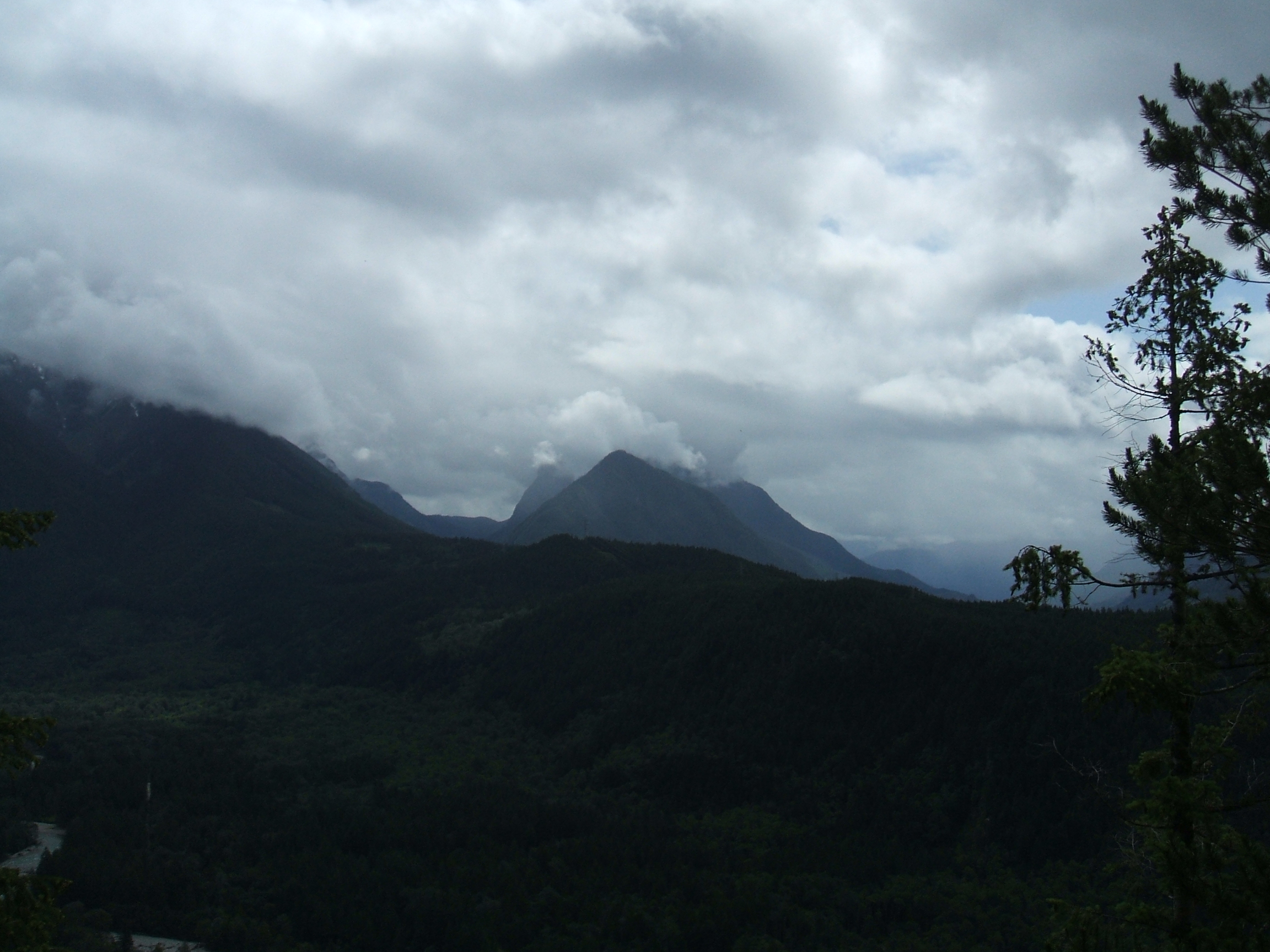
What I do know is that the mountains bring stories to me. They are mysterious, full of the unknown, of challenge, of scary things and uplifting things. When mountain tops are shrouded in sinking, rain-heavy clouds it’s easy to imagine Bigfoot up there. When you are alone in the woods and the light slants through the forest canopy just so, your heart soars. When you are alone in those same woods and something big and black moves through very close, grunting and foraging, your heart stops. The place is fertile ground for stories to sink roots and grow. When I have tried to write stories set elsewhere, they seem flat to me, missing that magic.

I’ve been to the high mesas and badlands of northeastern Montana, the rocky Oregon coast, northern Scotland, and Dublin, Ireland. All could be locations for stories some day, and I have drafts set in some of those places. But right now, what pulls words out of me is the temperate, lush rain forest of mountains. And the stories I write that are set there feel more alive, more compelling, to me.

Yes, the knowledge of place, characters, plot, etc. is important. But what is knowledge without heart? Like voice within rhythm, a story must have passion within knowledge. I know this must seem obvious to writers out there, but sometimes we need to restate the obvious in order to resurrect or honor that passion.


Occasional Story 2

When I first moved to the woods, I lived in a rustic cabin with no running water or electricity. It was summer and beautiful. I would eat breakfast on the old wood beams of a dilapidated deck, basking in sunshine, wind, scents of forest, sounds of the creek. I carried water from the creek, and learned about wildlife. One night I roamed with a flashlight trying to find the woman I’d heard screaming, only to learn later that cougars sound like women screaming…

And then winter came. I learned that it takes a huge amount of snow melting in a stock pan on the wood stove to make an inch of warm water. I learned that what looks like a huge amount of firewood when chopping it, shrinks to a tiny pile when stacked and needed. I learned a whitewater river can freeze if it gets cold enough. Those reading this that are locals will remember that winter of 1988 when the river froze. I quickly figured out that an outhouse in the summer, with the door open to mountain views, is much less romantic when the seat is covered with frost. The infamous words I said to my father still haunt me: “I’m not going to spend $200 on a heater that I’m only going to use a couple months a year!”

Remember leg warmers? An elderly woman made me a pair and she struggled with knitting so they reached from ankle to crotch. Picture that as you read on because this is what I wore, layered, to bed that first winter: heavy wool socks over two other pairs of socks, leg warmers, sweat pants, tee-shirt, flannel nightgown heavy sweater, robe, mittens, scarf, a cat under a big pile of blankets (living hot water bottle) and a dog on my feet, under her own blanket.

I woke up each morning with the blankets frozen to the walls and my breath turned into frost on the blankets. The cat’s water was frozen and the windows had a thick layer of ice on them, on the inside.

I bought a propane heater.

It worked really good, creating a glow that looked warm at the far end of my tiny trailer. It kept the cat’s water from freezing if I put the dish next to it. But it did nothing for the blankets frozen to the wall. I got used to that ripping sound when I got out of bed in the morning.

My parents retired and moved into the tiny cabin that I have been restoring recently, and have posted pictures of on this blog. My father, being a genius, built a water wheel out of pulleys and pipe caps and old single cell batteries, creating electricity. My brother, father, and I, put in 1500 feet of pipe down the ridge to get the flow of water needed to generate the electricity. We still used kerosene lanterns, but the electricity powered a refrigerator (in the summer I had used a small cooler powered by a car battery), and my father’s television. Reception was terrible, and he swore shows came in better when there was snow on the mountain.

And now, many years later, I have come full circle in a way, living there again with my husband and son. I know to stack lots of firewood. I know to have a supply of kerosene. I know to can and preserve and freeze to fill the shelves for winter. I know not to yell at cougars or to look for them with a flashlight alone in the dark. I know when the bears are in my compost. I know the haunting sounds of owls hunting at night, and the sight of stars not dimmed by city light pollution.

But sometimes I miss those days of self-reliance, of knowing how to live without. Well, I don’t miss the frozen blankets.

Here’s a link of last winter, on the road I live on. http://www.youtube.com/watch?v=kB9eN5SCoO0&feature=plcp I’m giving my son a lesson on driving in the snow, and the snow was actually deeper than it looks here. We were driving from our place into town in our big red diesel truck.