Being Anonymous

Why is the promise of anonymity so powerful?

From a writing standpoint I know all the reasons authors write under pseudonyms, not the least of which is the need for their families to not see what they are writing. But I’m wondering about this from a more generalized standpoint.

This past weekend my husband told me about a social media site called Whisper. People can post similar to Twitter or Facebook, but completely anonymous. I told him I found that rather creepy. He said some people need that in order to talk honestly about depression, identity, etc.

That makes me wonder about a society where we need a safety net of anonymous in order to be honest about who we are. In an ideal world that net would not be needed. But of course we are far from an ideal world.

With that said, I still find Whisper creepy. Maybe it’s the name. A whisper implies something secretive, sneaky, maybe even slightly cruel. After all, why whisper unless you don’t want someone else to hear? Remember those awful middle school and high school days when you’d be walking down the hall and see two kids whispering and giggling and know, just absolutely know, that it was about you? Remember that feeling in the pit of your stomach? That’s what the word ‘whisper’ implies to me.

Which brings me back to my initial question. Why is being anonymous so powerful? Why does it allow you to say or do things, or for that matter to post photos or behaviors, that you would not do if your name was attached? In a way it lowers inhibitions. So why are inhibitions lowered simply because your identity no longer exists?

I understand there are instances where personal safety could be seriously compromised if your name was visible, but I’m thinking here more about societal norms than politics, terrorism, racism, etc. Anonymous simply for the sense of power, not for safety or causes.

I don’t understand, and possibly because of that, I am going to strive to always sign my name, and if I’m doing something I don’t want my name attached to, then I better think twice about what I’m doing and why. Otherwise I may lose my identity by the simple act of not claiming my identity.

Old Books

Yesterday while weeding out books for the thrift store, I came across two old books.

The first was The Every Day Cook Book and Encyclopedia of Practical Recipes, written in 1892 by Miss E. Neil. It’s a quirky little book because the printer, Regan Printing House, in Chicago, put the cover on upside down. And inside the cover is a sticker for Wrigley’s Mineral Scouring Soap, sold by grocers everywhere at five cents a bar.

Why do I keep it? Some day when the mega-earthquake hits, I might need a recipe for cooking cow brains. Yes, there is one for that. Seriously though, Miss E. Neil fancied herself a scientist of ‘cookery’. I love the tone of her voice as she talks about the cooking water for potatoes being poisonous. She gives very thoughtful advice on how the mistress of the house should keep a passbook where she writes down her shopping list and the grocer writes in the prices so she can make sure the maid isn’t cheating her.

And then there’s this from her introduction where she is giving tips on maintaining the wood stove fire: ‘Food of every description is wholesome and digestible in proportion as it approaches nearer to the state of complete digestion, or, in other words, to that state termed chyme, whence the chile or milky juice that afterwards forms blood is absorbed, and conveyed to the heart. Now nothing is further from this state than raw meat and raw vegetables. Fire is therefore necessary to soften them, and thereby begin that elaboration which is consummated in the stomach.’

Think about all the women who used this cookbook, worrying about chyme.

The book is a snapshot through the window of time.

Miss E. Neil's tome.

Miss E. Neil’s tome.

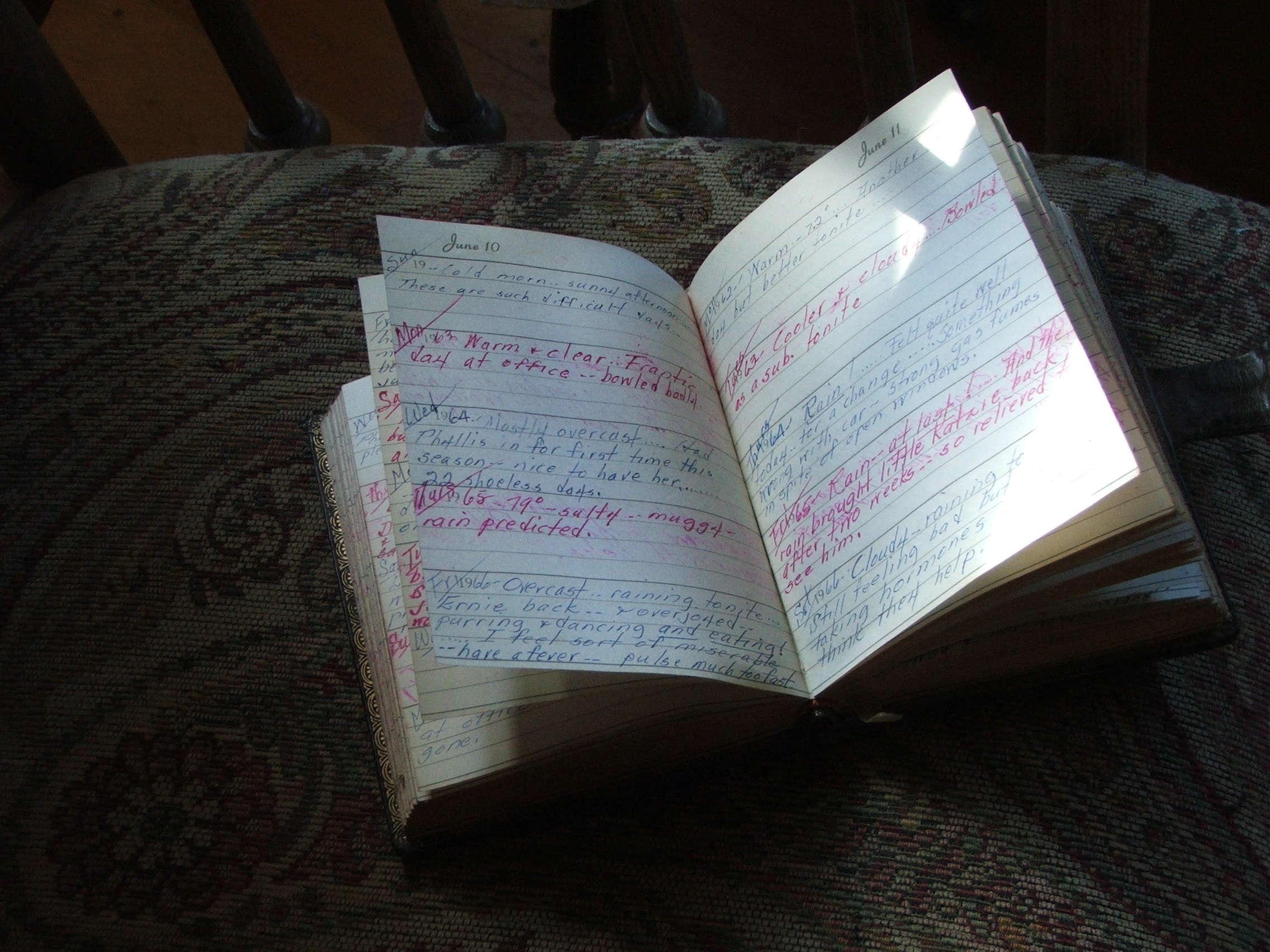
The second book is a diary of an old friend of my mother’s, Claire. I’ve posted before about her as she was a very unique woman who made a huge impression on me as a child. I planned to be just like her – a writer and hermit in the woods.

I admit to thinking diaries have to be these esoteric tomes where high lofty thoughts are left for those who follow. Probably why I struggle to write in one. But in reading Claire’s yesterday I realize that, like the cook book, diaries are also snapshots in time.

Claire's handwriting

Claire’s handwriting

Claire wrote about how many eggs she collected that day. What the weather was. What her weight was, her bowling score. How many days late or early her ‘shoes’ came. I used to wonder why she ordered so many shoes when I only saw her in men’s logging boots. I eventually realized ‘shoes’ were her euphemism for her monthly period.

She wrote about her daily thoughts, but in a five-year diary, which meant she had space for only a couple of sentences per day. Some days she simply said ‘A lonely day’.

And then I came across this, on Monday, September 9th, 1963. ‘Hot..89..Whew…all awash! Frank Nay died Saturday. Funeral Wed. 11th … a very sad thing…my arthritic bones all swollen & stiff.’

Why does that stand out to me with such gentle sorrow? I didn’t know until I read this that the day my father died was a Saturday of unseasonably hot weather. I think now of my mother sitting at the hospital with three children under age four, on a hot September day, waiting.

The details of daily life, jotted in a few sentences, can have such impact years down the road, beyond what the diary writer can probably ever imagine.

Honesty with Editing

Most writers know editing a story can be difficult. It isn’t simply a matter of having a great idea, writing it down, and making millions without doing any work.

In the past, the editing I’ve had to do has been a lot of work, but nothing like what I’m doing right now. I’ve been trying to figure out why this one is so hard and have decided it’s time for some honesty.

First off is the discouragement. The beta readers came back with very positive comments, and they loved the story. They had good, constructive criticisms. The editor, however, immediately caught all the things I’d subconsciously known were there, that I believe I’d been hoping would just slide by unnoticed.

Second is the fear. The characters are wanting to go into a darker place than I am comfortable writing about. But no matter how I try to twist the plot where I want it to go, their past keeps intruding. I believe I need to look at why I find this uncomfortable and why I don’t want to free the characters to face their true story.

All of this means I  feel at the moment that the whole story needs to be simply thrown away. I haven’t felt this low about writing since I was undergoing radiation and my screwed up brain chemistry told me I’d never write again.

However there is this. I am not so stupid that I don’t recognize this as a hole that can be edited out of. And I was smart enough to send off all my angst to the editor who keeps prodding me. And here below is part of her response.

Ghost Roads is a very good story. You need to make it a great story. You’ve got the characters, you’ve got the inciting incident, you’ve got the action moving from plot point to plot point, you’ve got it breathing life — now you have to add the passion. That comes from the characters having goals. And making sure they pursue those goals. That’s why I keep harping on the back story for Harlow, Leigh and Bonnie. Their collective past is influencing their present and driving the plot. I think if you look at each scene that way, you’ll find that you have not as much to do as you think — adding the undercurrent isn’t nearly as heavy a job as fixing a wandering plot.  In the piece between Bonnie and Harlow that you sent this past weekend, that’s what needs to be added to give it weight. And that piece is very important. It tells the reader the reason Harlow came home and why she isn’t packing up her backpack and dog and heading out when that’s what she’d really like to have happen. It shows us that she’s taking responsibility and facing down pain for the sake of someone else — and that struggle makes us want her to succeed. And, it’s not so much the words that grab the reader, but what the struggle of having that conversation tells the reader about the two women. Go for it.
Words of wisdom: sometimes this writing thing isn’t fun – – it’s hate-every-minute-of-it work.
Hugs. Pick up your sword and go back to the battle. You’ll win. I saw it in my crystal ball.”
Isn’t it amazing what a support system can do, especially when they are honest and won’t let you get away with taking the easy way out? I’m still feeling far from qualified to do Ghost Roads justice. But I just might be able to face the scene my editor references above. After that, well, we’ll see.